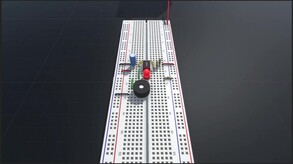
Powerful Realtime 3D Electronic Circuit Simulator
Modeled estimate, not a reported figure. How we estimate →
Discounts
Every price cut of more than 20% we have observed, in each market that quoted one, with this game's chart position on either side of it. These are episodes, not a model: a sale is one event, and one event cannot tell you what the next one will do.
Reviews, worldwide (the counter carries no country): 0.71/day in the week to Sep 11 → 4/day in the week after.
For scale, across Steam · Top Sellers · Brazil over the last 30 days: the 26 chart moves that followed a price cut of more than 20% went a median of 7 places towards #1, and the 2,400 moves with no price cut behind them went 2 away. One store, one chart, one country — it is the only place we have enough observations to say even that.
Prices outside the United States have been collected since 6 August 2026 and chart positions since 19 July 2026, so a cut older than that has no market to compare and a market that joined later has no history yet. Nothing here is converted between currencies.
About


Engagement
Reviews
Themes across 96 recent reviews and how positive each mention is. A keyword signal, not full sentiment analysis.
Reviews
К сожалению на данный момент в программе отсутствует даже базовый функционал симулятора. Контроль времени отсутствует, что не позволяет отлаживать схемы если они работают быстрее реального времени. Интерфейс сырой, осциллограф баганый, настройка развёртки так же отсуствует. Вообще в принципе настроек у осцилографа нет. Генератор и источник питания сложно настраивать, нет возможности ввода конкретных значений. Нет возможности отображения схемы, короче просто нет ничего :c Хотелось бы побольше базового функционала перед библиотекой компонентов. Зачем мне симуляция Arduino, когда я не могу отлаживать процессы происходящие в схеме на скорости МК? В общем грустно, разочаровывающе :c
This is not a game! This is 100% a simulator, it only gives you a bunch of components for you to build something out your own knowlodge. So please be aware the is not a story line, no tutorial, nothing that holds your hand and explain the single components in a productive manner. It is certanily well made and all but I suggest they should add a step by step guide for components to show their use, so that beginner can actually take this game and learn hardware from it. It will make it more accessable because as is, its only plain a sandbox.
Media

Related
Related
Price dynamics, follower growth, revenue and sales trajectories with interactive tooltips
This and every other Pro feature is free until October 20, 2026. A free account is all it takes.
Related
| Game | Estimated lifetime revenue | Reviews | Review score | Price |
|---|---|---|---|---|
| $248.5K | 598 | 88% | $9.99 | |
| $248.5K | 734 | 78% | $14.99 | |
| $248.5K | 698 | 73% | $9.99 | |
| $248.5K | 541 | 94% | $34.99 | |
| $248.5K | 371 | 82% | $12.59 | |
| $248.4K | 439 | 69% | $14.99 |
Related
| Game | Estimated lifetime revenue | Reviews | Review score | Price |
|---|---|---|---|---|
| $62 | 1 | 0% | $1.99 | |
| — | 0 | — | — | |
| $128.5K | 1.4K | 83% | $3.99 | |
| $9.6K | 39 | 77% | $8.30 | |
| $6.9K | 23 | 87% | $7.99 | |
| $140 | 1 | 0% | $4.99 |
Stats
All-time low is the lowest price we've recorded for this game since we started tracking it.
Languages: English
Hours played at review time, across 96 reviews with recorded playtime.
positive critical· bar length = how often the theme comes up
It seems like a pretty capable program, and from what I've been seeing of the progress being made, it'll be quite a powerful piece of software for anyone curious about hobby electronics, or for anyone who wants to try prototyping their design in a virtual space before attempting a physical build. I look forward to future updates!\
It really pisses me off not being able to stretch transistor pins to some other adjacent hole in the breadboard. Also if you have 2 breadboards stuck to each other you are not allowed to place a component so half of it is on one BB and the other half on the second BB. On a real board you can do it, so I'll just stick with the real prototyping. And this is just me spending half an hour on CRUMB. I feel sorry I spent the money on this app.
I don't know why people kept saying it's an awesome work (which it is) but the way the comments frame it appears to be a really exceptional product but I tell you the truth, though the concept is really good but it's a completely half baked product to be sold, it feels like the developer just push it through steam to compensate with the build as soon as possible. PLEASE wait till this is completed before buying. I requested for a refund.
This game looks amazing, and appears that it can be used for a lot. But I came into this not really knowing anything about it or how even to use a breadboard. And sadly there's no introduction except for controls. Maybe someday once I learn more I'll get it again.
The application as is still has some issues that won't get fixed as it is abandoned before really seeing any QoL or improvements in usability. The developer is focusing on version 2.0 and a switch in engines from Unity to Godot. While that feels hopeful I don't know what to expect from the developer, the "drop what you are doing for the new idea" method is a bit perturbing. I typically trust someone more when they finish something they start, more so when I have paid for their product. I cannot recommend purchase based on how little care to the original app is being given and how the developer seems to be interested in delaying a working version of 2.0 to work on modding support rather than a working beta version of the 2.0 product, even in a beta channel. I want to wire up a bread board. We can worry about scripting shaders and implementing the Godot editor redundantly later. What there is in the available version has working components and a fairly accurate simulation. But the Arduino support is fickle and the code editor doesn't quite save changes properly or compile well. (Pro tip: you have to set the voltage to just above 5V default for the Arduino or it flickers and acts wonky) Sometimes you will have a ghost component that won't delete unless you reload your workspace. There are no QoL or even basic design editing features that you'd usually find in a design app. I'm not sure if 2.0 will simply take this page over or not but I have to respectfully say this isn't really a good experience for me and look forward to seeing something that will meet my expectations. But I don't think I can change the review since it's for something that I see as a bad experience. That said it'll be a bit unfair to the new product and experience, however I'm not sure how else a developer switches to newer versions except that you simply release updates rather than calling it "2.0". I feel like the old version is an important reminder of what not to do... I mean if I ever can compare the two at some point. The way this is being handled doesn't really bother me like it would with an indie studio since it's a solo developer, but it does feel like there's a lot to be learned and addressed about the developer's process thus far. But keep it on your wishlist, perhaps.
CRUMB is a beautiful 3D sandbox from independent developer Mike Bushell. The project is visually appealing, but due to its closed architecture, it feels more like an interactive demo than a full-fledged simulator. Key limitations: Limited library contains a set of components that are difficult to even call basic. For example, Automatic night light with photorelay - impossible to assemble, because the catalog lacks a photoresistor and a light source. The same goes for DIY projects related to sound (maybe I'm wrong and just didn't find it. Please correct me) Lack of mods: Community access to modifications could significantly expand and improve this project. Limited physics: Modeling is too simplified. Creating such a 3D project on Unity alone is a difficult and respectable job. However, for practical learning or designing the tool, there is still a lack of flexibility in everything. I apologize if I offended anyone with my words, especially the author. It is important to be honest with people, especially creative and talented people, so an honest comment with an emphasis on problems is better than a positive lie. I apologize again and thank you for your work. CRUMB — це красива 3D-пісочниця від незалежного розробника Майка Башелла (Mike Bushell). Проєкт візуально привабливий, але через закриту архітектуру сприймається скоріше як інтерактивне демо, ніж повноцінний симулятор. Ключові обмеження: Обмежена бібліотека містить набір компонентів котрий навіть базовим назвати складно. Для прикладу Автоматичний нічник з фотореле — неможливо зібрати, бо в каталозі відсутній фоторезистор і джерело світла. Те саме і з DIY проєктами повязаними зі звуком(можливо я не правий і просто не знайшов. поправте) Відсутність модів: доступ спільноти до модифікацій могла би значно розшири і покращити цей проєкт. Обмежена фізика: Моделювання надто спрощене. Створення такого 3D-проєкту на Unity наодинці — це складна та варта поваги робота. Проте для практичного навчання чи проектування інструменту поки бракує гнучкості в усьому. Вибачаюсь якщо я когось ображу своїми словами особливо це стосується автора. Важливо бути чесними з людьми особливо з креативними і талановитими, тому чесний коментар із акцентом на проблеми це краще, ніж позитивна брехня. Ще раз вибачаюсь і дякую за вашу роботу.
on the surface it looks cool until you realize its not a game and just a bare bones simulator. most games have a crawl walk run start for beginner players that teaches them from the bare bones of gameplay to gradually learning more. In this there are no step by step tutorials, levels with increasing difficulty of tasks, guides, or walkthroughs. just examples. its made like a game to be appreciated by people who already know what theyre doing and want to experiment without already having the tools, not by people with the intent to learn about it, and before you say do research, most people are going to pick this game up thinking thats exactly what it is and something was going to be explained then are just thrown into the fire with no help at all. would not reccomend in its current state, but it does have potential. genuinely hope the dev sees this so he can turn it into the game it deserves to be
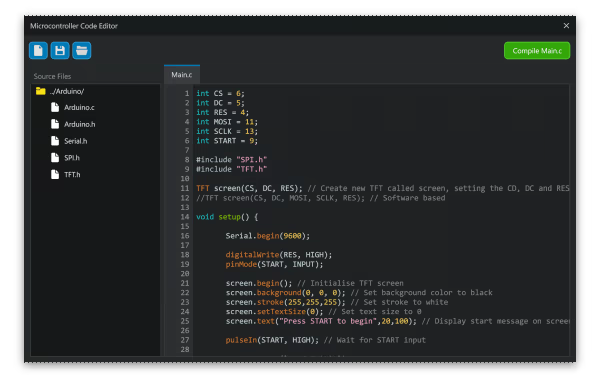
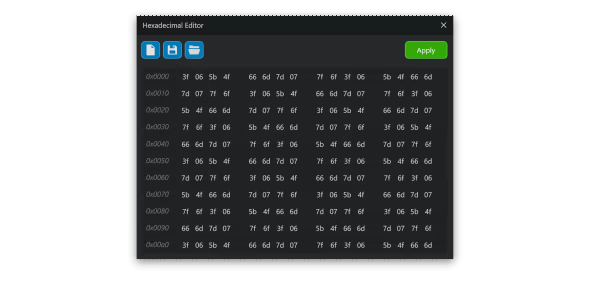
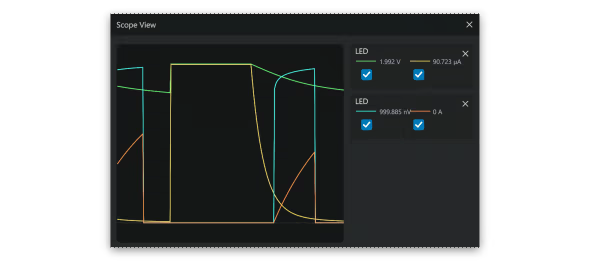
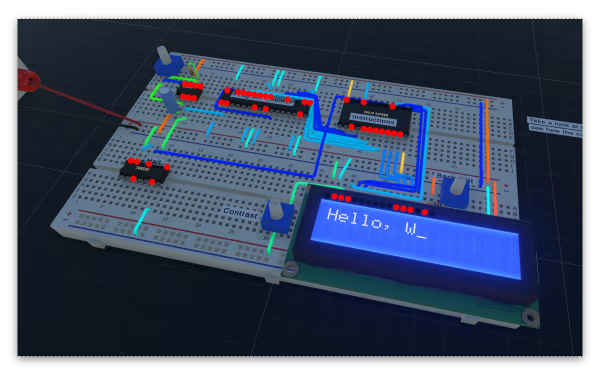
CRUMB Circuit Simulator offers a distinctive experience for anyone interested in electronics, circuit design, or simply discovering how electrical components interact. Rather than functioning like a conventional game with missions and progression systems, it provides a virtual electronics workbench where experimentation becomes the main attraction. Developed and published by Mike Bushell, the simulator presents components as recognizable 3D objects, allowing users to construct circuits in a way that resembles working with actual hardware. One of its greatest strengths is the freedom to experiment without worrying about damaging expensive components. Users can connect parts, rearrange their layouts, change values, and test different configurations while immediately seeing how the circuit responds. The three-dimensional workspace makes the process more tangible than traditional schematic-only software. Resistors, capacitors, switches, LEDs, transistors, integrated circuits, displays, and other components appear as physical objects, helping beginners understand the relationship between a circuit diagram and the equipment they might eventually encounter on a real workbench. The selection of components gives the simulator considerable versatility. Simple projects can be constructed using passive components, switches, diodes, and LEDs, while more ambitious designs can incorporate transistors, MOSFETs, logic devices, counters, timers, operational amplifiers, memory components, displays, and other integrated circuits. Power supplies and signal-generation tools further expand the possibilities. This progression from elementary components toward more sophisticated electronics makes the software useful for both casual experimentation and more serious learning. Programming adds another layer of depth. The inclusion of a programmable microcontroller allows users to explore the relationship between software and electronics instead of being restricted to purely analog or fixed digital circuitry. A built-in code editor provides a convenient environment for working with source files, while EEPROM functionality and hex editing offer additional opportunities for experimentation. These features make the simulator especially appealing to people interested in embedded systems, microcontrollers, and the fundamentals of hardware programming. Troubleshooting circuits is supported by useful visualization and diagnostic tools. Users can inspect voltage, current, logic states, component pins, and other important information that would normally require measuring equipment or careful physical testing. The built-in scope can monitor multiple components, making it easier to understand changing signals and identify problems. These visual aids are valuable for newcomers because electricity itself is invisible, and seeing circuit behavior represented directly on screen can make difficult concepts considerably easier to understand. The simulator does have a noticeable learning curve. It provides the tools needed to experiment, but it does not transform electronics into a heavily guided puzzle game. Someone with no previous understanding of voltage, resistance, polarity, logic, or component behavior may initially feel overwhelmed. Example circuits help demonstrate what the software can accomplish, but players who want structured lessons may need additional educational material. In this sense, CRUMB works best as a practical learning environment rather than a complete electronics course. There is also an unusual satisfaction to building something that functions correctly. Connecting a collection of components and eventually seeing an LED illuminate, a display operate, a logic circuit behave properly, or a programmed device respond as intended can be surprisingly rewarding. When something fails, diagnosing the mistake becomes part of the experience. This trial-and-error process encourages genuine understanding rather than simply rewarding players for following predetermined instructions. Those who enjoy engineering, programming, automation, or technical sandbox games are likely to appreciate this open-ended structure. Visually, the presentation favors clarity and functionality over elaborate graphical spectacle, which suits the subject perfectly. The physical representation of components makes complicated projects easier to interpret, while the relatively modest hardware demands help keep the software accessible. The interface inevitably becomes busier as circuits grow more complex, but careful organization can make larger projects manageable. Steam Deck compatibility is officially categorized as Playable rather than fully Verified. Performance with the default graphics configuration is considered suitable, and the game can run successfully on SteamOS. However, handheld players should expect compromises. Some functionality is not fully accessible through the default controller configuration, touchscreen interaction or a community controller layout may occasionally be useful, and text entry can require manually opening the virtual keyboard. Some interface text may also appear small, while certain prompts can display keyboard, mouse, or non-Steam Deck controller icons. It is therefore functional on the Deck, but the experience is less seamless than a fully optimized handheld release. CRUMB Circuit Simulator succeeds most strongly as a specialized sandbox rather than as a traditional game. Its combination of realistic 3D components, circuit simulation, programmable hardware, diagnostic instruments, and visual feedback creates an engaging environment for learning and experimentation. It will naturally appeal to a narrower audience than a conventional puzzle or construction game, but for electronics enthusiasts, students, makers, programmers, and curious beginners, it provides a practical way to explore circuit design without purchasing a workbench full of hardware. Its greatest accomplishment is making electronics experimentation approachable while retaining enough technical depth to remain genuinely useful. Rating: 8/10
Selling now
See how fast this game is selling right now — estimated copies and revenue per day from recent review growth.
Active players
Estimated daily and monthly active players (DAU/MAU) modeled from peak concurrency.
Players by region
Where this game's players are, estimated from review languages.
Players also reviewed
The games this title's players most often review too — audience affinity.