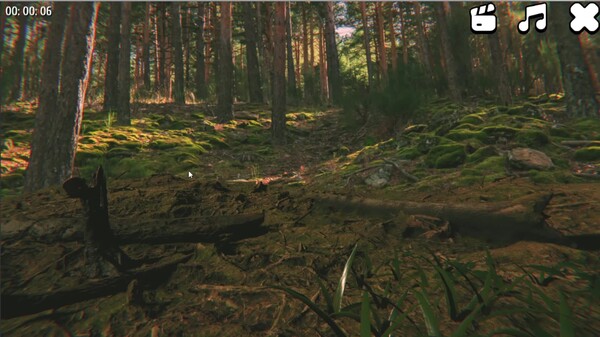
Catch the Chiken, developed and published by Hede, is a minimalist clicker-style experience that builds its entire identity around a single, almost absurdly simple premise: wait for a chicken to appear on the screen and click it before it disappears. There are no sprawling levels, no character progression systems, and no layered mechanics hidden beneath the surface. Instead, the game strips interactivity down to anticipation and reaction, presenting players with a deliberately sparse design that feels closer to a digital experiment than a traditional game.
The core loop revolves around patience. A chicken will occasionally run across the screen at unpredictable intervals, sometimes appearing quickly, other times taking a significant amount of time before showing up again. When it does, players must react fast enough to click on it and “catch” it. That is the fundamental interaction. There is no movement system to master, no strategic positioning, and no narrative context explaining why the chicken is running. The simplicity is both its defining trait and its most divisive feature. Success depends entirely on attentiveness and timing rather than skill progression or tactical planning.
Because the game does not bombard players with constant activity, much of the experience is spent waiting. This design choice creates an unusual rhythm. Instead of continuous stimulation, Catch the Chiken operates on anticipation. The quiet intervals between appearances become part of the gameplay itself. Players might find themselves leaving the game open in the background, glancing back periodically in hopes of spotting the next fleeting opportunity. In this way, it resembles idle or passive games, yet it requires active presence at unpredictable moments.
Presentation is extremely straightforward. The visual layout is simple and uncluttered, ensuring that when the chicken does appear, it is clearly visible and clickable. There are no elaborate animations or cinematic elements; the focus remains squarely on the single moving target. Sound design, if present, plays a secondary role to visual awareness. The game does not aim to immerse players in a richly detailed world. Instead, it offers a clean canvas where the central action—spotting and clicking the chicken—remains the sole point of engagement.
To provide at least some structure, the game includes achievements and leaderboard features. These systems add a layer of measurable progress, encouraging players to track how many chickens they have caught or how efficiently they respond. For some, the competitive aspect of leaderboards may introduce an incentive to remain attentive for longer sessions. However, beyond this meta-layer, the underlying mechanic does not evolve. There are no new abilities unlocked, no environmental changes, and no escalation of complexity.
What makes Catch the Chiken interesting is not its mechanical depth but its conceptual boldness. By reducing gameplay to a single repetitive interaction, it challenges conventional expectations of what constitutes entertainment in a game format. Some players may interpret it as a humorous novelty, appreciating its tongue-in-cheek minimalism. Others may see it as overly simplistic or lacking in substance. The experience is highly dependent on mindset: approached as a brief curiosity or background distraction, it can feel light and oddly relaxing; approached as a full-featured title, it may feel underdeveloped.
Ultimately, Catch the Chiken is a niche, experimental-style clicker that commits fully to its stripped-down concept. It offers no narrative, no evolving mechanics, and no traditional progression arc. Instead, it invites players to engage in a cycle of waiting and reacting, built entirely around one fleeting moment of action. Whether that minimalism feels charming or shallow depends entirely on player expectations. For those intrigued by unconventional design or seeking a simple background distraction, it provides a singular and focused interaction. For those expecting layered gameplay systems or sustained engagement, its simplicity may quickly exhaust its novelty.
Rating: 6/10