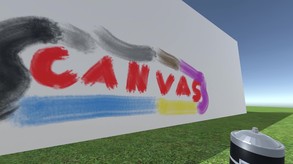
Canvas The Gallery, developed and published by CoughE, is a small experimental sandbox project released on Steam that functions more as a digital creative space than a traditional video game. Instead of presenting a structured campaign, challenges, or objectives, the experience places players inside a quiet virtual art gallery and gives them the freedom to decorate and transform that space through simple painting tools. The concept is intentionally minimalistic, focusing on creativity and exploration rather than competition or progression. In many ways, the project feels like an interactive art toy designed to let players experiment with digital expression inside a three-dimensional environment.
Upon entering the gallery, players find themselves in a calm and largely empty exhibition hall. The environment contains walls, canvases, and open spaces that serve as blank surfaces waiting to be filled with color and design. The main tool available to the player is a virtual spray paint can, which can be used to apply colors and shapes directly onto the surfaces around the gallery. Movement follows standard first-person controls, allowing players to walk around the room while freely painting wherever they choose. Because there are no restrictions on where paint can be applied, the entire environment effectively becomes a canvas for experimentation.
The painting mechanics themselves are intentionally straightforward. Players can change colors, adjust the size of the spray pattern, and make use of stencil shapes to create different visual effects. These tools are easy to learn and allow even inexperienced players to begin creating images within minutes. While the system lacks the complexity of professional digital art software, its simplicity makes the process approachable and encourages spontaneous creativity. Rather than focusing on precision and detailed illustration, the experience feels closer to a form of digital graffiti or freeform painting.
One of the more interesting aspects of Canvas The Gallery is the way it handles sharing and collaboration. When a player finishes decorating their gallery, the artwork is stored in a simple folder structure containing image files. These files can be shared with others, allowing friends to load the same gallery layout and explore the paintings within their own version of the game. This feature introduces a subtle social component, as players can exchange their galleries and view each other’s creations in a fully explorable 3D environment. The system also allows players to modify shared galleries and pass them along again, turning the project into a collaborative artistic experiment.
The game also offers a surprising degree of flexibility when it comes to importing external images. Because the paintings are stored as standard image files, players can replace them with any pictures they choose. This means the gallery can be used to display photographs, digital artwork, or any other image a player wishes to showcase. In effect, the gallery becomes a customizable exhibition space where players can curate collections of artwork or visual material from outside the game. This feature gives the experience a unique identity somewhere between a sandbox art tool and a personal digital museum.
Atmosphere plays an important role in shaping the overall tone of the experience. The gallery itself is deliberately minimalist, with simple architecture and uncluttered spaces that allow the player’s artwork to become the visual centerpiece. Instead of dramatic lighting or complex environmental design, the space remains calm and neutral, emphasizing the feeling of a quiet exhibition hall. Background music composed of classical piano pieces adds to the relaxed mood, encouraging players to slow down and focus on creativity rather than action. The soundtrack complements the meditative pace of painting and wandering through the gallery.
Visually, the game reflects its origins as a small independent project. The environments are simple, textures are basic, and there is little in the way of advanced graphical effects. However, this simplicity works in favor of the concept. Because the gallery space is intentionally understated, it never distracts from the artwork created by the player. The clean environment allows paintings to stand out clearly against the walls and surfaces, reinforcing the idea that the player’s creations are the true focus of the experience.
Despite its creative charm, the game’s minimal structure can also be its greatest limitation. Players looking for a traditional gameplay loop with objectives, progression systems, or challenges may find very little to hold their attention. Once the novelty of painting within the gallery fades, the experience can feel somewhat empty unless the player is genuinely interested in experimenting with digital art. Additionally, the painting tools themselves are fairly basic, which may leave experienced artists wishing for more advanced options or greater control.
Nevertheless, Canvas The Gallery succeeds as an unusual and thoughtful creative sandbox. It demonstrates how interactive spaces can function as tools for artistic expression rather than purely competitive entertainment. By stripping away traditional game mechanics and focusing entirely on creativity, the project offers a relaxing environment where players can experiment with visual ideas, share their work with others, and transform a simple digital gallery into a personalized art space.
While it may not offer the depth or replay value of larger sandbox titles, the experience remains a charming example of experimental game design. For players who enjoy creative tools, digital art experimentation, or calm exploratory environments, Canvas The Gallery provides a peaceful space where imagination takes center stage.
Rating: 7/10