Blackout
Also onSteam
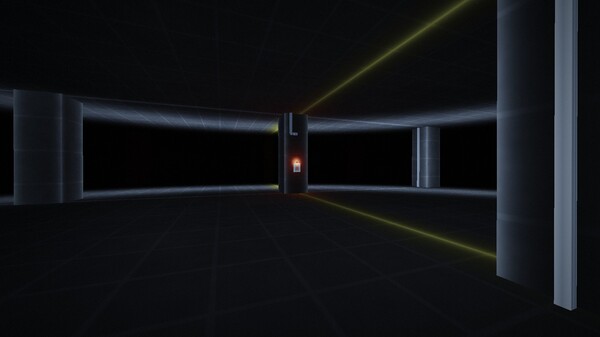
A first-person game about being unable to see. One warehouse, one hundred thousand kilometers on a side, with a single live switch somewhere in it. Clap to light the room for a few seconds; find the switch by ear, following a hum and a ticking relay. Nothing is in here with you.
Estimated lifetime revenue
Free-to-play
Revenue comes from in-game items and microtransactions, which our price-based model doesn't estimate. The player count below is how many people own it, not what they spent.
Est. players
0
people who own it
Reviews
0
Review score · Steam
51%
86 reviews · Steam version
Concurrent players
—
not read yet
About
About the game
BLACKOUT requires hearing. Not rewards it, requires it. The switch is found by ear and there is no second route to it. The audio is binaural throughout; there is no mono option and no speaker mode, and a player with hearing in one ear gets no accommodation here.
It requires headphones. Over speakers the bearing smears, and the bearing is the whole instrument.
It requires a dark room. Almost everything this game ever puts on screen sits a few values above black; an unlit frame peaks at 4 out of 255. In daylight, with a window behind you, you are looking at a black rectangle. There is a calibration swatch second from the top of the Options list: raise the brightness until the bar is only just visible. Set it before you start, not at kilometer nine.
And it requires time. One run is fifty to sixty kilometers of walking: about four hours if you read the space well, closer to five and a half if you fight it. There is one length. There is no shorter version of this. That is past the two-hour refund window, which is why it is at the top of this page rather than the bottom.
It saves as you go. The run is written every ten seconds, and again when you pause or quit, and the menu offers it straight back when you return, with the fragments you have already had remembered so the opening is not repeated at you. You do not have to walk it in one sitting. You do have to walk it.
If that reads as a warning, it is the right warning and you should believe it. If it reads as an invitation, the rest of this is for you.
THE BUILDING
You are a warehouse worker, eleven years on the same floor. You were issued a torch in your first week. It was not replaced.
The power is out. Procedure on loss of power is to proceed to the nearest live plate. Procedure does not say how far the nearest one is.
The floor is a hundred thousand kilometers on a side, ten to the sixteenth square meters of concrete, generated from a seed as you walk rather than built in advance. The same seed gives the same building, and you can type one in. Somewhere out there, on a random bearing, fifty to sixty kilometers away, one circuit is still live.
Pillars on a ten-meter lattice, in districts about six hundred meters across that are genuinely different from one another: open lanes you can run, yards packed with crates that stop you dead, canyons of steel racking, and collapsed stretches where roughly one column in six is lying across your line. Each has its own room sound, so you hear the boundary before you reach it: racking answers a footstep in nine milliseconds, an open lane in forty-two.
A building has one to four decks, with stairs between them and ramps of rubble where a deck has come down, and the switch can be on any of them. You cannot fall. Every opening is edged, deliberately. In a game with no light, losing four hours to a hole you had no way of seeing is not tension.
HOW YOU SEE
Mostly you do not. Walking puts nothing on the screen at all.
A clap sends a wavefront out of you in every direction at about twenty-six meters a second. It lights each surface as it sweeps past and leaves an outline behind it, edges and silhouettes and the shape of the lane, which fades over five and a half seconds. Useful detail comes back from something under fifty meters. You hold three claps and get one back every ten seconds, so even clapping the moment you are able, a little under half the walk is spent with nothing on screen at all.
Walking into something also lights it, out to eighteen meters, and makes a noise you will feel in your teeth. It is deliberately the worse instrument, because blundering into the building should never be a better way of seeing it than looking. Scraping along a wall gives you sound and no light whatsoever.
Measured against the real collision grid, a player who steers around what they meet covers ground about forty per cent faster than one who holds forward and bounces off everything. That is where four hours comes from instead of five and a half. Routing is the game.
HOW YOU FIND IT
By ear. The live circuit hums, and a faulty relay beside it ticks.
The hum carries a true bearing at any range, so direction is readable from fifty kilometers out; what it does not give you is distance, which is what the relay is for. Three things sharpen as you close. The tone comes up out of the mud. The muffling lifts. And the tick speeds up, from one every four seconds at the far end to better than one a second when you are standing on the plate. Inside about twenty-six meters a red pilot lamp finds you before you find it, and you can switch that off for a harder arrival.
You do not need perfect ears. Walked in simulation against the real building, misreading the bearing by forty-five degrees on every single reading costs about thirteen per cent of the time, because you resample constantly and the errors average out. Hearing well does not buy you the route. It buys you not being lost between ticks.
If you do get turned around, there is a concentrate key: six seconds of an arrow on the true bearing, then twenty-five seconds before you can use it again. You may lean on it as often as you like, and using it once stamps the run ASSISTED and takes it out of the running for your best time. It exists so that nobody loses four hours to being lost. It is not a way to play this without hearing it, and it is not offered as one.
NOTHING IS IN HERE WITH YOU
This is not horror, and the build enforces that rather than promising it. There is no entity. Nothing has a position that persists between events, nothing pursues you, nothing has state, and nothing can hurt you, cost you a charge, end a run or touch your save.
What there is instead is a building doing what a building that size does when the power fails. Thirty-two kinds of event: nothing at all for the first fifty to ninety seconds, then one every forty-five to a hundred and twenty seconds, every gap drawn fresh so the rhythm never becomes learnable. Something falls a long way off. A rack takes weight it was not taking a moment ago. Your own clap comes back late, from further away than the room allows. The reverb shuts down to almost nothing for a few seconds and then opens again. A red glow with no fitting behind it. Some of them sound like company. None of them is company.
The hum is never taken away. It can waver, detune and duck, but it is never silenced, because it is the only route out. And nothing fires at all inside the last hundred and thirty meters. That stretch belongs to you.
THE STORY, WHICH YOU CAN IGNORE
Twenty-four fragments arrive across the walk, paced against how much of it is left, and one more once the lights are on. They are not collectibles and not a mechanic; they gate nothing and change no number, and if you skip every one the game is identical. There were others on this shift. They will be walking too, in other directions. You will not meet them.
BEFORE YOU BUY
Windows only, 64-bit.
Keyboard and mouse or any standard gamepad, either one at any moment, menus and options included. Controls cannot be rebound. Button glyphs are chosen in Options rather than detected, so set them to match your pad.
Nothing is spoken anywhere in this game, so there is nothing to subtitle. The story is already text on the screen.
No achievements, no cloud saves, no leaderboards, no multiplayer, nothing to buy afterwards, and nothing that talks to the internet. Your best time lives on your own machine.
Ten interface languages. English is the original; the other nine are machine translations that nobody who speaks the language has read. Worth knowing before you pick one.