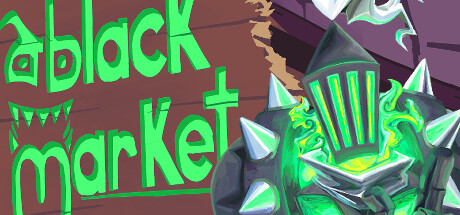
Black Market is an item shop simulator where you are a shopkeeper that pawns items and strikes deals with your villainous customers in order to make rent. It’s a cutthroat world out there.
Revenue comes from in-game items and microtransactions, which our price-based model doesn't estimate. Copies below reflect the player base, not paid sales.
Media

About
Black Market is an item shop simulator where you are a shopkeeper that pawns items and strikes deals with your villainous customers in order to make rent. It’s a cutthroat world out there.
Controls:
- WASD or Arrow Keys to Navigate
- Hit E key or Enter to Submit or Progress Dialogue
- Escape Key will bring up an options menu
- Alt + Enter to toggle fullscreen
Commands:
[Talk] - You talk. Do it sometimes!
[Inventory] - Opens your inventory, including money and guards
[Deal] - Automatically trade with a villain, only works if you have exactly what they want
[Hire] - You pay money so the villain protects your shop for one night. Hiring two characters for one night is a waste of a money!
[Barter] - Choose any number of items to trade with a villain. Careful, if you offer them something they don't like, they will be take their business elsewhere.
[Reject] - Refuse a villain's business
Genres
Stats
Languages: English
Reviews
Black Market by Wani Games LLC is a lean, text-driven shopkeeping simulator that builds its appeal around negotiation, scarcity, and the uneasy feeling of operating in a morally gray economy. Rather than dressing itself up with complex systems or expansive world-building, it keeps its focus narrow: you run a questionable storefront, interact with equally questionable customers, and try to stay solvent long enough to survive another day. The premise is simple, but it creates a steady tension that carries the experience, especially in its early stages. The core loop revolves around evaluating incoming customers and deciding how to handle their requests. Each visitor arrives with their own needs, offers, or demands, and the player must respond using whatever items are currently available. Transactions are not rigid; instead, the game encourages negotiation and experimentation, allowing players to combine items or adjust their approach in hopes of securing a better outcome. This flexibility gives each interaction a small layer of strategy, as success depends on reading the situation and making calculated decisions rather than following a fixed formula. What gives the system its edge is the constant pressure of limited resources. Inventory space is tight, money is never abundant, and every deal has consequences that extend beyond the immediate moment. Accepting a poor trade might solve a short-term problem but create a larger one later, while holding out for a better offer risks losing a customer entirely. This push-and-pull dynamic creates a steady sense of tension, turning even routine transactions into meaningful choices. The addition of minor systems—such as hiring protection or managing risks tied to certain customers—adds just enough variation to keep the loop engaging without overcomplicating it. Despite these strengths, the game’s mechanics remain relatively shallow over time. Once players understand how negotiation works and begin to recognize patterns in customer behavior, much of the challenge shifts from discovery to optimization. There are few new systems introduced as the game progresses, and the core loop does not evolve significantly. This makes the experience feel tight and focused, but also somewhat limited, as it lacks the kind of expansion or escalation that would sustain long-term engagement. The presentation reflects this minimalism. Visually, the game uses a simple, hand-drawn style that prioritizes clarity over detail. Characters and environments are conveyed through basic illustrations and text, leaving much of the world to the player’s imagination. This works well for the format, allowing the writing and interactions to take center stage, but it also means that the atmosphere relies heavily on suggestion rather than immersion. The setting feels more implied than fully realized, which may be effective for some players but underwhelming for others. Writing plays a significant role in shaping the experience. The tone leans into dark humor and casual cynicism, presenting a world where questionable behavior is normalized and survival often requires compromise. Dialogue is concise but carries enough personality to give each interaction a distinct flavor. However, because the system cycles through similar types of encounters, repetition becomes noticeable over time. Characters rarely develop beyond their initial roles, and the lack of deeper narrative threads limits the emotional impact. Replay value is modest, driven primarily by the variability of customer interactions and the desire to refine strategies. Each session can unfold slightly differently depending on available items and decisions made, but the overall structure remains consistent. Without additional modes, progression systems, or significant variations, the incentive to return diminishes once the core mechanics have been fully explored. Ultimately, Black Market succeeds in delivering a focused and coherent experience built around negotiation and resource management. It captures the tension of operating under constant pressure, where every decision carries weight and uncertainty is part of the process. At the same time, its limited scope and lack of mechanical growth prevent it from evolving into something more substantial. It works best as a short, experimental title—one that offers a clear idea executed with consistency, even if it does not extend far beyond that foundation. Rating: 6/10
Related
Related
Trends
Concurrent players on Steam, sampled daily since tracking started.
Black Market, kirayı kazanmak için eşyaları rehin tutan ve kötü müşterilerinizle anlaşmalar yapan bir dükkan sahibi olduğunuz bir eşya dükkanı simülatörüdür. Dışarıda acımasız bir dünya var.
"Black Market" is a weird browser-like game, just text and menus with a few badly done background images. The game itself is just a basic shop keeper/trading game run through static menus. It was, for pretty obvious reasons, a complete and utter failure. So, it's hard to describe this as a game, the focus of the product is more like that of an e-book/visual novel, there's only minor, shallow and uninteresting gameplay elements. The crux of this is to push some very low quality, badly done fan-fiction tier writing, where we see once more a developer fail to understand the importance of "Show, don't tell", and for whatever reason, weren't able to convey their narrative through gameplay, giving us endless lines of badly written e-book text instead. My gaming rig is not a kindle. The graphics aren't great, just text and menus with a few badly drawn, mostly static/barely animated backdrops. That's understandably a turn off for a lot of gamers, and it's a big contributor to the failure of the game to attract gamers despite having no up-front cost. Gaming is a primarily visual medium, and if developers want to succeed, they must understand that it's not an area for compromise. You deserve better than compromises. Now on to pricing and value for gamers. This is "free" enough (not every "free" game in the "free" section is truly free, there's usually some hidden price tag), at least you won't be expected to spend any more money after you download this, but just because something is free doesn't mean it's good, and the cost of a game is more than just financial, your time is valuable too. In terms of public reception, this failed. There's over 130 million unique gamers visiting Steam every month. SteamDB showed the game peaked at [b]only 2 concurrent players[/b]... this is a dismal public reception. This was so bad they couldn't even give it away. Since free games don't contribute to your game collector badge and other profile stuff, is this a worthwhile addition to your Steam library? This is a hard pass. There's no immediate financial commitment, but there are thousands of more compelling games on the platform that will give you a lot more enjoyment for your time.
I played through Black Market for a good bit of time over the course of one day, and I intend to go back to it at least one or two more times. I overall recommend it; I found that it had some good entertainment to accompany it. I'm going to start with a couple things I wish I had had during my gameplay experience: -Save feature: Having to play the entire game in one sitting isn't difficult per se, but it would be nice to pick up where I left off if I have something come up while playing. -Clear indicators of an ending: The game does have multiple endings, but it's not immediately clear how to attain them. You'll be able to intuit this as you get deeper into the game and start noticing certain things being tracked across multiple interactions with certain customers. Keep in mind, this isn't intended to be a AAA title. It's an indie title developed by a small team. When I encounter indie titles, I think it's more important to emphasize what is done well instead of what could be done better. Here's what I enjoyed about the game: Characters and Art: You're going to find a lot of different customers as you progress through the game. Each one has a unique appearance and style to them that makes it easy to remember who they are and what they like. They also have unique speech patterns and personality. In fact, if you have multiple customers and switch between them before making some kind of deal with them, they will oftentimes interact briefly with each other with specific dialogue tailored to that interaction. I thought this was a really nice touch. Barter System: One mistake I made early on was thinking that if I didn't have specifically what a customer wanted (Using the "Deal" option to fulfill this if possible), that I was SOL and had to tell them to leave ("Reject"). It turns out the "Barter" option is a vital component of survival in this game. Essentially, there is some kind of hidden intrinsic value behind every item you can find and trade in the game. I'm not sure if it slants up/down based on the character or not. If you offer enough value in the barter (Which can be a combination of any goods/coins you have available), they will be happy with the deal and typically give you something ranging from decent to quite good in exchange. Some items seem to only be attainable by bartering, and often they carry high intrinsic value for future barters or for fulfilling difficult customer orders. Bartering can also make it much easier to survive the only "hazard" feature in the game explained below. The Bandit: You know, at first I hated this thing. Each night, there's a random chance you'll get ransacked by a bandit that takes half of your inventory (Maybe coins too, I didn't specifically look at that). There's two ways I've found you can avoid a bandit attack for one night: Bodyguards and turrets. Bodyguards are typically customers you have bartered with who really like the deal you make with them, and defense turrets are an item you can occasionally obtain by making deals with a specific customer. After a bodyguard or turret defends from a bandit attack once, it's gone, but you have a chance of getting more. You can even "stack" multiple bodyguards, which comes in useful when a bandit's RNG is particularly aggressive towards you. Once I realized there was a way of stocking resources like these to prevent the bandit, I found it an enjoyable balance in the gameplay. Plus I always got a little bit of glee when I saw the bandit get chased off by a two-headed dragon lady or samurai fox woman. Yes, it's text only, but you can't help but imagine what that must look like. This review is getting long, but on the whole I enjoyed Black Market quite a bit. I'm eager to see what projects this team comes out with in the future. I understand they're very active on itch.io, so consider looking them up to see what's coming down the pipe in the future.
Chill game to pass some time on. The art style is really unique and the gameplay loop seems confusing at first but actually becomes quite interesting as you develop strategy to acquire more items or coin.
Hard to bash a free game with no microtransactions, it was a neat play but definitely felt rough. Cant change the resolution so it only took up about a 10th of the screen, and the menus felt clunky when interacting with characters.
No saving, but this game's pretty new, so. Plus big titty snake(?) woman/witch
♥♥♥♥♥ не понял.
разок сесть поиграть можно интересные персонажи вы держите лавку, ночью возможно соберете мусор или вас ограбят, днем продаете обмениваете зарабатываете и можно нанять охранника на ночь.
Игра 'Black Market' предлагает увлекательный геймплей, затягивающий с первых минут. Суть проста: покупать дешёвые товары и продавать их подороже, грамотно управляя своим капиталом и учитывая колебания рынка. Однако, кажущаяся простота обманчива. Нужно постоянно следить за конкурентами, прогнозировать изменения спроса и предложения, а также уметь вовремя рисковать. Ошибки могут дорого обойтись и привести к банкротству. Мне понравилась динамичность игрового процесса и возможность испытывать разные стратегии. Можно быть агрессивным спекулянтом, скупающим все подряд в надежде на крупную прибыль, или осторожным инвестором, делающим ставку на стабильные товары. Графическое оформление выполнено в минималистичном стиле, но оно не отвлекает от сути игры. Интерфейс интуитивно понятен, и разобраться в нем не составит труда. Единственный небольшой минус – хотелось бы видеть больше товаров и событий, чтобы разнообразить геймплей в дальнейшем. В целом, 'Black Market' – это отличная экономическая стратегия, требующая внимательности, аналитического мышления и умения принимать взвешенные решения. Рекомендую всем любителям жанра.