Agromatic
A grid-based farming and automation game where the workforce is the automation. Hire workers with their own traits and assign them to fields, workshops, mines and rail lines. Start with one plot and scale up to industrial production.
Estimated lifetime revenueLow confidence
—gross
—
Modeled estimate, not a reported figure. How we estimate →
Est. copies sold
0
mid estimate
Reviews
0
Review score
—
Concurrent players
About
About the game
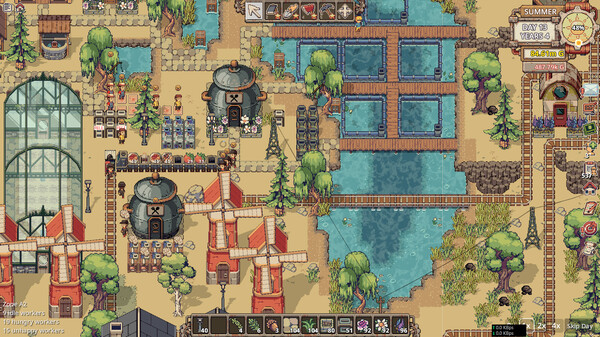
You do not play as a character walking around. You give the orders and your workers do the job. You start with one plot of land, some money and a list of things that need doing. Agromatic is a grid-based farming and automation game, and what you build is not a single factory but a whole operation: fields, workshops, mines, rail lines and the people who run them.
Then the war arrives, and everyone wants what you produce.
Workers Run the Floor
A craft station does not run itself. You place it, tell it what to make, and it sits there until a crafter walks over with the ingredients. The station is the recipe. The worker is the throughput. Same for fields, mines, kitchens and research computers, every one is a place someone has to be, and the specialists you hire walk your layout with traits that set the pace.
That makes layout the core puzzle. Every step a worker takes is time they are not producing.
You can cook for them, too. Run your own crops through a kitchen and each meal gives a different buff. Nobody starves, so the pressure is on your efficiency, not on your conscience.
Supply a War
Partway through the run, an empire start invading your city. Its army needs supplies. So does the resistance fighting it.
Pick a side or neither, and what you ship decides how the front moves.
Both sides send orders with deadlines. Miss too many and your ally walks, for good. Finishing them pays out, and each faction rewards you with things the other one does not offer.
Production Chains
Selling raw is just flat. A pack of wheat is a pack of wheat, and the only way to earn more from it is to plant more of it.
Processing changes the ratio. Mill that wheat, bake the flour, and every step after it is worth more than the one before. Ore into bars, milk into cheese, strawberry into wine, cotton into cloth. Same land, same harvest, more money per item, and that margin is what pays for the next expansion.
Resources Never Run Out
Nothing on the map runs dry. An ore patch keeps giving ore forever. A cut tree can be replanted, the river never gets fished out, an oil spot pumps for as long as you keep it fed. A mine you built in your first hour still works in your last one.
What a node actually costs you is fuel and a worker standing there. So growing bigger is a question of how much you can keep running at once, not how much is left in the ground.
That does not make a finished farm a static one. You get more out of it in place instead of moving it: better equipment on the same zone, a meal buff on the worker working it, a specialist whose traits fit the job. Same layout, more coming out of it.
Trains Between Zones
Your map is not one screen. You buy zones outward, each with its own resources, and moving goods between them is a logistics problem you actually solve.
Lay track, build depots, assemble trains from heads and wagons, then decide what each one hauls. Each wagon hauls one good, and you set how much it takes, how much it drops off and when it leaves. Get it right and a zone you are not even looking at keeps the one you are in supplied.
Raids and Guards
Bandits show up and name their price. Pay it and they leave. Tell them no and they come take it.
Fighting is something you prepare for, not something you click. Guards are hired and equipped, a decent weapon, medicine, a meal buff before the wave lands. Guards you never armed will not hold, and then you lose the stock you refused to pay with.
Paying is not always the worth option either. Their demand can cost more than the fight, and a bandit that gets paid once comes back later and asks for more. Sometimes the cheapest answer is to fight them.
They always come from the same place. Every invasion enters the map at the same point, so defense is something you build once and keep, not a scramble across the whole farm.
The Year Turns
Every season changes what you can do. Some crops only grow in specific season. Some fish can only be caught in specific season. The thing that made you the most money last season might not even be available now, so it pays to think a year ahead.
The calendar is a schedule, not a wall. When a crop is in season you plant it wide and stockpile the harvest, then spend the off-season turning that stock into processed goods that sell in any weather.
You can also buy your way out of the calendar. A greenhouse ignores the season entirely, anything planted inside it grows year round, so the crops you lean on never drop off the menu. Fish cages do the same for the water. Instead of waiting for the season that lets you catch a species, you stock a cage with it, keep it fed, and the fish breed for you all year.
Build Instantly, Iterate Fast
No construction timers. Place a building and it is there.
Removing is just as direct, and you get every material back, nothing is lost. Moving a workshop, re-routing a rail line or tearing out a whole district costs you nothing but the few seconds it takes, so you can see what a new layout does to your throughput right away.
Play While You Work
It runs properly in windowed mode. Keep the farm on half your screen while you work, browse or watch something on the other half, check a production chain, fix a schedule, and get back to it.