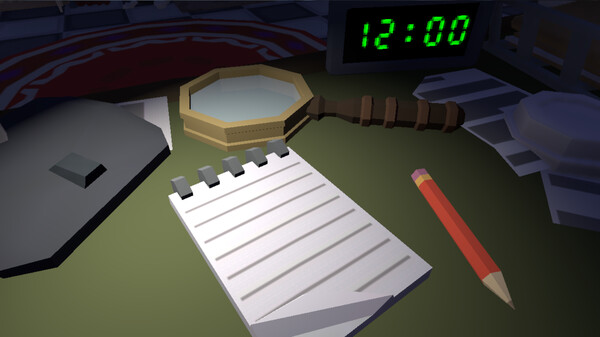
Puzzle out the who, what, where, and why of an imminent murder in this casual mystery title!
Modeled estimate, not a reported figure. How we estimate →
Media

About
Five mystery authors have gathered at the Gargoyle Hotel... and one of them has ill intent! Discover the would-be murderer before the clock strikes midnight in this retro-style puzzle/strategy game; record conversations via your super-high-tech surveillance setup (or simply eavesdrop), search for clues in the suspects rooms, or tease information out of them via targeted interrogation over the phone. Once you have the suspect, victim, murder weapon, room, and motive, a single phone call is all it takes to unravel their entire nefarious scheme.
Features:
20 mysteries to puzzle out (4 in the demo)
Bite-sized play sessions (~36 minutes per case)
Humorous characters and dialogue
Stats
All-time low is the lowest price we've recorded for this game since we started tracking it.
Languages: English
Reviews
Whodunnit needs work. It's not a finished product, and I think the developer made a mistake going for case quantity over quality. There are enough design issues here that I struggled to keep this review from turning into a description of the entire game. - The main menu's white font over a transparent black background layered on a mixed-color image is genuinely difficult to read. The scenario selection screen looks like it was phoned in, a recurring theme throughout this game. It was not at all clear how to start a case, or even that this was a scenario selection screen. Not a label to be seen anywhere. I had to guess that the left side represents difficulty. Maybe that's part of the mystery. I'm really not sure how this menu got through any kind of playtesting. - Once you start a case, there's no explanation of what you're supposed to do to solve it or what your tools are. I wouldn't have figured out how to play if the only other review on this game hadn't laid it out in detail (thanks Sosich!) - The surveillance menu also needs to be redone. It makes no sense that recording and monitoring are separate functions, or that you have to manually select when to record, or that you only get three recording slots. It took me multiple failed runs to figure out that after you select the time and room you want to record in, the thing that looks like a bullet point next to the room dropdown is actually a button that initiates the recording. - The suspect information sheets are one of the worst parts of this game and an absolute phoned-it-in moment. Instead of creating actual characters for fully developed scenarios, the developer built a bank of character traits that get randomly assigned to suspect files at the start of each case. These traits have nothing to do with the crime. They're just a list of eight throwaway facts like "doesn't know how to boil water." Why you wouldn't write actual suspect profiles in a murder mystery game is beyond me. - Worse, these random traits are used to gatekeep your two investigation tools: the phone and breaking into people's rooms. So you just have to remember that Edgar can't boil water, or you're locked out of that room or phone call for a period of time. That doesn't add anything to the experience, it just gives you random noise to memorize for no reason. - The clue system is where you can see the developer's potential. Pointer clues tell you to surveil a specific place at a specific time are fine, functional. The surveillance recordings themselves are probably the only genuinely good writing in the game. On the phone, you can ask suspects several types of questions, like "what do you think of X as the murder weapon" where X could be gun, poison, knife, and so on. The suspect faces reacting to you getting close to the truth is a nice touch and the meta around suspects is clever. They clearly spent time engineering difficulty into the mysteries and trying not to be obtuse about it. They ruin all of that effort by slapping bad randomized character writing, mechanics that serve no purpose but to exist, and bad UI design on top. The developer should've spent more time on the fundamentals and less time packing the game with scenarios. I was pleasantly surprised to see they're actively developing (there was a patch in June), but it doesn't seem like they've gotten enough critical feedback, or they're ignoring the feedback they do get, because this is really, really bad.
You are the greatest detective, which makes sense since you share a last name with the most famous sleuth of all time. You have been invited to a hotel where the world’s finest mystery writers are holding their annual meeting. However, one of them is a murderer. There are 20 cases to play in any order. While the core structure remains the same, each case features a different theme. You will always have the same five suspects, the same locations, and the same investigative options, but the clues, conversations, and information in the suspects’ files change. Although certain details repeat across cases, they appear in a different order each time. Your objective is to identify the murderer, the victim, the weapon, and the motive. These elements vary in every case. You have only a limited number of minutes to gather clues, as time never stops. Everything must be solved before midnight, when the killer strikes. Because time is limited, characters move between locations. To keep track of them, you have access to surveillance cameras that monitor every room. This allows you to eavesdrop on conversations or confirm a suspect’s whereabouts before breaking into their room. Characters change locations every 30 minutes, and you can speed up time by clicking the clock on the table. Breaking into rooms is interesting. To succeed, you must choose the correct response, which you can determine by studying suspect files, listening to conversations, or taking a calculated guess. Choosing the wrong response alerts a guard, who will watch the door for a few minutes. You can always return later to try again. Each room can only be broken into once, as you collect all available evidence during your visit. Cleared rooms are grayed out, helping you focus on those you have yet to investigate. Once all rooms have been searched, you no longer need to worry about this mechanic. All discovered evidence is automatically recorded in your notepad. The notepad also stores transcripts of phone calls and eavesdropped conversations. The phone is a crucial feature that allows you to question suspects. As with breaking in, you must select the correct responses. If you choose incorrectly, you can try again later, and once you find the right response, you will not need to select it again. You can ask each character four questions before they hang up, but you can immediately call them back and continue where you left off. After exhausting all questions, your notepad organizes the collected statements into a chart for clarity. From there, you must continue advancing the hours, gathering additional clues, and comparing them to the suspects’ statements. When you determine that something is impossible or untrue, you can eliminate it from consideration. Once you believe you have identified the murderer, you must call that person and make your accusation. You cannot afford a mistake, as a false accusation ends the game. Overall, the presentation is simple, but the gameplay has a distinct old school feel and can be quite challenging. Although the notepad keeps track of the information, the reasoning is entirely up to you.

Related
Related
Trends
Concurrent players on Steam, sampled daily since tracking started.
Momentum
Pace estimated from the game's recent review growth (our daily snapshots) at its own sales-per-review ratio — a momentum signal, not booked sales.
Related
| Sakura Mirror | $470.7 | 57 | 75% | $0.59 |
| 幻想异乡曲 Butterfly~Rin | $472.3 | 52 | 85% | $0.99 |
| Wanderer | $473.1 | 69 | 75% | $4.99 |
| Cute Girls: Find Secrets | $476.8 | 77 | 65% | $0.99 |
| 101 Cats in Australia | $464.9 | 61 | 95% | $0.99 |
| Furry Woof and Nya | $464.4 | 75 | 85% | $0.99 |