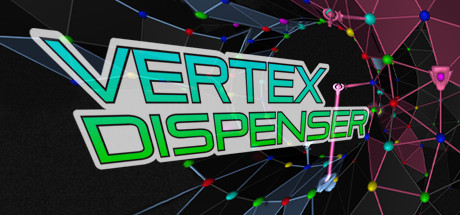
Vertex Dispenser is an uncompromisingly abstract strategy title developed and published by Michael Brough, a designer known for distilling complex decision-making into minimalist systems. Rather than presenting players with characters, armies, or narrative framing, the game strips strategy down to its bare essentials: geometry, color, territory, and time. This deliberate austerity immediately sets the tone for an experience that asks players to think spatially and systemically, rewarding curiosity and patience while offering little in the way of conventional onboarding or thematic comfort.
The core of Vertex Dispenser unfolds on a geometric surface composed of vertices, edges, and faces, where influence is exerted by coloring vertices and claiming faces. Control of territory is not just a score metric but a defensive mechanic, as owning faces strengthens your position and makes it harder for opponents to encroach. The act of expansion is therefore inseparable from defense, creating a constant tension between spreading influence and consolidating it. Every action subtly reshapes the board, and even small decisions can cascade into major positional advantages or vulnerabilities.
What elevates the game beyond a static puzzle is its real-time structure. Unlike turn-based strategy games that allow for careful deliberation, Vertex Dispenser operates in continuous time, forcing players to balance foresight with immediate reactions. This real-time pressure adds urgency to what is otherwise a deeply cerebral experience, compelling players to internalize the system well enough to act decisively without perfect information. The result is a rhythm that feels closer to an ongoing mental exercise than to traditional RTS combat, where anticipation and pattern recognition matter more than speed alone.
Color mechanics form the heart of the game’s strategic depth. Different colors unlock distinct powers and effects, each with strengths, limitations, and situational uses. Mastery comes not from favoring a single approach but from understanding how these colors interact with one another and with the evolving geometry of the board. Choosing when to invest in a color, when to pivot, and when to deny an opponent access to certain powers becomes a nuanced layer of mind games, especially against human opponents who are learning and adapting in parallel.
The visual presentation reinforces this focus on abstraction. Shapes are clean, colors are stark, and there is little visual noise to distract from the underlying system. This clarity makes the battlefield readable once you understand it, but it also contributes to the game’s initial opacity. New players are offered few intuitive cues, and the lack of thematic context can make early matches feel confusing or arbitrary. However, for those willing to push past that initial barrier, the simplicity becomes a strength, allowing the mechanics themselves to take center stage without embellishment.
Single-player play offers a space to experiment and internalize the rules, but the game truly shines in multiplayer, where the abstract systems become a language shared between opponents. Human play introduces unpredictability and psychological tension, as players attempt to read each other’s intentions through shifts in color use and territorial focus. Matches can swing dramatically as a well-timed move or power activation reshapes the board, giving the game a dynamic quality that belies its minimalist appearance. That said, the niche appeal and age of the title mean that finding active opponents can be inconsistent, reinforcing its status as a cult rather than mainstream multiplayer experience.
The learning curve is steep and unapologetic. Vertex Dispenser does little to explain itself, and success often comes only after repeated failures and moments of realization. This can be frustrating for players who expect gradual tutorials or narrative motivation, but it aligns with Michael Brough’s broader design philosophy, which treats games as systems to be discovered rather than guided experiences. The satisfaction comes not from spectacle or story payoff, but from the moment when the abstract logic finally clicks and deliberate control replaces confusion.
In the end, Vertex Dispenser is less a conventional game and more a focused exploration of strategic thought expressed through geometry and color. It will not appeal to everyone, particularly those seeking narrative context, visual flourish, or immediate gratification. However, for players drawn to experimental design, spatial reasoning, and tightly interlocked systems, it offers a rare kind of engagement—one that feels intellectually demanding, quietly elegant, and deeply personal. As a product of a singular creative vision, it stands as a testament to how far strategy games can be pushed when stripped down to their most fundamental elements.
Rating: 6/10