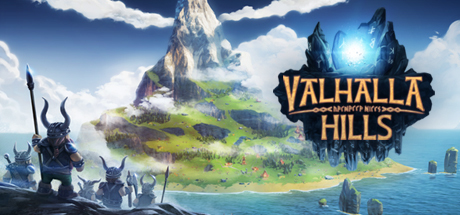
Lead your people. Survive the wilderness. Fight for honor. Reclaim your eternal reward. A brand new strategy game from the developers of Cultures and The Settlers II.
Modeled estimate, not a reported figure. How we estimate →
Media

About


Genres
Stats
All-time low is the lowest price we've recorded for this game since we started tracking it.
Languages: English*, German*, Russian, French, Italian, Spanish - Spain, Japanese, Korean, Polish, Portuguese - Brazil, Simplified Chinese, Traditional Chinese*languages with full audio support
Engagement
Hours played at review time, across 40 reviews with recorded playtime.
Reviews
Themes across 40 recent reviews and how positive each mention is. A keyword signal, not full sentiment analysis.
positive critical· bar length = how often the theme comes up
Reviews
Valhalla Hills ist ein charmantes Aufbauspiel mit entspannter Atmosphäre und liebevollem Design. Das Spielprinzip erinnert an die klassischen Siedler-Spiele und macht richtig Spaß, wenn man seine Wikinger beim Bauen, Sammeln und Erforschen beobachtet. Die Mischung aus Strategie, Ressourcenmanagement und dem humorvollen Wikinger-Setting sorgt für viele Stunden Spielspaß. Wer Aufbauspiele mag, sollte Valhalla Hills unbedingt ausprobieren!
bunch of hornheaded so called vikings with lern immunity.
un buen juego abandonado
Valhalla Hills is a Viking-themed strategy and settlement management game developed by Funatics Software and published by Daedalic Entertainment that draws clear inspiration from classic city builders while carving out its own identity through procedural maps, indirect control, and a mythological framing. From the outset, the game establishes a clear and focused premise: a group of fallen Vikings has been denied entry to Valhalla, and it is up to the player to guide them through harsh, mountainous landscapes, build thriving settlements, and ultimately prove their worth to the gods. Rather than telling this story through dialogue or cutscenes, the game expresses its themes through systems, objectives, and the steady climb toward each island’s summit. At the core of Valhalla Hills is a resource-driven settlement simulation that emphasizes planning and logistics over micromanagement. Each map is procedurally generated, ensuring that terrain, resource placement, and environmental constraints vary from mission to mission. This procedural structure forces players to adapt their strategies rather than relying on fixed build orders, as access to food, wood, stone, and metal can differ dramatically depending on geography. Establishing a sustainable economy requires careful placement of buildings, thoughtful expansion of production chains, and an understanding of how resources flow through the settlement. Success is not measured by endless growth, but by efficiency and the ability to reach specific goals within the constraints of the environment. One of the defining design choices of the game is its indirect control over villagers. Rather than issuing commands to individual units, players assign professions by constructing buildings, and the Vikings autonomously carry out their duties. This approach creates a sense of a living settlement that operates on its own logic, which can be both rewarding and frustrating. When everything aligns, watching villagers transport goods, expand infrastructure, and sustain themselves is deeply satisfying. However, when something goes wrong—such as a bottleneck in production or unclear worker behavior—the lack of direct control can make problem-solving feel opaque. Understanding the underlying systems becomes essential, as the game expects players to think like planners rather than commanders. Progression in Valhalla Hills revolves around unlocking paths upward, both literally and figuratively. Each island culminates in a portal guarded by powerful entities that must be dealt with either through military force or offerings to the gods. This choice introduces light strategic variation, allowing players to decide whether to invest more heavily in weapon production and soldier training or focus on resource surplus for sacrifices. While combat is present, it is not the primary focus; battles are largely an extension of your settlement’s economic strength. If your village is well supplied and efficiently run, combat encounters tend to resolve smoothly, reinforcing the idea that preparation matters more than tactical finesse. Visually, the game adopts a stylized, almost storybook art direction that leans into warmth and charm rather than grim realism. Characters are expressive and slightly exaggerated, environments are colorful despite their harsh settings, and lighting effects give settlements a cozy feel even on dangerous mountain slopes. This aesthetic choice helps soften the sometimes demanding nature of the gameplay, making long sessions of planning and optimization feel inviting rather than exhausting. The soundtrack and ambient audio further reinforce this tone, providing a calm, atmospheric backdrop that complements the slow, deliberate pace of the game. Despite its strengths, Valhalla Hills does struggle with repetition over extended play. The core loop—establish settlement, secure resources, climb the mountain, deal with the guardian—remains largely unchanged across missions. While procedural generation introduces variation in layout, the objectives and progression structure stay familiar, which can make later stages feel predictable. Some players may also find the interface and feedback systems lacking in clarity, especially when diagnosing inefficiencies or understanding why villagers are behaving a certain way. These issues do not break the experience, but they do highlight the game’s reliance on patience and genre familiarity. The inclusion of additional content through expansions and the Definitive Edition helps broaden the experience, introducing new environments and challenges that add some variety to the formula. These additions are most rewarding for players who already enjoy the base mechanics and are looking for more scenarios to test their planning skills. However, even with expanded content, the game remains firmly rooted in its original design philosophy, favoring steady, methodical progression over dramatic shifts in gameplay. Ultimately, Valhalla Hills is a game that appeals most to players who appreciate classic settlement builders and are comfortable with indirect control systems. It does not aim to overwhelm with complexity or dazzle with narrative spectacle, instead offering a measured, systems-driven experience built around efficiency, adaptation, and quiet satisfaction. While it may not reach the depth or longevity of genre-defining titles, it succeeds as a thoughtful and atmospheric city builder with a distinct Viking flavor. For players seeking a relaxed yet challenging strategy experience that rewards planning and observation, Valhalla Hills offers a climb worth taking, even if the path upward is sometimes uneven. Rating: 5/10
норм
玩起來不好懂,也不能控制裡面的人物,只能一直蓋各種屋子,敵人來襲還沒辦法做任何指令或操作去對抗,只能等敵人靠近才會有士兵去抵抗,是一個很無聊的遊戲。
It is a charming, relaxing city-builder that successfully captures the spirit of classic titles like The Settlers and Cultures whilst keeping things simple and accessible. The game's standout feature is its beautiful, "paper cut-out" art style and atmospheric lighting, which make managing your Viking tribe feel like a cozy, low-stress experience. While the core loop of gathering resources and building up a settlement to reach a mountain portal is engaging at first, later it becomes repetitive, and you see the lack of a traditional story campaign a bit thin for long-term play. Additionally, the indirect control of units can lead to occasional frustration when the AI doesn't quite behave as expected. Also, the Achievements are broken. I got 1 hour play Achievement after 5 minutes of play, got other Achievements way faster and before than expected, when I didn't meet the requirements. I don't know why, but from what I heard, I am not alone, some players do get random Achievement pop ups.
This game desperately needs a difficulty setting.
I think it's only fair to say that I was only able to get a first impression from this title. As such, it's very possible that some of my negative review is because I did not find it interesting enough to sink enough time into the title to unlock all of the buildings. But part of that issue comes down to game design, especially early game design, and not being interested enough in the title to progress far enough to see if these issues are addressed. Regardless, the early game does not give a good first impression. It's possible that after the learning curve is passed that there's a fantastically balanced city builder beneath what I saw. Much of that learning curve seems to be from shadow-mechanics that just don't behave the way you'd expect them to in a city builder: especially the fairly casual type that this seems to be. Perhaps the tutorial for what seems like a fairly casual city builder was a last minute, half-assed effort. I get that. Regardless, my first impressions of the jankiness were enough to say "I don't think this is worth investing my time in learning" when there are multitudes of much better city builders in my library. The biggest issue with this title are strange design choices for a city builder. This is not a sandbox where you can build anywhere that you want. For whatever reason, the developer decided that there are only certain areas buildings can be placed and buildings of different types have different areas. If you look at the videos, you'll see just how strange road pathing etc., becomes due to its hex-based aspect (it's actually quite unique, but not in a good way). Think of it similarly to residential vs. commercial vs. industrial zoning. This leads to there being herds of animals who should be huntable, but no area to place a hunting lodge because perhaps I put a road or a tent there. It's just very strange and janky and sadly I doubt it's something that will be touched 10+ years later with something like a zone overlay. The end result? It completely takes away the element of planning, because once you've placed a wheat farm, you may not have the ability to place the mill and bakery next to it. The game was also plagued by poorly done tutorials. Like many city builders, you start the "tutorial" levels with few buildings and receive more and more as you play more. With Valhalla hills, the issue is that the tutorial levels seem really janky for completion due to food shortages. I don't quite know if this remains a theme in late game, but something just felt really off and it isn't a great first impression to make me want to invest my time to learn more. I mean, if the tutorial levels are that poorly balanced.. what can I expect from the gameplay loop for the end-game to be like? As such, my experience on the first and second level basically felt like a cheesy forced attempt at victory (and I succeeded) because I ran out of food, my production shut down completely, I was not able to equip my actual military units like directed, and I just sent off my villagers to succeed at a villager rush of the portal (which had no enemies). I won. The second round was much the same, but this time I prioritized my only food building. Meanwhile, knowing I had limited time before I ran out of berries, I tried to equip my military with weapons.. Of course, since I had been trying to pursue a sustained economy with fishing huts (who needed fishing poles - another tool), I also ran out of food. Again, I YOLO'd the portal and won. The third round I knew I was playing the clock, but I got a wheat farm, flour mill, and bakery up with a couple hunters. I don't quite know if I'd have been in the green on food for infinite sustainability or for how long, but once I equipped my military with stone axes I decided to trigger the portal. Only to discover that my military behaved more like a tower defense title and did not leave their "zone." In this round, I figured out several other very non-intuitive mechanics that just.. didn't seem to make sense again? For one, military units only get equipped with weapons if a tool maker is in their zone. I thought that couriers may address this (who distribute things), but they too seemed to have a limited zone. However, you can't really build couriers close enough to each other.. (again, ghost zone rules). So my conclusion was that I needed a second toolmaker in my army's radius. OK. Army equipped. We got this right? Activate portal. Only then did I discover that the military behaves more like a tower defense game, where they only attack things in their area of influence which is small. So for the third time, I relied on a villager rush (and succeeded). [b]After this gaming session I did learn that I can move the military building and presumably some other buildings freely, which may address a few of the jankiness complaints[/b] But given that I wasn't quite getting that dopamine kick of satisfying end results and have noticed a pattern of very strange design choices, I just don't know if I care enough to play several more maps, unlock several more buildings, only to find other janky mechanics. Further, gather rates seem to be way to slow and would benefit from splitting the dime into nickles and pennies. What I mean by that is sometimes I'm just not sure if my buildings are actually producing or being built, because it's so slow to produce something. To be fair, it may only take 4 lumber to build something.. but I'd rather produce 10x faster and it cost 40 so I know everything is actually responding how it could. Even <$3 I paid for this title and its DLC, I just cannot recommend it relative to other city builders out there. Now that I know I can move the army building, which is easy to overlook, I may give it another session. But if I don't give it a second try and my playtime remains at 2.5 hours, that speaks even more because of the minimal entertainment that I've felt there is to be had from the first attempt and all of its questionable choices. In all fairness, I think there is a playable title here. It's not purely just completely unplayable indie vapor ware and might hit the right spot for some people. That said, I think a title like Banished, Endzone, Against the Storm, Oxygen Not Included, or Timberborn just has much more fun to be had. Albeit, most are also much larger productions and newer.
why not better
Related
Related
Trends
Modeled estimate over time, reconstructed from Steam's monthly review histogram.
Momentum
Pace estimated from the game's recent review growth (our daily snapshots) at its own sales-per-review ratio — a momentum signal, not booked sales.
Audience
Estimated from the language of this game's reviews — a proxy for where players are, not official Steam demographics.
Related
| Virtual Battlemap | $59.4K | 94 | 52% | $29.99 |
| Gnomes and Knights | $59.4K | 409 | 80% | $4.99 |
| 角斗士学院(Gladiator School) | $59.4K | 339 | 93% | $5.99 |
| Mars Power Industries Deluxe | $59.4K | 683 | 93% | $5.99 |
| The Architect: Paris | $59.4K | 235 | 73% | $17.99 |
| Trivia Vault: Food Trivia | $59.4K | 126 | 61% | $13.99 |