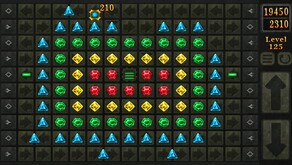
Up and Down is a deliberately minimalistic puzzle experience that builds its entire challenge around a single, tightly controlled idea. It strips away nearly all excess, presenting players with a straightforward objective and a very limited set of inputs, yet manages to create a surprisingly demanding gameplay loop. At its core, the game is about controlling movement along predefined paths while avoiding obstacles and collecting targets, but what gives it its identity is the constant forward motion that cannot simply be halted. This design choice transforms what could have been a simple mechanic into something that requires anticipation, planning, and a steady sense of rhythm.
The gameplay quickly reveals itself to be less about reacting to situations and more about predicting them. Because movement is continuous, players must think ahead and time their inputs carefully, often committing to decisions before fully seeing their consequences. This creates a unique kind of tension where every action feels locked in, and mistakes are difficult to recover from once they begin to unfold. As the levels grow more complex, the game leans heavily into pattern recognition, asking players to memorize sequences and refine their execution through repeated attempts. When everything clicks, there is a satisfying sense of flow, but reaching that point can take persistence and patience.
With a large number of levels built around this central concept, the game offers a consistent but narrowly focused progression. Each stage introduces new arrangements of familiar elements, gradually increasing the difficulty without significantly altering the core mechanics. This approach keeps the learning curve clear and predictable, allowing players to improve their skills over time. However, it also highlights one of the game’s main limitations, as the lack of new mechanics means that the experience does not evolve in a meaningful way. Instead, it relies on increasingly intricate configurations of the same ideas, which can feel either rewarding or repetitive depending on the player’s perspective.
Difficulty is a defining aspect of the experience, often requiring precise timing and a willingness to repeat levels multiple times. The margin for error can be quite small, and success often depends on executing movements with near-perfect accuracy. This can create a strong sense of accomplishment when a difficult section is finally completed, but it can also lead to frustration when progress feels tied more to rigid mechanics than to creative problem-solving. The game demands focus and persistence, making it better suited for players who enjoy overcoming strict, skill-based challenges.
Visually, the game embraces a clean and uncomplicated style that prioritizes clarity. The environments are easy to read, ensuring that players can quickly understand the layout of each level and the position of hazards. While this simplicity supports the gameplay, it also means that there is little visual variety to keep the experience feeling fresh over time. The audio design follows a similar path, providing basic feedback that reinforces player actions without adding much in terms of atmosphere or emotional depth.
Another notable aspect of the game is how well it fits into short play sessions. Its straightforward structure and quick level restarts make it ideal for brief bursts of gameplay, where players can attempt a few challenges and gradually improve. However, when played for longer periods, the limited scope becomes more apparent. Without additional systems or variations to break up the repetition, the experience can begin to feel one-dimensional, relying heavily on the player’s personal motivation to continue.
In the end, Up and Down is a focused and disciplined puzzle game that succeeds in exploring a single idea with precision. It offers a challenging experience that rewards timing, memory, and persistence, but it does so within a very narrow framework. For players who appreciate minimalist design and are willing to engage deeply with a demanding mechanic, it can be satisfying in short, concentrated sessions. For others, its lack of variety and reliance on repetition may limit its appeal.
Rating: 6/10