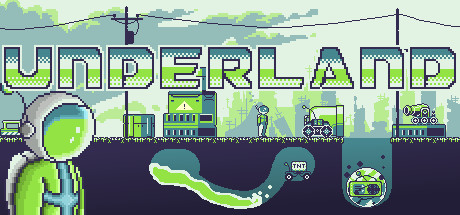
Underland, developed and published by Minicactus Games, is a deceptively simple yet deeply engaging 2D puzzle game that combines physics-based problem solving with a minimalist sense of adventure. Set in a post-apocalyptic world where the surface has become uninhabitable, the game follows a small group of astronauts who must make their way beneath the earth in search of a new home. What begins as a straightforward descent soon becomes a series of cleverly constructed engineering challenges, requiring players to manipulate the environment, control machinery, and use the laws of physics to carve out a path toward survival. It’s a game that rewards thought, experimentation, and patience more than reflex or speed, making it an understated yet satisfying experience for fans of logic-driven design.
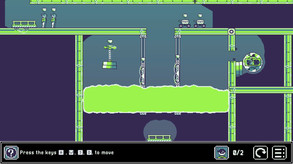
The visual presentation of Underland captures a blend of simplicity and atmosphere. Its pixel art style evokes a classic indie charm, with muted colors and clean lines that keep the focus on the mechanics rather than spectacle. Each level is composed of distinct layers of earth, machinery, and flowing substances—whether water, gas, or acid—that interact dynamically with the player’s actions. The sense of progression is communicated visually rather than narratively, as players dig deeper into the planet’s crust, encountering increasingly complex tools and environmental hazards. There’s a somber undertone to the presentation; while there’s no overt storytelling or dialogue, the ruined state of the surface and the cold precision of the underground facilities suggest a quiet desperation. The visuals are functional yet thoughtful, evoking a tone of survival and ingenuity without unnecessary embellishment.
Gameplay is where Underland finds its true identity. Each level presents a goal—reach the elevator that leads deeper underground—and a series of obstacles that demand creative manipulation of physics. The astronauts under your control cannot fight or build directly; instead, you must use a combination of levers, pumps, excavators, pipes, and explosives to alter the terrain. Every element behaves according to simple physical principles—gravity pulls, fluids flow, and structures collapse. Solving a puzzle requires understanding how these systems interact and using them in clever sequence. Sometimes you’ll have to redirect acidic liquid away from a fragile structure; other times, you might use a pump to fill an area with water to float debris upward. The game encourages a hands-on approach where trial and error become part of the discovery process. The best moments come when a single well-timed action sets off a satisfying chain reaction that opens a path to the exit.
One of Underland’s strongest qualities is its pacing. It begins gently, introducing tools one at a time to let players learn how each interacts with the environment. Early puzzles serve as straightforward tutorials, while later levels demand careful coordination of multiple systems. The difficulty curve is steady and fair, gradually layering complexity without overwhelming the player. Because each level is short and self-contained, the game maintains a sense of rhythm—failure never feels punishing, and success always feels earned. This structure makes it perfect for short play sessions, though it also has the kind of meditative appeal that can draw players into longer stretches of experimentation. There is a certain elegance in how it allows mistakes to become part of the learning process; rather than penalizing failure, it encourages players to tweak and retry until the pieces click into place.
While the mechanics are consistent and satisfying, Underland’s design is intentionally narrow in scope. Its focus on concise, physics-driven puzzles means there isn’t much room for narrative development or character progression. The astronauts serve as symbols more than personalities, and the world’s story remains largely implied. For some, this will feel refreshing—a reminder that not every game needs lengthy exposition or cinematic storytelling. For others, the lack of deeper context may feel like a missed opportunity, as the setting suggests a world ripe for exploration beyond the mechanics. Still, what it lacks in narrative ambition, it makes up for in polish and clarity. The minimalist interface and crisp physics create a sense of precision that keeps the experience focused and frustration-free.
The presentation of sound and atmosphere complements this design philosophy. The ambient music and subtle mechanical noises provide a quiet backdrop that enhances concentration rather than distraction. There’s a sense of isolation in the soundscape, a feeling that you are burrowing into an unknown world far removed from civilization. The sparse use of audio cues gives weight to the physical interactions—each pump, explosion, or shifting piece of machinery feels deliberate and grounded. This restraint contributes to the overall mood of calm persistence, fitting for a game that thrives on careful problem-solving rather than frantic action.
Underland ultimately succeeds as a compact, elegant puzzle game that knows exactly what it wants to be. It doesn’t chase spectacle or complexity for its own sake; instead, it delivers a well-balanced series of challenges rooted in logical thinking and environmental manipulation. Its short length makes it easy to complete in a few sittings, but the satisfaction of its mechanics lingers long after. It’s a testament to how a small concept, executed with clarity and purpose, can result in an experience that feels both relaxing and intellectually rewarding. For players who enjoy physics-based puzzle solving, quiet atmosphere, and the gratification of mastering systems through experimentation, Underland is a hidden gem that deserves a place among the best minimalist puzzle adventures of its kind.
Rating: 8/10