Trippy Jump is a deliberately stripped-down platformer that focuses almost entirely on one elemental idea: the satisfaction and tension of perfectly timed jumps. Developed by Semi Sağlam and published by My Way Games, it avoids layered systems, narrative framing, or complex progression in favor of an experience that feels closer to an arcade reflex test than a traditional platform adventure. From the moment you start playing, the game makes its intentions clear—it wants your full attention for brief, concentrated bursts, asking you to rely on timing, rhythm, and consistency rather than discovery or long-term planning.
The core gameplay loop is extremely simple and unapologetically repetitive. Platforms appear in an endless sequence, and your only real task is to keep jumping without falling. There are no checkpoints, no forgiving safety nets, and no gradual penalties for mistakes; a single failed jump ends the run outright. This all-or-nothing structure creates constant pressure, turning even small stretches of success into tense accomplishments. Precision is rewarded through scoring mechanics that encourage clean, well-timed jumps rather than sloppy survival, giving skilled players a reason to refine their technique beyond just staying alive for as long as possible.
While the mechanical foundation is narrow, it is reasonably well tuned for what it attempts to do. Movement feels responsive, and the timing window for jumps is strict but readable, allowing players to improve through repetition rather than trial-and-error frustration. Occasional power-ups add minor variation, briefly altering how jumps behave or how points are earned, but these elements function more as short-lived diversions than meaningful shifts in strategy. The game never truly evolves beyond its initial premise, instead relying on player self-improvement and score chasing to sustain engagement.
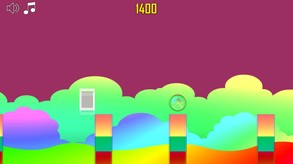
Visually, Trippy Jump adopts a clean, minimal style that prioritizes clarity over personality. Platforms, characters, and backgrounds are simple and brightly colored, ensuring that players can instantly read distances and timing without visual clutter. This aesthetic choice supports the game’s mechanical focus, as there are no distractions from the precise spacing between jumps. However, the presentation is functional rather than expressive, and players looking for artistic flair, dynamic environments, or visual progression over time may find it lacking. Sound design follows the same philosophy, providing basic audio feedback that reinforces actions without adding much atmosphere or emotional texture.
In terms of content, the game is intentionally lean. There are no distinct modes, handcrafted levels, or unlockable systems to work toward over extended play. What you see early on is effectively what the game remains throughout its lifespan. This design makes Trippy Jump well suited for short sessions—something to play for a few minutes to test focus or kill time—but less effective as a game to sink hours into consecutively. For some players, this purity is refreshing, while for others it highlights the absence of variety or long-term goals.
The mixed reception the game has received reflects this divide in expectations. Players who approach it as a minimalist arcade challenge tend to appreciate its honesty and tight focus, enjoying the meditative rhythm that emerges once muscle memory develops. Those expecting even modest progression systems, evolving difficulty structures, or creative twists often come away disappointed, finding the experience too shallow to justify repeated play. The game makes little effort to broaden its appeal, instead committing fully to a very specific niche.
Ultimately, Trippy Jump succeeds or fails based entirely on how much value a player places on pure mechanical repetition. It is not a game about exploration, creativity, or narrative expression, but about mastering a single action under pressure. As a compact reflex challenge, it delivers exactly what it promises with little excess. For players who enjoy minimalist platforming and score-driven endurance tests, it can offer brief but satisfying moments of focus. For those seeking depth, variation, or a sense of progression, it is likely to feel too slight to leave a lasting impression.
Rating: 5/10