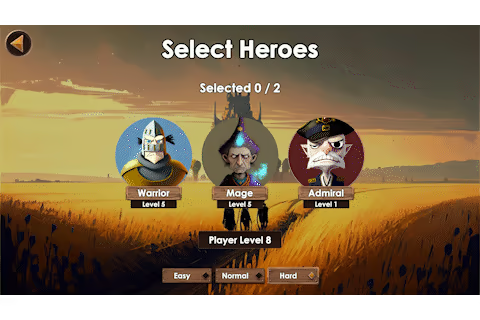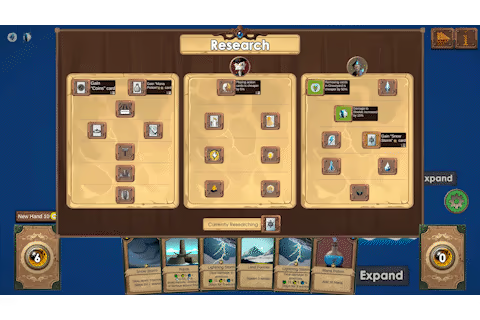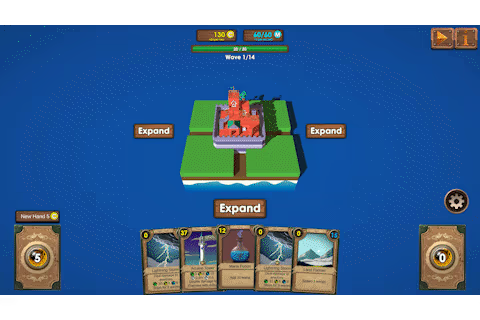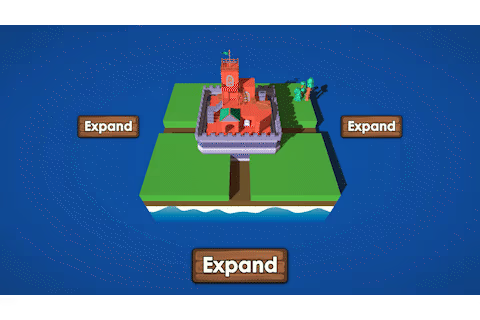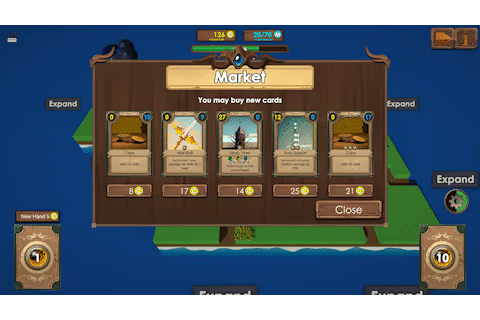
A combination of Tower Defense and Rogue-like deckbuilding. Select your heroes, place towers, cast spells, research new technologies and build your deck to defend your castle from enemy forces.
Modeled estimate, not a reported figure. How we estimate →
Media

About


Stats
All-time low is the lowest price we've recorded for this game since we started tracking it.
Languages: English, French, Spanish - Spain, Japanese, Korean, Portuguese - Portugal, Russian, Simplified Chinese, Lithuanian
Engagement
Hours played at review time, across 40 reviews with recorded playtime.
Reviews
Themes across 40 recent reviews and how positive each mention is. A keyword signal, not full sentiment analysis.
positive critical· bar length = how often the theme comes up
Reviews
Un juego de tower defense bastante entretenido ya que incorpora un sistema de mejoras estilo idle que lo hace más interesante. https://youtu.be/nbux1sM3hB0
NIce idea and nice game.... but it's an Early access, the games is way too short and too easy.
O jogo é bom, joguei 6 horas sem parar, tem muito potencial para ser melhorado, 4 personagens para escolher que vão subindo de nível conforme vai jogando. Vamos torcer para que os desenvolvedores continuem atualizando com melhorias. Pontos Ruins: - falta de explicação em algumas cartas, não deixa bem claro o que ela faz, mas da para descobrir jogando - tradução feita pelo google tradutor, algumas palavras confundem - poderia ter rotação da câmera do jogo, fica ruim para colocar uma torre atrás da outra, mas com jeito você aprende a colocar. Resumindo, se você curte TOWER DEFENSE vale a pena pegar em uma promoção, mas o jogo também está barato atualmente em seu preço original que é R$32,99 neste dia em que faço essa análise.
poor derivative of rogue tower
Towers Deck is a compact roguelike strategy game that merges deckbuilding mechanics with tower defense gameplay in a way that feels both accessible and surprisingly tactical. Developed and published by ThinKING Cat Games, the title focuses on building efficient defensive setups through card management, resource control, and careful battlefield planning. While the game clearly takes inspiration from popular roguelike deckbuilders, it succeeds by keeping its systems streamlined and mechanically focused instead of overwhelming players with unnecessary complexity. The result is an indie strategy experience built around experimentation, optimization, and replayability rather than flashy presentation or large-scale storytelling. The gameplay centers around defending against waves of enemies using cards that summon towers, activate attacks, deploy traps, and provide support abilities. Every encounter forces players to balance limited resources while constructing defensive systems capable of surviving increasingly dangerous enemy assaults. The combination of tower defense structure and deckbuilding progression works remarkably well because both mechanics naturally support each other. Instead of simply attacking enemies directly like many card battlers, players are constantly planning defensive layouts and preparing for future enemy waves several turns in advance. One of the game’s greatest strengths is how quickly its mechanics become understandable. The foundation is simple enough that most players can grasp the core systems within a short time. Draw cards, spend energy, place defenses, and survive incoming attacks. However, the deeper strategic possibilities gradually reveal themselves as new cards, synergies, and enemy patterns appear. The game strikes a strong balance between accessibility and depth, making it approachable for newcomers while still rewarding players willing to experiment with more advanced tactics. Deckbuilding is easily the most satisfying part of the experience. Successful runs require careful refinement and efficient synergy management rather than simply collecting strong cards randomly. Some builds focus on overwhelming enemies with rapid-fire attacks and aggressive towers, while others revolve around slowing enemy movement, generating large amounts of resources, or creating layered defensive structures that gradually wear opponents down. Certain strategies prioritize cycling through cheap cards quickly, while others depend on building powerful combinations that dominate later waves. The game consistently rewards experimentation because unexpected card interactions often become the foundation for highly effective builds. The roguelike progression systems also help maintain replayability. Each run introduces randomized rewards, enemy arrangements, and upgrade opportunities that constantly force players to adapt their strategies. The game rarely allows players to rely on exactly the same approach every time, which keeps the experience engaging over repeated runs. Even failed attempts usually feel educational because players leave with a better understanding of card synergies, defensive positioning, and resource efficiency. Another major strength is the pacing. Towers Deck moves quickly without becoming overwhelming, creating a satisfying rhythm where players are constantly making meaningful tactical decisions. Enemy waves steadily escalate in difficulty, forcing players to refine their decks and improve their defensive planning throughout a run. The game avoids excessive downtime and keeps attention focused almost entirely on strategic decision-making, which helps maintain engagement even during longer sessions. The battlefield positioning mechanics add another important layer to the strategy. Tower placement matters heavily because poorly positioned defenses can leave vulnerable gaps or waste valuable resources. Different tower effects interact with enemy movement patterns in meaningful ways, encouraging players to think carefully about spacing and timing rather than relying entirely on raw damage output. This tactical layer helps the game feel more dynamic than traditional deckbuilders where combat often revolves solely around card efficiency. Visually, Towers Deck adopts a minimalist art style that prioritizes gameplay clarity over graphical spectacle. The environments, towers, and enemy units are all simple but readable, allowing players to process information quickly even during more chaotic waves. While the presentation lacks the elaborate visual polish found in larger strategy roguelikes, the clean interface and uncluttered battlefield design work well for a game so heavily focused on tactical precision. The minimalist aesthetic ultimately supports the gameplay rather than distracting from it. The sound design is similarly restrained but effective. Background music creates steady tension during battles, while attacks and tower activations provide satisfying audio feedback. The soundtrack may not leave a particularly strong impression outside the game itself, but it supports the pacing and atmosphere effectively enough during active gameplay sessions. One of the most impressive aspects of Towers Deck is how well it respects player time. Runs are compact enough for short sessions while still offering enough strategic complexity to remain rewarding. The game avoids unnecessary filler and focuses almost entirely on delivering a tight gameplay loop built around planning, experimentation, and adaptation. This structure makes it very easy to fall into the addictive cycle of constantly wanting to attempt another run. However, the game does have several weaknesses that become more noticeable over time. The most significant issue is the relatively limited amount of content. Although the core gameplay systems are strong, experienced players will eventually begin noticing repetition in enemy types, maps, and strategic patterns after enough runs. Additional cards, enemies, environments, and gameplay modifiers would significantly improve long-term variety. The minimalist presentation may also divide players. While the clean visuals improve readability, some players may find the art direction too simplistic compared to other modern indie roguelikes with more elaborate visual styles and effects. The game intentionally emphasizes mechanics over spectacle, but that design choice may reduce its overall visual memorability. Balance can occasionally feel uneven as well. Certain tower combinations and card synergies become dramatically stronger than others once discovered, allowing some runs to snowball into overwhelming power fairly quickly. Meanwhile, weaker builds can struggle heavily if useful cards fail to appear during important moments. The randomness is part of the roguelike appeal, but luck occasionally has a larger influence on run quality than ideal. Another limitation is the lack of narrative or worldbuilding depth. Towers Deck focuses almost entirely on gameplay systems, offering very little story, lore, or character development. Players looking for strong atmosphere or emotional progression may find the experience somewhat mechanically focused compared to more narrative-driven strategy games. For players who enjoy roguelike deckbuilders, tactical tower defense games, and compact strategy experiences focused on optimization and experimentation, Towers Deck offers a rewarding and highly replayable indie experience. It may lack the massive content variety and presentation quality of larger strategy roguelikes, but its focused design and addictive tactical gameplay still make it a worthwhile title for fans of mechanically driven strategy games. Rating: 7/10
Wer es günstig bekommt ok, für den Vollpreis hätte es für mich jedoch zu wenig Inhalt und ist viel zu einfach egal auf welchem Schwierigkeitsgrad. Man hat ein bisschen strategische Tiefe aber nicht all zu viel, das Game richtet sich wohl eher an Towerdefens Einsteiger, trotzdem macht es Laune.
Played for a bit. Enjoyed first game, will update in the future..
Grazie agli sviluppatori che mi hanno permesso di provare il gioco in modo gratuito. Potrebbe essere un gioco interessante, non solo per adulti. Potrebbe avvicinare i giovincelli a questo tipo di giochi strategici o con le carte. Non è complessissimo, però necessita di accortezze. La grafica molto semplice è una nicchia per gli amanti di questo genere. Piccolo problema è che non ho trovato istruzioni per il gioco e ho dovuto iniziare subito a giocare contro le ondate dei nemici, che al primo tentativo, alla decima ondata, hanno avuto la meglio. Se volete vederlo ho caricato un video sul mio canale youtube: https://youtu.be/wEhdNaZjb9A
почему бы и нет, хоть и играть не много надо
Had a good time while playing this game. Simple and interesting gameplay. Can't wait for more content!
Related
Related
Trends
Concurrent players on Steam, sampled daily since tracking started.
Audience
Estimated from the language of this game's reviews — a proxy for where players are, not official Steam demographics.
Related
| Clicker Clicker Clicker | $10.1K | 105 | 65% | $1.49 |
| Ghosts of Miami | $10.2K | 67 | 87% | $8.99 |
| AQUA KITTY UDX | $10.1K | 70 | 84% | $6.99 |
| AudioTheory Guitars | $10.1K | 90 | 86% | $6.99 |
| ReMix | $10.1K | 98 | 82% | $5.99 |
| Elise | $10.1K | 54 | 56% | $6.99 |