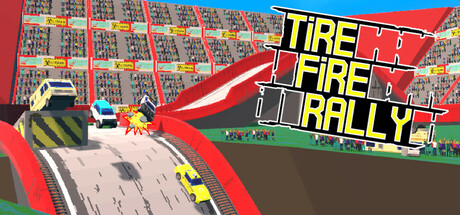
Tire Fire Rally is a wonderfully chaotic arcade racing game that feels like it was built by someone who genuinely misses the era when racing games prioritized absurdity, speed, destruction, and pure fun over realism or competitive precision. Developed and published by Andrew Connelly, the game embraces the spirit of late-1990s and early-2000s arcade racers with complete confidence, delivering a loud, reckless, and intentionally ridiculous experience where every race feels seconds away from becoming a catastrophic pileup. Instead of trying to imitate realistic simulators or modern open-world racers packed with endless progression systems, Tire Fire Rally focuses entirely on exaggerated track design, unstable vehicle handling, dangerous environmental hazards, and nonstop arcade energy. The result is a low-budget indie racer overflowing with personality and charm, even if its limited content and rough mechanical edges occasionally prevent it from fully reaching the greatness of the classics that inspired it.
From the very beginning, Tire Fire Rally establishes itself as a game completely unconcerned with realism. The tracks are absurdly dangerous, the vehicles feel barely roadworthy, and the rival drivers behave as though every race is a desperate attempt to survive rather than a professional sporting event. The game’s entire world operates on exaggerated arcade logic where giant ramps, loop-de-loops, collapsing obstacles, oversized hazards, and impossible road layouts are treated as perfectly normal racing conditions. Every track feels less like an organized circuit and more like a giant death trap designed by reckless engineers who somehow convinced sponsors to finance the event anyway. This absurdity becomes one of the game’s greatest strengths because Tire Fire Rally understands that arcade racing is often at its best when it fully embraces chaos and spectacle instead of realism.
Visually, the game strongly channels the energy of classic PlayStation-era and arcade-cabinet racers through its colorful low-poly aesthetic and exaggerated environmental design. The retro-inspired visuals are not technically advanced, but they fit the game’s personality perfectly. Bright colors, chunky vehicle models, oversized track hazards, and intentionally stylized environments all contribute to the nostalgic feeling that Tire Fire Rally could have existed as a forgotten arcade cabinet sitting in the corner of a loud racing arcade decades ago. The visuals constantly reinforce the game’s identity as an unapologetically arcade-focused experience where style, chaos, and excitement matter far more than graphical realism.
One of the game’s most enjoyable qualities is how much personality exists within the tracks themselves. Every race course feels intentionally built around creating memorable disasters and dramatic moments rather than simply testing driving precision. Giant ramps launch cars into the air unexpectedly, collapsing obstacles force players to react instantly, and ridiculous environmental hazards constantly threaten to completely destroy the flow of the race. Certain tracks almost resemble amusement park rides more than racing circuits because the game prioritizes spectacle above everything else. Surviving the environment often becomes just as important as actually beating opponents to the finish line. This exaggerated design philosophy keeps races exciting even when the core mechanics themselves remain relatively simple.
The driving mechanics sit comfortably between accessible arcade racing and deliberately unstable chaos. Vehicles respond quickly enough to remain enjoyable, but the handling constantly feels loose, slippery, and unpredictable in ways that support the game’s reckless atmosphere. Drifting around corners, bouncing off walls, scraping through obstacles, and recovering from collisions become regular parts of every race. Clean driving rarely lasts long because the tracks and AI opponents constantly create situations where disaster feels inevitable. Instead of punishing players harshly for losing control, the game embraces those moments and turns them into part of the entertainment. Massive crashes, near misses, and chaotic pileups often become more memorable than the actual race results.
The AI opponents contribute heavily to this chaotic energy. Rival racers drive aggressively, recklessly, and sometimes almost suicidally, behaving less like professional competitors and more like exhausted maniacs barely holding their vehicles together. Opponents crash into obstacles, slam into walls, accidentally block sections of the track, and frequently create unpredictable chain reactions that force players to improvise constantly. The AI may not be sophisticated from a technical perspective, but its unpredictable behavior gives races an entertaining sense of instability. Every race feels alive because the other drivers are constantly causing new problems rather than simply following clean racing lines mechanically.
Vehicle variety also helps reinforce the game’s comedic and nostalgic identity. Players unlock a range of bizarre and intentionally impractical cars inspired by exaggerated arcade racer traditions and childhood fantasy vehicles. Some cars feel powerful and stable, while others appear almost intentionally terrible in ways that make them fun to experiment with. The differences between vehicles are not incredibly deep mechanically, but the strange designs and exaggerated personalities attached to them help maintain the game’s arcade spirit. Unlocking new cars feels rewarding largely because players are curious to see what ridiculous machine the game introduces next.
The soundtrack deserves praise because it perfectly complements the game’s chaotic atmosphere. Loud energetic music, exaggerated engine noises, screeching tires, and explosive crash sounds all contribute to the feeling of participating in a reckless outlaw racing event where destruction is practically encouraged. The audio design is intentionally exaggerated and arcade-like rather than realistic. Crashes sound dramatic, environmental hazards feel dangerous, and every race maintains a loud energetic momentum that constantly pushes the player forward. The game clearly understands the importance of audio in maintaining arcade racing excitement.
One particularly admirable aspect of Tire Fire Rally is the clear passion behind the project. Andrew Connelly openly discussed the challenges involved in developing the game and acknowledged that the original vision was much larger and more ambitious than what was ultimately possible within the realities of indie development. Inspired heavily by classic racers like Hydro Thunder and Cruis’n USA, the game began as a much bigger concept before being scaled down into a smaller but more focused arcade experience. Instead of abandoning the project or trying to disguise its limitations, the developer leaned into the smaller scope while maintaining the game’s personality and arcade identity. That honesty gives the project a certain sincerity that makes it easy to appreciate even when its flaws become obvious.
For players who grew up loving reckless arcade racers and miss the era when racing games prioritized fun, spectacle, and destruction over realism, Tire Fire Rally offers an entertaining and surprisingly memorable experience filled with giant jumps, ridiculous hazards, unstable vehicles, and wonderfully stupid racing chaos. Its limited content, rough physics, and low-budget presentation prevent it from becoming a modern arcade racing masterpiece, but the game’s humor, personality, and commitment to pure arcade fun still make it stand out within the indie racing scene. The experience ultimately succeeds because it understands a simple truth that many modern racing games forget: sometimes the most entertaining races are the ones where absolutely everything goes horribly wrong at high speed.
Rating: 7/10