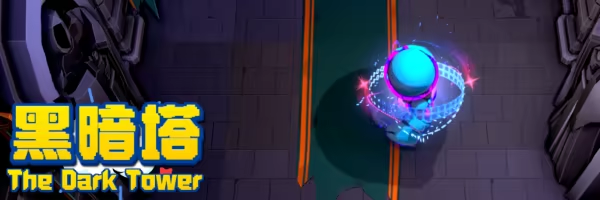
The Dark Tower is an independent roguelike action game developed and published by Qiao Yuancheng that combines procedural progression, dungeon exploration, and fast-paced combat into a challenge-driven experience built around persistence and adaptation. Instead of focusing on story-heavy presentation or cinematic moments, the game places nearly all of its attention on gameplay systems designed to reward learning and experimentation. Every attempt inside its dangerous tower becomes part of a larger process of improvement, creating a structure where failure is expected and progress comes through mastery.
The central concept revolves around surviving and navigating a mysterious tower filled with traps, enemies, and unpredictable obstacles. The environment itself acts as the game’s primary challenge. Advancement depends less on numerical progression and more on understanding how the tower operates. Enemy placement, environmental hazards, and procedural elements ensure that players cannot rely entirely on memorization. Each run presents situations that require adaptation, reinforcing the roguelike design philosophy that defines much of the experience.
One of the game’s more interesting ideas comes through how combat functions. Rather than emphasizing drawn-out encounters or extensive statistics, The Dark Tower focuses heavily on timing and precision. Combat rewards quick reactions and positioning awareness, creating encounters that often feel immediate and demanding. Enemy threats require attention because mistakes carry consequences, especially when progressing deeper into increasingly dangerous sections of the tower.
The faster combat pacing helps separate it from slower dungeon crawlers that depend more heavily on grinding or traditional role-playing progression. Success depends primarily on player skill rather than purely collecting stronger equipment or raising character numbers. The structure creates a stronger sense of personal growth because improvement comes directly from learning enemy behavior and refining movement rather than relying entirely on progression systems.
An additional gameplay layer comes from companion support systems that help diversify how players approach dangerous areas. Rather than navigating the tower entirely alone, players gain assistance that influences survival and progression. Combined with enemy encounters and environmental hazards, these mechanics help create greater gameplay variety while supporting the larger focus on adaptation and resourcefulness.
Exploration plays an equally important role throughout progression. Maze-like layouts and dangerous environmental design encourage players to approach movement carefully rather than rushing recklessly toward objectives. The tower itself feels hostile and unpredictable, reinforcing tension across repeated attempts. Learning layouts and understanding environmental threats gradually becomes just as important as mastering combat systems.
Procedural generation also strengthens long-term replayability. Repetition naturally becomes part of the roguelike experience, but randomized elements help prevent repeated attempts from becoming completely predictable. This unpredictability helps maintain tension and creates satisfying moments where experience gained from previous failures directly improves future performance.
Visually, The Dark Tower remains relatively modest while supporting gameplay effectively. Independent development limitations remain visible throughout presentation, but the artistic direction prioritizes readability and atmosphere over technical complexity. The darker visual tone complements the dangerous nature of the tower itself, helping establish a consistent identity without distracting from gameplay systems.
The atmosphere benefits from simplicity as well. Rather than overwhelming players with visual effects or excessive detail, the game keeps attention centered on survival and progression. The result feels focused rather than limited. The presentation aligns naturally with the game’s philosophy of prioritizing challenge and mechanical improvement over spectacle.
Pacing remains one of the stronger aspects of the experience. Roguelike games depend heavily on maintaining momentum between failure and improvement, and The Dark Tower handles that progression loop effectively. Every unsuccessful attempt still contributes knowledge that becomes valuable later. Players slowly develop stronger understanding of enemy behavior, environmental danger, and movement strategy. That gradual learning process creates satisfying long-term progression.
However, the game’s strengths may also create limitations depending on player preference. The Dark Tower commits fully to difficult progression and repeated experimentation. Players who prefer heavily guided experiences or narrative-focused gameplay may find the structure less engaging. Roguelike repetition remains central to the experience, and enjoyment depends heavily on whether players appreciate learning through repeated attempts.
The smaller independent scope also becomes noticeable across overall content variety. Players expecting expansive systems or large-scale progression mechanics may occasionally encounter simplicity that feels limiting over extended play sessions. The game focuses tightly on challenge and survival rather than broader ambition.
What ultimately helps The Dark Tower succeed is commitment to its identity. Qiao Yuancheng clearly designed the experience around persistence, mastery, and mechanical growth rather than accessibility or cinematic presentation. It understands its audience and builds every major system around rewarding improvement.
For players who enjoy procedural dungeon crawlers and skill-driven progression systems, The Dark Tower offers a rewarding challenge built around experimentation and perseverance. It may not reinvent roguelike fundamentals, but it delivers a focused experience that captures the satisfaction of overcoming difficulty through patience and mastery.
Rating: 7/10