Can you really take over the world with a sandwich? Short answer... MONEY IS EVIL!
Revenue comes from in-game items and microtransactions, which our price-based model doesn't estimate. Copies below reflect the player base, not paid sales.
Media

About


Genres
Stats
Languages: English
Engagement
Reviews
Themes across 40 recent reviews and how positive each mention is. A keyword signal, not full sentiment analysis.
Reviews
...
Complete waste of time. Came back on my third day after being gone. Telling me that I am banned. Play anything else but this complete dump.
Related
Related
Trends
Concurrent players on Steam, sampled daily since tracking started.
Hours played at review time, across 40 reviews with recorded playtime.
positive critical· bar length = how often the theme comes up
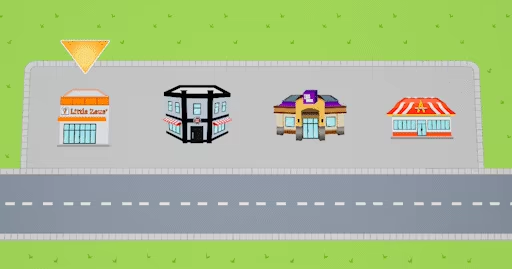
免费 有成就 没中文 超级人生:连锁大亨 《超级人生:连锁大亨》是一款连锁店铺经营放置类游戏,世界观延续自《超级人生 RPG》,采用挂机成长玩法体系。 声明:本游戏专为移动设备设计,在安卓或 iOS 平台体验最佳。 可经营品牌: 小宙斯 Slimmy Sam's 塔可盒子 安格斯麦邦格斯 (非实际游戏画面) 游戏内容 从小规模起步,通过升级设备、研发新菜品来提高收益。 亲自接单,或雇佣员工全权代劳;你只需处理客诉与工伤事故。 解锁员工福利,招募更优秀的员工;提升员工等级,让店铺运营更省心。 在农场养殖牲畜用于屠宰,或从农贸市场商贩处采购新鲜食材。 购买(或 “顺手拿走”)亚马逊箱子,获取助力运营的道具,或是让对话偏向对你有利的方向。 摇钱树回归,作为游戏内多重每日奖励之一。 还能从金币采矿机领取免费金币,完成每日任务获取额外奖励。
*Super Life: Franchise Lord*, developed and published by Klick Ink L.P., takes the familiar framework of idle and incremental games and wraps it in a business simulation that is equal parts casual management and tongue-in-cheek satire. Rather than aiming for a deeply technical or realistic portrayal of running a company, the game focuses on the addictive cycle of growth, automation, and profit, presenting the rise of a franchise empire in a way that is intentionally exaggerated and often darkly humorous. The gameplay begins on a very small scale, placing players in direct control of daily operations. Early on, progress requires constant interaction—serving customers, managing basic production, and carefully allocating limited resources. This hands-on phase is crucial because it establishes the rhythm of the game while making each upgrade feel meaningful. As profits begin to accumulate, the experience gradually shifts toward automation. Hiring employees, upgrading equipment, and streamlining processes allow the business to run with increasing independence, transforming the player’s role from active worker to strategic overseer. This transition is satisfying and mirrors the broader appeal of idle games, where the reward comes from watching systems evolve and operate efficiently on their own. What gives *Super Life: Franchise Lord* a bit more personality than typical clicker-style titles is its tone. The game leans into absurdity and doesn’t shy away from presenting morally questionable or outright ridiculous scenarios as part of its progression. Whether it’s the way resources are handled or the kinds of “opportunities” that arise during expansion, there’s a clear sense that the game is poking fun at the idea of unchecked business growth. This humor helps keep the experience from feeling too mechanical, adding a layer of entertainment that goes beyond simply increasing numbers. In terms of mechanics, the game adheres closely to genre conventions. Progression is driven by unlocking upgrades, improving efficiency, and reinvesting profits into new systems that accelerate growth. There is a steady sense of forward momentum, especially in the early stages when each new feature noticeably changes how the game plays. However, as the empire grows larger, the experience becomes more about optimization than discovery. The core loop remains largely unchanged, and while this consistency can be relaxing, it also means that players looking for evolving gameplay systems may find the later stages less engaging. The visual and interface design reflects the game’s overall philosophy: simple, functional, and easy to navigate. The presentation does not aim to impress with detail or complexity, but it succeeds in keeping information clear and accessible. Menus are straightforward, and tracking progress is intuitive, which is important in a game where players are frequently managing upgrades and monitoring performance. This simplicity makes it easy to jump in and out of the game, reinforcing its suitability for short, casual play sessions. One of the more notable aspects of the game is how it balances active and passive play. Players can choose to engage directly with the mechanics or let the automated systems handle most of the work, checking in periodically to make adjustments. This flexibility is one of the game’s strengths, as it accommodates different playstyles and time commitments. However, it also highlights one of its limitations: once automation is fully established, the need for player input diminishes significantly, which can reduce the sense of involvement over time. Replayability is primarily driven by the desire to optimize and refine strategies rather than to experience new content. There are opportunities to experiment with different upgrade paths and approaches to growth, but the overall structure remains consistent. Without major variations in gameplay or narrative elements, the motivation to restart or revisit the game depends largely on how much the player enjoys the incremental progression itself. Ultimately, *Super Life: Franchise Lord* is a game that understands its niche and delivers a focused experience within it. It doesn’t attempt to compete with more complex management simulations, instead offering a lighter, more accessible take on building a business empire. Its combination of steady progression, automation, and playful humor makes it easy to engage with, even if it doesn’t provide the depth or variety needed for long-term immersion. For fans of idle and incremental games, it offers a satisfying and occasionally amusing journey through the absurdities of franchise expansion. Rating: 6/10
soooooooooooooooo fun
haha funni
Moneh ♥️
It is an okay casual game that you can play without really any thought. It is good to spend time on and just let it run in the background.
An idle game that rewards the player by playing other than clicking a button. Wish there was more, though.
Audience
Estimated from the language of this game's reviews — a proxy for where players are, not official Steam demographics.