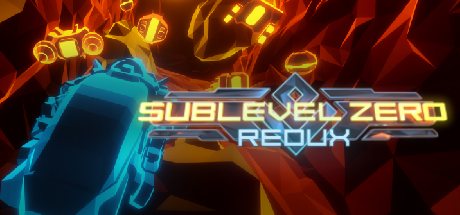
Sublevel Zero Redux is a roguelite six-degree-of-freedom shooter in a universe where reality is falling apart. Use your zero-g gunship to fight through a vast underground facility, looting advanced weapons to destroy hordes of deadly enemies.
Modeled estimate, not a reported figure. How we estimate →
Media

About
Stats
All-time low is the lowest price we've recorded for this game since we started tracking it.
Languages: English, French, Italian, German, Spanish - Spain, Russian
Engagement
Hours played at review time, across 41 reviews with recorded playtime.
Reviews
Themes across 41 recent reviews and how positive each mention is. A keyword signal, not full sentiment analysis.
positive critical· bar length = how often the theme comes up
Reviews
Terrible, absolutely terrible.
Kul och extra svårt om man spelar med tangentbord.
Pretty fun
Sublevel Zero Redux is a distinctive blend of six-degrees-of-freedom shooting and roguelike exploration that immerses players in a disorienting, yet exhilarating, descent into a collapsing universe. Developed and published by Sigtrap, the game expands upon the classic foundation of titles like Descent and Forsaken, reimagining that free-form, zero-gravity combat with modern visuals, procedural generation, and a layer of roguelike progression. At its heart, it places players inside the cockpit of a nimble gunship navigating labyrinthine complexes, scavenging technology, battling autonomous drones, and racing against the inevitable decay of reality itself. Every mission feels like a daring expedition into chaos, where spatial awareness, reflexes, and resource management become vital to survival. The first impression Sublevel Zero Redux makes is overwhelmingly atmospheric. The world around the player is a fusion of industrial corridors, pulsating neon chambers, and vast caverns that shimmer with synthetic light. Its visual style is sharp and deliberate, combining low-poly retro design with vibrant particle effects that give every explosion and thruster flare a sense of kinetic energy. This visual presentation is elevated by a soundtrack that pulses with electronic intensity, providing a rhythmic companion to the player’s frantic maneuvers. The echo of plasma fire and the hum of engines resonate through the metallic tunnels, creating an immersive audio environment that captures the essence of deep-space combat with remarkable precision. The gameplay loop is simple to grasp but deceptively demanding. Each descent begins with a procedurally generated map that forces players to adapt their strategy on the fly. They must seek out reactor cores buried deep within complex networks of rooms, defeat the mechanical hordes that guard them, and gather the precious components scattered along the way. Combat is fast and multidirectional, with enemies attacking from every conceivable angle, making constant movement and situational awareness crucial. The player’s arsenal grows through scavenging and crafting, a system that allows for experimentation but also introduces risk, as using resources for upgrades may leave one short of ammunition or vital materials. This balance of creation and consumption ensures that every decision carries tangible consequences, especially in a game where death resets progress. Sigtrap’s integration of crafting and ship customization adds an element of long-term progression that complements the high-intensity action. Weapons, hulls, and modules can be built, fused, and enhanced, creating subtle differences in playstyle from one run to another. While not every blueprint or upgrade feels transformative, the satisfaction of gradually improving one’s ship remains a steady incentive. Players who take the time to master the mechanics find themselves rewarded with deeper runs and more efficient navigation through the maze-like environments. However, repetition eventually sets in as certain level layouts and enemy formations begin to recur, reminding the player of the game’s reliance on pre-assembled room structures rather than fully dynamic procedural complexity. Despite this, the thrill of piloting a ship that can roll, strafe, and dive freely through three-dimensional space continues to provide moments of exhilaration that few games can replicate. The control system is both a source of empowerment and challenge. True to its heritage, Sublevel Zero Redux demands complete mastery of six-directional movement, and for newcomers, the initial hours can feel like a fight against the ship itself. The sense of freedom is intoxicating once mastered—players can twist through narrow tunnels, flip upside-down in pursuit of foes, and dodge through debris with seamless precision—but this freedom also punishes hesitation and confusion. In VR mode, the immersion intensifies to near vertigo-inducing levels, fully placing the player in the cockpit of chaos. The Redux version refines the handling and adds options for comfort, but the learning curve remains steep, preserving the authentic challenge of 6DOF navigation. From a design perspective, Sublevel Zero Redux excels at maintaining a consistent tone of isolation and tension. There are no allies, no safe zones, and no moments of rest—only the quiet hum of your ship between battles and the distant alarms of a world tearing itself apart. This oppressive solitude reinforces the game’s roguelike core, where each failure feels personal and every small victory feels hard-earned. The procedural generation, though imperfect, ensures that no two runs are exactly alike, and even familiar layouts become arenas of improvisation as enemy spawns and loot drops shift unpredictably. This constant variation encourages cautious exploration and keeps players alert, preventing the experience from descending into monotony too quickly. While the game has its share of limitations, its artistry and mechanical depth are undeniable. The environments can feel repetitive after many hours, the enemy roster could benefit from greater diversity, and the crafting system, while functional, sometimes lacks the depth necessary to fully sustain long-term engagement. Yet these shortcomings are balanced by the fluidity of combat and the raw satisfaction of mastering flight and precision shooting in a fully three-dimensional arena. Every skirmish, every evasive roll, and every reactor explosion contributes to a rhythm that is both chaotic and methodical, testing not only reflexes but also spatial intuition and resource awareness. Ultimately, Sublevel Zero Redux stands as a rare hybrid—part retro homage, part modern experiment—that succeeds in rekindling the excitement of true six-degrees-of-freedom combat within a roguelike framework. Its presentation, sound design, and intense moment-to-moment gameplay form a cohesive experience that rewards persistence and skill. Though its procedural elements and upgrade systems show their seams over time, the game’s core remains compellingly unique. For players craving an old-school challenge wrapped in a sleek, modern shell, it offers an experience that is as exhilarating as it is unforgiving, proving that even in a collapsing universe, there is beauty in the struggle to survive one more descent. Rating: 8/10
Excellent, claustrophobic, a pivotal 6dof blaster for the genre.
very cool
yes.
Fun game but soft locks every stage change.
Like running around the house at full speed, blindfolded, lights off with two broken toes and a broken nose. Just couldn't see the point and can't find the fun.
This easily became my favorite 6DoF game after Descent 1, despite having only superficial ties to that classic series. Rather than an exact successor to the Descent genre, they used that type of FPS gunship combat setting to create an early member of the roguelike field with procedural generated levels and quality gameplay where just minor flaws stick out. Anyone with experience in 6DoF combat should be able to immediately jump in and start flying through the 3 – 6 levels of a run looking for lore and parts, unlocking more crafting blueprints and starting classes and enemy info after runs. The music and movement speed and projectile dodging gives a dance-like feel, a ballet of bullets and missiles and beams where the only thing preventing you from escaping every attack is your own skill and some degree of enemy knowledge. At the easiest difficulty, I completed almost every run and had a great time, while at the hardest, any mistake could be fatal and I had to take every precaution even with an excellent build. Weapons are split into two categories, guns and launchers. The former tend to be faster and with plentiful ammo, while the latter are likely to have an area of effect and rarer ammo. Two of each can be equipped, which allows for quick swapping with toggles. Both guns and launchers have three types of ammo (for six types overall) so it's good to have a backup weapon of a different ammo type in case you run out of another. Almost every weapon feels different and satisfies various kinds of spectacle entertainment, with enough to keep runs distinct (though they could have used more launchers) but not so many that you forget which is which. Engines and hulls are a bit more basic while affecting the stats of your ship. Hulls change your total health, your ammo pools and your inventory space. Engines affect your normal speed, your boost speed and how much damage you do when ramming foes. After starting a run with standard equipment, you find parts which emphasize certain stats over others, any of which could become more or less important depending on your build for a run and special boons gained between levels. In addition to simply finding parts on a run, you can also melt certain parts together with nanites. Every part is classified by 3 tiers (you combine two lower-tier parts to get one higher tier) and most have unique stats and modifiers which can be positive, negative or mixed. When you combine parts, they keep the better stats while averaging out modifiers, which gives you a reason to find room in your limited inventory for every good item you find. I ended up making myself a quick reference sheet of part tiers and recipes so I'd know which to hold onto. The background story is dark and intriguing, featuring a shattered futuristic apocalypse universe where wormholes open up randomly across known space and steal bits of worlds. People have been reduced to scattered warring tribes, and you are one of their scouts. After being pulled into a mysterious “flux research” space station filled with angry robots, you search for the the heavily defended reactor cores which contain components you need to escape, and along the way discover clues to what happened. So overall this is a game about flying freely through a series of rooms, destroying robot guards and opening chests to gain better equipment until you reach the reactors. On the positive side, that's a very addictive loop for anyone who enjoys this kind of gameplay. But on the negative side, the experience can feel thin after a few runs as everything starts to look the same. Unlike later roguelikes which give you reasons to keep playing like permanent buffs or unlocked customization at a home base, all you get from this is the satisfaction of survival and more entries in the enemy codex. I was left wanting more rewards for successful runs, not just more challenge. Losing a run and being told that I just unlocked even more dangerous foes is rough. Higher difficulties get very tense but mostly what you bring to them is knowledge, along with some interesting starting classes with modifiers such as half hitpoints and better nanite collecting, deadly slow speed and higher accuracy, or burning plasma excellence. I would have liked a “Custom” ship class which could start runs with a basic boon kept from a previous successful run, suggesting that my wins were affecting the world. The deadly dance of combat has you constantly pulled in by rewards and pushed back by danger. Foes burst into confetti clouds of ammo and nanites, forcing you to get there quickly before the important stuff vanishes, but not so quickly that you take damage from their explosion or run into minefields. I often wished the pickup range was longer. Naturally the enemies are happy to have you come close chasing goodies rather than shooting from a safer distance. Fights boil down into four types: a few foes clearly not ready for you, or frantic flying in small spaces while managing too many all at once, then the optional mini-boss “trap chest” rooms where rewards may not be worth the risk, and finally the “boss fights” against reactors with ever-greater defenses that become stale tests where you know the answers. Nothing is bad and the procedural generated levels and enemy placement can sometimes combine for a fun room, but mostly they feel ordinary. Speaking of the procedural generated levels, they string together rooms like puzzle pieces into chaotic sequences, like a magma tube or crystal cave connected to a shiny sci-fi lab or a reactor room. Sometimes you'll get a long set of rooms with no choices to make, or you'll get splitting paths with helpful teleport spheres at the dead ends. The few locked doors and colored keys seem entirely unnecessary, more a callback to Descent and other shooters than anything else; keys work best in handcrafted levels, after all. In summary, I enjoyed my time with this great game despite feeling its procedural generated nature was limiting the upper range of fun. Be prepared for a tough challenge at the high difficulty, give every ship class and weapon a try, and try to get every achievement before dying 100 times. Too bad they never got to create the sequel which the finale hints toward.
Related
Related
Trends
Modeled estimate over time, reconstructed from Steam's monthly review histogram.
Momentum
Pace estimated from the game's recent review growth (our daily snapshots) at its own sales-per-review ratio — a momentum signal, not booked sales.
Audience
Estimated from the language of this game's reviews — a proxy for where players are, not official Steam demographics.
Related
| Dead Secret | $159.2K | 596 | 81% | $14.99 |
| Spooky Starlets: Movie Monsters | $159.2K | 545 | 66% | $9.99 |
| Battle Royale Tycoon | $159.2K | 516 | 69% | $9.99 |
| Bone's Cafe | $159.1K | 363 | 96% | $14.99 |
| The MISSING: J.J. Macfield and the Island of Memories | $159K | 1.2K | 88% | $5.99 |
| Junji Ito Maniac: An Infinite Gaol | $159.3K | 699 | 79% | $11.99 |