Steel Defence is a tactical twin-stick roguelike where defeating a boss changes the arena's geometry. Build a loadout from 4 weapon classes, upgrade your mech with microchips, and adapt to survive when the solid ground suddenly becomes an abyss.
Modeled estimate, not a reported figure. How we estimate →
Media

About
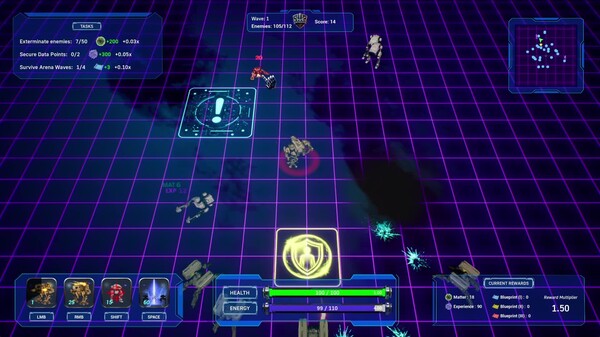
Steel Defence has no one-button gameplay or randomly generated "broken" builds. It's a twin-stick shooter for those who value balance, battlefield control, and a fair challenge. The game keeps you on your toes not just with hordes of enemies, but with the level geometry itself, forcing you to think on your feet.
Key Features:
Shifting Arena: Runs are built in cycles: three enemy waves, followed by a boss fight. After defeating each boss, the level geometry changes drastically. What was a convenient maneuvering space in the last stage can turn into a deadly abyss. You'll have to adapt your tactics and re-learn the battlefield before each new stage.
Tactical Arsenal Without the Clutter: The game features 16 weapons strictly divided into 4 categories: Primary, Secondary, Tactical, and Global. You can only equip one weapon from each group at a time, forcing you to thoughtfully select your loadout for specific tasks.
Fine-Tuning with Microchips: Weapons are upgraded not by random buffs, but through a flexible chip system. Unlock blueprints, earn experience, and install up to four chips (of three power levels) into each gun to tailor it to your playstyle.
Workshop: Death is just a reason to return to base. Collect matter during runs to invest in permanent mech upgrades: increase base stats and unlock new weapon slots.
Multi-Phase Bosses: Bosses do not forgive mistakes. They combine different attack patterns and summon minions, forcing you to use your entire arsenal and constantly control your position on the arena.
Stats
All-time low is the lowest price we've recorded for this game since we started tracking it.
Languages: English, Russian, French, German, Spanish - Spain, Spanish - Latin America, Simplified Chinese, Korean, Polish, Portuguese - Brazil, Portuguese - Portugal, Japanese
Reviews
The game offers a decent survival experience but is limited, featuring only one map, one boss, a single mech, no unlockables, and progression that relies heavily on repetitive grinding. Compared to many similar games in the genre, this one is quite minimalist in terms of character selection and customization. You’re given only a single default character, or mech, to play with. The only customization available comes at the very start, when you choose one of three initial skills: a grenade, a spinning disc, or a laser. Each of these abilities has its own distinct properties and stats, offering a slightly different playstyle. However, once you pick one, you’ll likely stick with it for every single run. Personally, I favor the grenade because it boasts the fastest fire rate and area damage. After selecting your starting skill and difficulty level, which initially defaults to easy, with the higher levels needing to be unlocked, you are placed on a simple map with a straightforward objective: survive until the timer runs out and then defeat the boss. The difficulty level determines both the strength of the enemies and the amount of time you have to survive, but there are no unique mechanics introduced as the difficulty scales. Essentially, the gameplay loop revolves around moving around the map, firing at incoming enemies, collecting the experience they drop, and filling up your level-up bar. Leveling up works in the classic fashion. Each time you gain a level, you choose one benefit from a random selection of three options. These benefits can range from a new weapon to support abilities that enhance either your offensive or defensive capabilities. You can even select the same upgrade repeatedly to increase its effectiveness. This choice is particularly important because, aside from your starting skill, you are limited to only four additional benefits per run. Unlike the starting skill, which you must actively use, these additional skills trigger automatically once their cooldowns expire. Your starting skill also has a cooldown period, and combined with the game’s generally slow pace, it can take several seconds before you can use it again. Because of this, it’s often advantageous to focus on area-of-effect abilities, such as spinning discs or EMP blasts. Prioritizing the development of your starting skill is also crucial because neglecting it early on will make progress extremely difficult. Beyond experience, certain enemies drop helpful items. Regular foes may drop health, magnets that attract experience orbs, or stat-boosting items for your mech, which can enhance speed, collection rates, or even provide an extra skill slot. Stronger enemies, often functioning as mini-bosses with separate health bars, drop superior rewards, such as skill upgrades. These upgrades significantly alter an ability’s behavior; for example, a laser skill might gain two extra beams, or ally mechs spawn with rocket launchers. In addition to experience, enemies also drop the game’s currency, called matter. Whether you die or win, you return to the main menu, where matter can be spent in the workshop on permanent upgrades. These upgrades give you a better chance of surviving subsequent runs, but your choices are limited to five options at a time, and unlocking higher-tier upgrades requires winning rounds. Unfortunately, these upgrades generally offer only marginal improvements and are quite costly. Investing in speed upgrades early is essential because your mech moves slowly, which is a major factor in early deaths. The combination of slow movement and long skill cooldowns makes it difficult to evade enemies or their projectiles, a problem that worsens on higher difficulties due to faster enemies. As a result, you are forced to grind on easier levels to purchase enough speed upgrades to survive more challenging runs. Overall, the game provides a decent survival experience, but it feels limited in scope. With only one map, one boss, and a single playable mech, the content is sparse. There are no unlockables, and progression often feels gated behind repetitive grinding.
Way too tedious and slow, AI usage in the graphics and 1 map with 1 boss, even though the price is just about 2 euros; I wouldn't recommend putting your time into it personally.
Steel Defence is an action roguelike developed and published by Storytime Games that combines mech-based combat with strategic progression and dynamic battlefield design. While the genre is filled with games that focus on endless enemy swarms and increasingly outrageous power combinations, Steel Defence takes a more methodical approach. It emphasizes tactical decision-making, adaptation, and careful build construction, creating an experience that rewards planning as much as quick reflexes. Players take control of a heavily armed combat mech tasked with surviving relentless waves of hostile machines and powerful bosses. The premise is straightforward, but the execution introduces enough unique ideas to make the journey feel distinct. Every run begins with a modest arsenal and limited resources, gradually expanding into a more powerful and specialized build as players earn upgrades and discover new tactical possibilities. The core loop is instantly recognizable to fans of the roguelike genre, yet several mechanics help the game establish its own identity. The most notable feature is the evolving battlefield system. Rather than keeping arenas static from beginning to end, Steel Defence transforms the combat zone after major encounters. Defeating a boss can dramatically alter the map, changing pathways, removing safe areas, and creating entirely new tactical considerations. This mechanic ensures that players cannot rely solely on memorization or repetitive movement patterns. Every transformation forces a reassessment of strategy, making survival dependent on adaptability rather than routine. It is a clever concept that keeps matches feeling fresh and unpredictable. Combat itself strikes a satisfying balance between accessibility and depth. Movement remains responsive, weapon attacks feel impactful, and enemy encounters encourage constant repositioning. Success depends on understanding the strengths and weaknesses of your loadout while reacting to increasingly dangerous threats. Enemy variety contributes significantly to the pacing, with different units requiring different approaches. Some adversaries overwhelm through numbers, while others create hazards that limit mobility or force players into uncomfortable positions. This variety prevents battles from becoming repetitive and encourages experimentation with different tactics. A particularly strong aspect of the design is the weapon system. Instead of allowing players to collect an excessive number of tools simultaneously, Steel Defence organizes equipment into distinct categories. Players must choose carefully which Primary, Secondary, Tactical, and Global weapons they wish to bring into battle. This limitation creates meaningful decisions throughout a run. Every new acquisition represents a trade-off, encouraging players to build around specific strategies rather than simply stacking power indiscriminately. The result is a system that feels more deliberate and balanced than many comparable roguelikes. The microchip enhancement system further expands customization. Weapons can be upgraded through various modifications that alter performance and effectiveness, allowing players to tailor their mech to preferred playstyles. Whether focusing on raw damage output, improved survivability, or specialized tactical advantages, the upgrade system provides flexibility without becoming overwhelming. Progression feels rewarding because improvements are tied to player choices rather than pure randomness, creating a stronger sense of control over each run. Boss encounters serve as the centerpiece of the experience. These battles demand more than simple firepower, often requiring players to recognize attack patterns, manage positioning, and make efficient use of their equipment. The challenge feels fair because victories are typically earned through understanding mechanics rather than exploiting loopholes. Defeating a boss is satisfying not only because it marks progress but also because it directly influences how the battlefield evolves moving forward. This connection between boss fights and arena design helps make progression feel meaningful and interconnected. Outside of individual runs, Steel Defence includes a persistent progression system through its Workshop mechanics. Resources collected during gameplay can be invested into permanent improvements, unlocking new opportunities and enhancing future attempts. This structure gives players a sense of long-term advancement even after failure. Each defeat contributes toward future success, encouraging repeated experimentation while maintaining the addictive “one more run” appeal that defines the best roguelikes. Visually, the game adopts a clean science-fiction aesthetic centered on mechanical warfare. The presentation prioritizes readability, ensuring that enemy attacks, projectiles, and environmental hazards remain visible during hectic battles. While the graphics may not push technical boundaries, they effectively support the gameplay and maintain a consistent futuristic atmosphere. Explosions, weapon effects, and battlefield transformations provide enough visual excitement to keep combat engaging without distracting from strategic considerations. Steel Defence is ultimately at its best when it challenges players to think. Rather than relying on excessive randomness or overpowered combinations, it encourages adaptation, experimentation, and mastery of its systems. The changing arenas, structured weapon choices, rewarding progression, and demanding boss encounters work together to create a roguelike experience that feels focused and thoughtfully designed. It may not reinvent the genre entirely, but it introduces enough fresh ideas to stand out among countless competitors. For players who enjoy action roguelikes that reward strategic planning as much as mechanical skill, Steel Defence offers an engaging and satisfying experience. Its combination of evolving battlefields, meaningful customization, and intense mech combat creates a gameplay loop that remains entertaining across multiple runs. The game demonstrates a strong understanding of what makes the genre compelling while adding its own distinctive twist through environmental transformation and tactical depth. Rating: 6/10
Интересный рогалик с элементами прокачки и возможностью массово уничтожать надоедливых механических захватчиков. Визуально приятно, управление простое и понятное, можно комбинировать различные виды вооружения для своего стиля игры. Получение ресурсов на миссиях позволяет прокачивать различные перки и модули для усиления своего робота, открывая больше возможностей, а таблица лидеров запоминает самых стойких бойцов. Последнее крупное обновление сильно изменило игру и привнесло значительную переработку различных механик, а так же затронуло множество других игровых аспектов, что положительно сказалось на игровом процессе в целом. Некоторые элементы баланса, все еще требующие корректировки, а так же мелкие недоработки активно исправляются выходящими патчами.
Ультроразъеб
БОЛЬШЕ РОБОТОВ! И ЕЩЕ БОЛЬШЕ РОБОТОВ! ДАВАЙ ЕЩЕ РОБОТОВ! В целом бодро, но хотелось бы быстрее. С удовольствием гонял бы на портативе.
Хорошая игра, зацепило, но контента маловато, жду обновлений
Прикольная игрушка .В начале сложновато но с уровнем и прокачкой становится все интереснее .Отличный саундтрек
Прикольный рогалик. Вау эффекта не производит, но своих денег стоит. Приятная музыка и визуал, интересная задумка с прокачкой. Надеюсь в будущем будет больше контента.
For the price it's ok. nothing glamorous, but it's good enough. It is basically mech vampire survivors except with one map. I'll update as i play more.
Related
Related
Trends
Concurrent players on Steam, sampled daily since tracking started.
Related
| Glasses and Girls | $315.6 | 51 | 82% | $0.99 |
| Bongo Quest | $315.6 | 51 | 45% | $0.49 |
| Food and Girls | $315.6 | 51 | 86% | $0.99 |
| Dances and Girls | $322 | 52 | 83% | $0.99 |
| Anime Sunset Ride | $334.4 | 54 | 67% | $0.49 |
| Carnival and Girls | $334.4 | 53 | 85% | $0.99 |