SpyHack is an indie stealth and espionage game developed by Pyramid Games and Art Games Studio S.A. and published by Art Games Studio S.A., set in a futuristic world where technology and corporate power dominate society. It places players in the role of an agent from the Advanced Technology Division (ATD), working to uncover and dismantle a secretive organization called The Dome Ltd. that threatens the balance of human civilization. The game’s setting evokes a near-future cyber dystopia filled with surveillance, drones, and hidden agendas, where intelligence and patience take precedence over brute force. The premise carries promise, suggesting a mix of stealth, hacking, and investigation that would appeal to fans of classic cyber-espionage stories. However, while SpyHack introduces intriguing ideas and a distinctive theme, its execution struggles to deliver a consistent or polished experience.
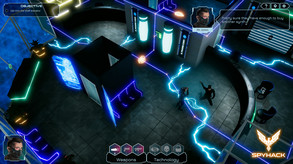
At its core, SpyHack attempts to merge traditional stealth mechanics with environmental hacking. Each mission involves infiltrating high-security facilities, avoiding detection, and using technology to manipulate your surroundings. The player can hack into cameras, control turrets, unlock doors, and access computer terminals to bypass obstacles or neutralize threats. This system encourages strategic thinking, allowing multiple approaches to the same problem—whether disabling an enemy’s defenses from afar or sneaking through unnoticed. The hacking mechanic, while conceptually sound, is not as deep as it could be. Most interactions are simple one-button actions or context-sensitive events rather than fully realized puzzles or code-breaking sequences. Despite this, when the system works, it adds a layer of tension and tactical freedom to the gameplay that helps differentiate SpyHack from more traditional stealth titles.
The stealth aspect of SpyHack relies on observation and timing. Players must monitor guard patrol routes, exploit blind spots, and make use of shadows and cover to stay hidden. Unfortunately, the enemy AI is inconsistent, often swinging between extreme lethargy and sudden omniscience. Guards patrol predictable paths and can sometimes fail to notice obvious movement, while at other times they detect the player through walls or obstructions. These inconsistencies break immersion and make it difficult to develop reliable strategies. When detection occurs, the shift from stealth to combat is abrupt and unrefined, revealing one of the game’s major weaknesses: its action mechanics. Gunplay feels stiff and imprecise, with poor feedback and limited control. The transition from tactical infiltration to firefight strips away the game’s intended tension, replacing it with frustration. It is clear that SpyHack’s strength lies in its quieter moments of observation and infiltration rather than direct confrontation.
Visually, SpyHack adopts a clean but minimalistic aesthetic. Its environments—labs, corridors, and corporate offices—are functional but lack the personality or detail that might make the world feel alive. The lighting design does a decent job of establishing atmosphere, casting long shadows that enhance the feeling of isolation, but textures and models are basic, and animations are often stiff. The visual style communicates the cyberpunk tone well enough, but it also underscores the game’s low-budget limitations. The sound design follows a similar pattern: serviceable but unremarkable. The ambient background music creates a sense of futuristic intrigue, while the sound effects of security systems, typing terminals, and mechanical locks reinforce the high-tech espionage setting. However, the voice acting and dialogue delivery are weak, undermined by awkward pacing and inconsistent localization that make the narrative harder to take seriously.
The story, while ambitious in concept, never truly evolves beyond its introductory beats. The game introduces the idea of The Dome Ltd. as a shadowy corporation conducting experiments that endanger humanity, yet the plot rarely digs into the moral or thematic implications of such a premise. Much of the narrative unfolds through short dialogue exchanges, mission briefings, and computer logs scattered throughout levels. The writing is straightforward and sometimes clumsy, with grammatical errors and stilted phrasing that suggest an underdeveloped translation. As a result, the world and its characters feel underexplored, and the stakes lack emotional weight. SpyHack’s episodic format only compounds this issue, as the game ends abruptly after a handful of missions, leaving the impression of an unfinished experience or proof of concept rather than a complete story.
Technical performance and user experience also suffer from a lack of refinement. The controls feel unresponsive, particularly during critical moments that demand quick reactions. Collision detection is inconsistent, occasionally causing the player character to get stuck on corners or objects. Objectives are sometimes unclear, forcing players to wander aimlessly until they stumble upon the correct path or trigger. These issues, combined with occasional bugs and a lack of mid-mission saves, make progression more cumbersome than it should be. For an experience built around precision and control, these shortcomings significantly diminish the tension and satisfaction that stealth games depend on. It is apparent that the developers had a strong vision of what they wanted to achieve but lacked the resources or technical polish to fully realize it.
Despite its flaws, SpyHack does show glimpses of potential. The idea of merging environmental hacking with stealth is appealing and could form the basis for a more refined and immersive experience. The world-building, though thin, hints at a setting that could support a much richer narrative if given more development time and stronger writing. For players willing to overlook its technical shortcomings, there is a certain charm in its ambition—the desire to bring espionage gameplay into a futuristic, high-tech world. It may not reach the sophistication of genre giants like Deus Ex or Metal Gear Solid, but it demonstrates a creative spark that could evolve into something meaningful with further refinement.
Ultimately, SpyHack is a game that feels caught between concept and execution. It presents a fascinating premise and a set of mechanics that promise depth, but it struggles to deliver on those promises consistently. Its uneven AI, rough combat, simplistic hacking, and underdeveloped story prevent it from achieving the immersive espionage experience it strives for. Yet beneath these issues lies an earnest attempt to innovate within the stealth genre, one that may appeal to players who appreciate experimental indie projects or enjoy dissecting the ideas behind flawed but imaginative games. SpyHack is less a polished espionage thriller and more a blueprint for one—a reminder that even in its imperfection, ambition can be as compelling as execution.
Rating: 4/10