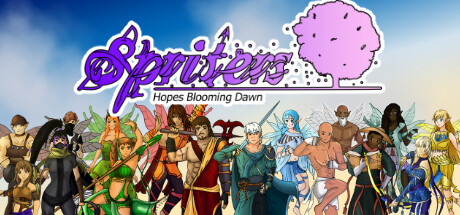
Spriters: Hopes Blooming Dawn is an RPG-style game that takes you on an epic adventure through a world filled with magic, mystery, and danger. Battle dangerous creatures, collect Gems with unique powers, and uncover the mysteries of your past in this engaging and innovative game.
Modeled estimate, not a reported figure. How we estimate →
Media

About
Stats
All-time low is the lowest price we've recorded for this game since we started tracking it.
Languages: English
Reviews
Spriters, Hopes Blooming Dawn, developed by Tusk.ink and published by Andrew Vermeulen, is a modest indie role-playing game that embraces the structure and sensibilities of classic 2D RPGs while introducing a few small twists to differentiate itself. Set in a colorful fantasy world, the game begins with a familiar hook: an amnesiac protagonist awakening in an unfamiliar land, forced to rediscover their identity while gradually uncovering a broader threat that endangers the world around them. While the premise does not stray far from genre conventions, it provides a functional framework for a journey that emphasizes exploration, party-building, and steady progression. The narrative unfolds in a linear fashion, guiding players through a sequence of environments populated by towns, dungeons, and open areas that gradually reveal more about both the protagonist and the overarching conflict. Along the way, the player meets companions who join the adventure, each bringing their own personality and role within the group. These characters add a sense of companionship and help break up the otherwise solitary nature of exploration, though their development remains relatively straightforward. The story focuses more on maintaining a consistent tone and pace than on delivering unexpected twists, relying on familiar fantasy tropes to carry the experience. Gameplay is rooted in traditional exploration and turn-based combat, with players moving through a 2D world, interacting with objects, and engaging in battles to progress. The combat system follows a standard structure but incorporates a rotating party mechanic where characters cycle into battle as others fall. This creates a subtle layer of strategy, encouraging players to think beyond immediate actions and consider how their entire lineup will perform over the course of an encounter. While not a drastic departure from genre norms, this feature adds a small but noticeable sense of continuity to battles, making them feel less static than typical turn-based encounters. Character progression is supported by a system of equippable enhancements that allow players to customize their abilities. These upgrades, tied to items that can be attached to weapons, provide additional effects and encourage experimentation with different combinations. While the system does not fundamentally change how combat operates, it introduces enough flexibility to keep encounters from feeling entirely repetitive. Players can adapt their approach based on preference, whether focusing on offense, defense, or more balanced setups, which adds a layer of personalization to the overall experience. Visually, the game leans into pixel art, presenting its world through colorful, sprite-based environments and characters. The aesthetic evokes a sense of nostalgia, drawing inspiration from older RPGs while maintaining a clean and readable presentation. Although the visuals do not reach the level of highly polished modern pixel art titles, they are cohesive and effective, supporting both exploration and combat without becoming visually overwhelming. The environments are varied enough to maintain interest, even if they do not offer extensive detail or complexity. The audio design complements the visual style with a soundtrack that reinforces the game’s tone. Music shifts appropriately between exploration, combat, and quieter narrative moments, helping to establish a consistent atmosphere throughout the journey. While the compositions may not stand out as particularly memorable, they serve their purpose well, enhancing immersion without distracting from gameplay. Sound effects are similarly functional, providing feedback during battles and interactions without adding significant depth. Pacing is generally steady, though it can fluctuate depending on the balance between exploration and combat encounters. Some sections move briskly, introducing new areas and story developments at a satisfying rate, while others may slow down due to repeated battles or longer stretches of traversal. The game’s structure remains largely linear, with limited branching paths or major deviations, which keeps the experience focused but also restricts the sense of player agency. In terms of replayability, the game offers a moderate incentive through its customization options and the possibility of exploring different character setups. However, once the main story has been completed, there is little additional content to encourage multiple playthroughs beyond revisiting the core experience. The lack of significant variation in progression paths means that most players will see the majority of what the game has to offer in a single run. Overall, Spriters, Hopes Blooming Dawn is a sincere and approachable RPG that captures the essence of classic genre design while introducing a few minor innovations to keep things interesting. Its strengths lie in its accessible mechanics, cohesive presentation, and steady progression, while its weaknesses stem from limited depth, predictable storytelling, and a lack of significant evolution in its systems. It is best suited for players who appreciate traditional RPG experiences and are looking for a smaller, self-contained adventure rather than a deeply complex or highly ambitious title. Rating: 6/10
Absolutely love this indie game! V cute and would definitely recommend.
Related
Related
Trends
Concurrent players on Steam, sampled daily since tracking started.
Momentum
Pace estimated from the game's recent review growth (our daily snapshots) at its own sales-per-review ratio — a momentum signal, not booked sales.
Related
| Black Myth: Wukong | $794.9M | 1.2M | 97% | $59.99 |
| DARK SOULS™ III | $467M | 437.9K | 94% | $59.99 |
| 7 Days to Die | $425.3M | 403.5K | 87% | $44.99 |
| Hogwarts Legacy | $323.6M | 369.9K | 90% | $59.99 |
| Mount & Blade II: Bannerlord | $309.8M | 293.9K | 88% | $49.99 |
| Palworld | $279.6M | 445.8K | 94% | $20.99 |