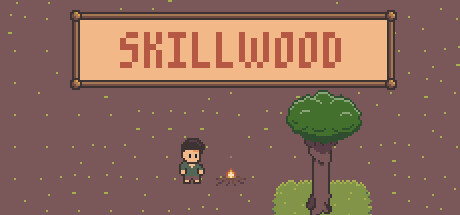
Skillwood is a laid-back resource-gathering simulator that finds its appeal in turning repetitive work into a satisfying cycle of gradual improvement. Developed and published by sshulin, the game combines elements of incremental progression, resource management, exploration, and light survival mechanics without becoming a demanding survival experience. Its central activities are intentionally simple: chop trees, mine rocks, collect resources, improve facilities, and gradually gain access to more productive areas. Rather than relying on combat or constant danger to create tension, it focuses on efficiency and the pleasure of watching modest beginnings develop into a much smoother operation.
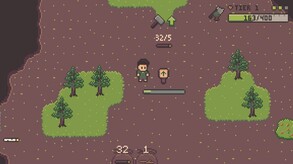
Stamina provides the main limitation on gathering. Chopping and mining consume energy, preventing players from harvesting indefinitely and encouraging them to think about when to continue working and when to recover. The fireplace becomes particularly important because upgrading it increases maximum stamina while improving regeneration when the character is nearby. Renewable food sources such as berry bushes provide another way to regain stamina quickly. These mechanics are uncomplicated, but they give the gathering process enough structure that progression feels more meaningful than simply clicking on resources until they disappear.
The skill system reinforces this feeling of continuous advancement. Frequently using a particular skill improves its effectiveness, allowing each hit to accomplish more. Progress eventually reaches tier limits, however, requiring upgrades to the corresponding workbench before further improvements become possible. Workbench upgrades can substantially increase efficiency, but stronger actions also consume additional stamina. This is a clever balancing element because greater power does not completely eliminate resource management. Improving productivity encourages players to strengthen their stamina-related infrastructure at the same time, creating a progression loop in which several systems support one another.
Exploration gives gathering a broader purpose. New resources required for structures are located throughout different areas, and reaching them can involve constructing bridges and ladders. This provides tangible reasons to venture beyond familiar harvesting locations. Previously unlocked regions can also be upgraded, causing additional types of trees and stones to appear. Instead of simply abandoning an area after collecting its initial resources, players can improve it and make it increasingly useful. The world therefore functions partly as an environment to explore and partly as a resource network that becomes more productive through investment.
Trading with NPCs, improving forests, discovering additional resources, unlocking areas, and building useful structures broaden the basic woodcutting concept. The incremental influence becomes especially noticeable as upgrades accumulate. Tasks that initially require patience gradually become faster and more efficient, producing the familiar satisfaction of seeing earlier obstacles become trivial. A prestige mechanic extends this idea by allowing progression to restart with advantages that can make subsequent runs more effective. Starting over consequently becomes another form of advancement rather than simply losing everything that has been achieved.
Its pixel-art presentation complements the relaxed gameplay nicely. The top-down perspective keeps resources, pathways, structures, and environmental features easy to understand, while the colorful natural surroundings support the cozy atmosphere. The game does not require elaborate visual spectacle because its strongest moments come from mechanical progression rather than cinematic presentation. Its casual appearance also communicates the type of experience players should expect: this is primarily about peaceful harvesting and optimization rather than dramatic storytelling or action.
The greatest potential weakness is repetition. Chopping, mining, recovering stamina, improving equipment, and repeating the process remain central throughout the experience. Players looking for extensive combat, elaborate quests, deep character development, or a narrative-heavy adventure may find the structure too narrow. There is also a degree of patience required before efficiency upgrades noticeably transform the gathering routine. For players who enjoy incremental games, however, this repetition is largely the point. Watching numbers improve, resources become easier to obtain, areas become richer, and skills become more powerful provides the motivation to continue.
Steam Deck compatibility is another positive aspect. The game is rated Playable on Steam Deck, with its functionality accessible through the default controller configuration, readable interface text, and satisfactory performance using the default graphics configuration. SteamOS compatibility is also supported. The primary inconvenience is that mouse, keyboard, or non-Steam-Deck controller icons can occasionally appear. External Bluetooth or USB controllers may also require manually changing the active controller. These are relatively minor compromises for a game whose simple gathering loop is well suited to portable play.
Skillwood succeeds by concentrating on a specific kind of satisfaction rather than attempting to become an enormous survival sandbox. Resource gathering, stamina management, skill advancement, workbench upgrades, area development, exploration, construction, trading, renewable food sources, and prestige progression all feed into the same objective of becoming increasingly efficient. Its limited scope and repetitive nature will not appeal equally to everyone, but players who appreciate cozy resource management and incremental progression should find a pleasantly addictive experience beneath its straightforward exterior. The result is a focused simulator that makes chopping another tree or mining another rock feel worthwhile because almost every action contributes toward the next improvement.
Rating: 8/10