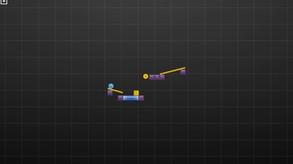
Shoot, push, portals is a compact but thoughtfully designed indie puzzle game developed and published by CrewLab that focuses entirely on the elegance of physics-driven problem solving. Rather than relying on story, characters, or elaborate presentation, the game distills its experience down to a single core idea: using momentum, gravity, and spatial logic to guide a small ball to its goal. What emerges from this minimalist foundation is a puzzle experience that feels clean, focused, and quietly rewarding, especially for players who enjoy experimentation and logical deduction.
Each level presents a contained challenge built around simple interactive elements such as pushable objects, directional forces, switches, and portals that bend the rules of space. The objective is always clear, but the solution rarely is. Players must consider how their actions affect the environment over time, anticipating how objects will collide, fall, or accelerate once set in motion. Shooting or pushing at the wrong moment can send the ball careening off course, while a carefully timed interaction can create a satisfying chain reaction that solves the puzzle in one elegant sequence. The game’s strength lies in how it encourages players to think ahead, visualizing outcomes before committing to an action.
The physics system feels consistent and reliable, which is crucial for a puzzle game built on cause and effect. Gravity behaves predictably, momentum carries weight, and portals interact with objects in intuitive ways that still allow for creative solutions. Because the rules are stable, failure rarely feels unfair; instead, it becomes a learning opportunity. Players are encouraged to retry levels, refine their approach, and experiment freely until the solution clicks. This trial-and-error process is central to the game’s appeal, offering small bursts of satisfaction each time a previously confusing puzzle finally resolves.
Visually, Shoot, push, portals adopts a clean and colorful minimalist style that keeps the focus squarely on gameplay. Objects are clearly defined, interactive elements are easy to read at a glance, and the uncluttered presentation ensures that players can quickly assess each puzzle space. There are no distracting effects or unnecessary details, which suits the game’s cerebral nature. The simplicity of the visuals also gives the game a light, almost playful tone, making even repeated failures feel approachable rather than frustrating.
Sound design follows the same understated philosophy. Audio cues are subtle and functional, providing feedback for movement, collisions, and successful completion without drawing attention away from problem solving. There is no dramatic soundtrack pushing emotion or urgency; instead, the soundscape supports a calm, focused atmosphere that complements the thoughtful pacing of the puzzles. This restraint makes the game well-suited for relaxed play sessions where concentration and experimentation take center stage.
Progression is handled through steadily increasing complexity rather than sudden difficulty spikes. Early levels serve as natural tutorials, introducing mechanics one at a time and allowing players to understand their behavior through play rather than instruction. As the game advances, these mechanics are layered and combined in more intricate ways, forcing players to reconsider earlier assumptions and apply familiar tools in unfamiliar contexts. While the overall scope remains modest, the level design demonstrates care and intentionality, ensuring that each new challenge feels purposeful.
The game’s limitations are largely tied to its focused scope. There is no narrative arc, no evolving theme, and no dramatic shifts in mechanics beyond variations on the core ideas. For some players, this restraint will be part of the appeal, offering a pure puzzle experience without distractions. Others may find the experience brief or wish for greater variety. However, within its chosen boundaries, Shoot, push, portals delivers exactly what it promises: a series of well-crafted physics puzzles that respect the player’s intelligence.
Overall, Shoot, push, portals is a strong example of minimalist game design done right. It demonstrates how a small set of mechanics, when refined and thoughtfully arranged, can create an engaging and satisfying experience. The game does not attempt to impress through scale or spectacle, instead earning its appeal through clarity, consistency, and clever problem design. For players who enjoy logic-based puzzles, physics interactions, and the quiet satisfaction of solving a challenge through insight rather than reflex, it offers a concise but rewarding journey that lingers longer than its simple presentation might suggest.
Rating: 6/10