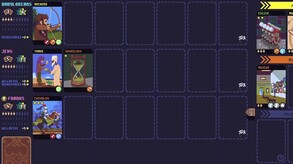
Remake history and race your opponents for a complete and glorious timeline in this lightning-fast card game.
Modeled estimate, not a reported figure. How we estimate →
Media

About
Genres
Stats
All-time low is the lowest price we've recorded for this game since we started tracking it.
Languages: English
Engagement
Reviews
La idea del juego es atractiva: se asemeja a Civilization, pero adaptado a un juego de cartas que es fácil de jugar y donde las partidas duran un poco más de cinco minutos. Además, capta la atención visualmente gracias al inspirador, aunque algo tosco, pixel art que ilustra las cartas. Entonces, ¿qué ha podido salir mal? Pues todo. La jugabilidad es sencilla. Cada jugador tiene que ir jugando cartas históricas de distinto tipo (personajes, tecnologías, herramientas, etc), prestando atención a las distintas sinergias que se crean entre ellas para ganar más puntos. Por ejemplo, las cartas de "Isla", "Navegación" y "Nuevo mundo" se complementan entre sí, por lo que conviene jugarlas juntas siempre que se pueda. El gran problema es que hay una excesiva aleatoriedad en el juego, y la victoria o la derrota dependen demasiado de tu suerte a la hora de robar las cartas que necesitas. Hay algunas formas para obtener las cartas concretas que uno quiere, como la carta de "Comercio", pero no son suficientes para salir del encorsetamiento del azar. Además, la variedad de cartas es muy pequeña, y el juego, en vez de presentártelas poco a poco para que te vayas haciendo a ellas, te las ofrece todas desde el principio. De este modo, en tan sólo dos o tres partidas, que, recordemos, se juegan en tan sólo quince o veinte minutos, uno ya ha visto todas las cartas disponibles. Así pues, la monotonía llega extraordinariamente rápido. A eso hay que añadirle que el juego está plagado de bugs. Una vez he tenido un crasheo directo al escritorio, pero eso no es lo más grave ni de lejos. Como el juego está lleno de diferentes tipos de cartas que se hacen referencias unas a otras con sus bonus de puntuación o efectos especiales, demasiadas veces el juego calcula mal las puntuaciones finales o se equivoca al resolver los efectos, quedándose uno ojiplático al ver como su jugada maestra que le habría dado la victoria si el juego hubiese seguido sus propias normas acaba como un fracaso absoluto. Asimismo, la IA es un completo despropósito: el ordenador se autosabotea a sí mismo constantemente, destruyéndose sus propios edificios, quitándose cartas que le habrían sido útiles para hacer combos, o forzando el final de la partida cuando va perdiendo. En fin, si los desarrolladores arreglasen la IA para que ésta no fuese más tonta que un saco de piedras, puliesen los bugs e hiciesen que las cartas funcionasen correctamente, añadiesen un mayor número de cartas para dar más variedad, y arreglasen el tema de la absoluta dependencia de la suerte, otro gallo cantaría, pero que tal como está ahora, soy incapaz de recomendar este juego. Nota: 3 de 10.
Related
Related
Trends
Concurrent players on Steam, sampled daily since tracking started.
Hours played at review time, across 36 reviews with recorded playtime.
Rush for the Ages, developed and published by PUNKCAKE Delicieux, is a compact strategy title that takes the broad concepts of civilization-building and condenses them into a fast-paced, card-driven format. Instead of sprawling maps and hours-long campaigns, it delivers a streamlined experience where every decision is immediate and impactful. The game feels less like a traditional 4X strategy and more like a cleverly designed board game, emphasizing efficiency, timing, and adaptability within a tightly contained structure. The core gameplay revolves around constructing a timeline of historical developments using a limited hand of cards. Each turn presents a choice: play a card into your personal timeline, contribute it to a shared pool, or cycle your options in search of something better. This shared pool becomes one of the game’s most interesting mechanics, as it introduces a layer of indirect competition. Adding cards to it can accelerate progress into new eras and unlock opportunities, but it also benefits your opponents, forcing you to weigh personal gain against potential advantage for others. This constant push-and-pull gives even simple decisions a strategic edge, as you are never acting in isolation. What makes the experience particularly engaging is how much depth emerges from such a minimal setup. Cards often interact with one another through subtle synergies, rewarding players who can recognize patterns and plan ahead. Building a strong timeline is not just about placing powerful cards, but about creating connections that amplify their effects. At the same time, the randomness of the draw ensures that no two matches play out identically, encouraging players to adapt their strategies rather than rely on a fixed approach. This balance between planning and improvisation keeps the gameplay fresh, even across repeated sessions. Matches are intentionally short, often lasting only a few minutes, which gives the game a strong sense of immediacy. There is little downtime, and each turn moves the game closer to its conclusion, whether through the completion of a timeline or the exhaustion of available resources. This pacing makes it ideal for quick sessions, but it also means that mistakes can be costly, as there is limited opportunity to recover from poor decisions. The result is a game that feels both accessible and demanding, offering straightforward rules that conceal a layer of strategic nuance. The game includes multiple civilizations and difficulty levels, providing some progression and variation as players become more familiar with its systems. Higher difficulties introduce tougher opponents and require a deeper understanding of card interactions, adding a layer of challenge for those looking to refine their skills. Additional modes extend the experience slightly, but the core structure remains consistent throughout, with the primary appeal lying in repeated plays rather than long-term evolution. Visually, Rush for the Ages adopts a clean and understated presentation. The interface is easy to read, allowing players to quickly assess their options and the state of the game without unnecessary distraction. While the art style is simple and lacks elaborate detail, it serves its purpose effectively, keeping the focus on the mechanics. The audio design is similarly restrained, providing a subtle backdrop that complements the gameplay without drawing attention away from it. Despite its strengths, the game’s minimalism also defines its limitations. The absence of a multiplayer mode is particularly noticeable, as the mechanics seem well-suited for competitive play against human opponents. Relying solely on AI reduces some of the unpredictability that could make matches more dynamic. Additionally, while the core gameplay loop is satisfying, it does not expand significantly over time, which may lead to a sense of repetition for players seeking a more expansive experience. In the end, Rush for the Ages succeeds as a focused and intelligently designed strategy game that captures the essence of civilization-building in a concise and approachable form. It offers quick, engaging matches that reward thoughtful play and adaptability, making it a strong choice for players who enjoy strategic decision-making without the time commitment of larger titles. While it may lack the depth and variety of more ambitious games, it excels within its scope, delivering a consistently satisfying experience built on a clever central idea. Rating: 8/10
Definitely a really fun card game! I recommend it to people who like games dealing with age progression like age of empires. It doesn't play similarly, but it feels similar, and I like that.
The game is simple and fun. I recommend it but it could be a bit more accessible. The font in all caps is a bit hard to read for me. I stumbled upon a few graphic glitches/bugs when playing Gauntlet mode and for Quick Game I wish there was a "quick" way to Play Again right after finishing a game, instead of being thrown back at the main menu. However, some of the suggestions by Viewless are very much needed and are still not in the game. Abandoning a game without having to kill the program, for example. It doesn't have to save the progress, just being able to go back to the main menu would be good. Also being able to trigger the Prestige Token tool-tips when being prompted by a decision. It gives crucial information that you'll need if you don't have the tokens memorized. Finally, I noticed the AI for the civilizations tends to finish the game even if it's not convenient for itself. Like, it plays the final card not caring if it's going to lose, sometimes giving me the win and sometimes giving the win to the other AI, so it feels like their heuristics don't care that much about their own individual victory, but for any of the two AIs to win which then feels either unfair or arbitrary. On the brighter side, it is fun. I don't care that much about the RNG, not every game has to be overly competitive and strategic. You play the hand you're dealt. Also it's very pretty, I like the simple aesthetic, the style of the pixel art, how quick the games are, and that you can play it with just the mouse. It has a somewhat addictive game loop, and it deserves some more awareness, especially to motivate the dev to update it.
Rush for the Ages is a very polished card game with ~5 minutes games, perfect for a coffee break. The game is not very hard (even on mastermind difficulty) but really satisfying to play. I highly recommend it!
Simple to learn and enough tactic component to have fun. Luck is a factor but with experience this is minimised. The AI is very competent.
Audience
Estimated from the language of this game's reviews — a proxy for where players are, not official Steam demographics.
Related
| Blockmind | $5.2K | 143 | 79% | $1.99 |
| Silicon Girl | $5.2K | 51 | 71% | $2.99 |
| Up or Lava! | $5.2K | 56 | 70% | $4.99 |
| There Won't be Light | $5.2K | 56 | 55% | $4.99 |
| Escape: VR | $5.2K | 173 | 80% | $1.99 |
| DESTRUCTURE: Among Debris | $5.2K | 187 | 91% | $1.59 |