RPG: Squad battle, developed by Tero Lunkka and Valkeala Software, is a modest action RPG that attempts to build its identity around small-party combat and straightforward mission-based progression, but ultimately feels more like an early-stage concept than a fully developed experience. Set in the fictional world of Collastrobia, the game follows a familiar narrative structure in which a group of heroes must push back against an encroaching evil. Rather than focusing on a single protagonist, the game places emphasis on controlling a trio of characters—typically a melee fighter, a ranged attacker, and a magic user—offering the player the ability to switch between them while the remaining members are handled by AI.
On paper, this party-based approach suggests opportunities for tactical depth and coordination, but in practice, the system remains quite limited. Switching between characters during combat can be useful, particularly when adapting to different enemy types or situations, but the AI controlling the inactive party members often lacks awareness and responsiveness. Teammates may fail to position themselves effectively or contribute meaningfully in combat, which diminishes the sense of cohesion that is central to squad-based gameplay. Instead of feeling like a coordinated team, the group often operates as separate entities loosely tied together by the player’s input.
Combat itself is functional but overly simplistic. Each character archetype fulfills a predictable role, with basic attacks and a small set of abilities that do not evolve significantly over time. Encounters tend to rely on repetition rather than strategy, with enemy behavior remaining consistent across most scenarios. While the game introduces different enemy types and occasional boss fights, these variations do little to alter the overall approach required to succeed. As a result, combat quickly settles into a routine, where the same tactics can be applied repeatedly without much need for adaptation or experimentation.
The structure of the game is built around discrete levels and objectives, such as defeating enemies or collecting items, which provide a clear but somewhat rigid progression path. Each stage is self-contained, and while this keeps the experience easy to follow, it also limits the sense of immersion and continuity. Exploration is minimal, and the environments serve more as backdrops for combat encounters than as spaces to discover or interact with. The separation between exploration and combat zones further reinforces this segmented design, making the world feel less cohesive and more like a series of disconnected scenarios.
Progression systems are present but lack depth. Characters gain improved stats over time, and players can find consumable items such as potions to aid in survival, but there is little in the way of meaningful customization. The absence of skill trees, branching upgrades, or impactful equipment choices means that character development feels linear and predictable. Rather than shaping a unique playstyle, progression becomes a matter of gradual numerical improvement, which can feel unrewarding over extended play.
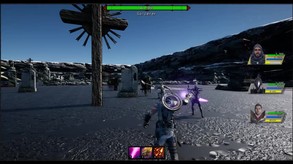
Visually, the game reflects its low-budget origins. The environments, while varied in theme—ranging from snowy landscapes to fiery regions—are sparsely detailed and lack the visual richness needed to create a strong sense of place. Character models and animations are similarly basic, often appearing stiff and lacking polish. While the game is technically functional, it does little to stand out aesthetically, and its presentation can feel dated even within the indie space. Audio design follows a similar pattern, with serviceable but unremarkable sound effects and music that do not significantly enhance the experience.
Narratively, the game provides only the bare minimum needed to support its structure. The story is straightforward and largely undeveloped, offering little in the way of character depth or world-building. Dialogue is sparse, and there are few moments that attempt to engage the player on an emotional level. This lack of narrative investment further contributes to the sense that the game is focused primarily on its mechanics, without fully exploring the potential of its setting or characters.
One of the more noticeable aspects of RPG: Squad battle is its overall lack of refinement. Technical roughness, limited gameplay variety, and underdeveloped systems all contribute to an experience that feels incomplete. While the core idea of managing a small team in an action RPG framework has potential, it is not explored in a way that delivers meaningful engagement. The repetition of combat, combined with the absence of deeper systems, makes it difficult for the game to maintain interest beyond its initial stages.
That said, the game’s simplicity may have a certain appeal for players looking for a very basic and accessible experience. Its straightforward mechanics and clear objectives make it easy to pick up and understand, requiring little time investment to grasp its systems. However, this accessibility comes at the cost of depth, limiting its ability to satisfy players seeking more complex or rewarding gameplay.
In the end, RPG: Squad battle feels like a foundation that was never fully built upon. It introduces ideas that could support a more engaging and strategic experience, but does not develop them far enough to leave a lasting impression. While it may provide brief moments of entertainment for those willing to overlook its limitations, it struggles to stand out in a genre defined by depth and variety.
Rating: 5/10