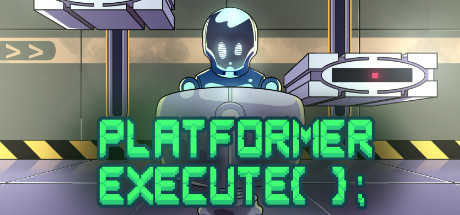
Platformer::Execute(); approaches the platforming genre from an unusual direction by making planning and programming more important than direct character control. Created and published by AwesomeBugGames, the game places players in the role of a robot programmer who must guide a machine through a succession of 2D stages. Rather than controlling every movement as it happens, the player develops a sequence of instructions and then watches the robot execute them. This simple shift transforms what initially resembles a traditional platformer into a logic-focused puzzle game centered on prediction, experimentation, and efficient problem solving.
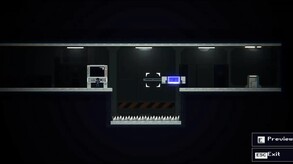
Each stage essentially functions as a small programming problem. The environment establishes the conditions, the destination provides the objective, and the available commands become the tools used to construct a solution. Players need to examine distances, obstacles, platforms, and the robot's expected behavior before deciding which instructions should be performed and in what order. Once the sequence is executed, the consequences of every decision become visible. When the robot fails to reach its destination, the failed attempt provides useful feedback, encouraging players to identify the faulty instruction, reconsider their assumptions, and modify the sequence.
This trial-and-error structure captures some of the satisfaction associated with debugging without requiring players to write conventional programming code. The game is therefore less about memorizing syntax and more about developing logical thinking. Commands must work together in the correct sequence, and even a seemingly minor mistake can produce an entirely different result. Successfully correcting a flawed solution can be particularly rewarding because the answer comes from understanding why the original plan failed rather than simply improving reaction speed.
An important element is the ability to think beyond basic completion. Reaching the goal solves the immediate puzzle, but the game also encourages players to reduce the number of programming steps used. This optimization component gives individual stages additional depth. A complicated chain of commands may technically work, yet discovering a shorter and more elegant solution becomes its own challenge. Players interested only in progressing can concentrate on functional solutions, while puzzle enthusiasts can revisit their approach and search for greater efficiency.
The platforming presentation works well with this concept because it gives abstract programming logic an easily understood visual form. Instead of dealing exclusively with symbols and theoretical instructions, players can immediately see a robot moving through a physical environment according to their decisions. Platforms, gaps, and obstacles communicate problems visually, while the execution phase clearly demonstrates whether the player's reasoning was correct. There is an enjoyable sense of anticipation in starting a completed sequence and watching the robot follow the planned route.
Visually, the game favors a relatively straightforward 2D presentation that suits its puzzle-oriented nature. The technological theme complements the programming premise without distracting from the actual level layouts. Since understanding spatial relationships is essential, visual clarity is more valuable here than elaborate scenery. The overall presentation reinforces the feeling that each stage is a controlled problem waiting to be analyzed and solved.
The experience is particularly suitable for players who enjoy programming concepts, logical puzzles, automation, or games where preparation matters more than reflexes. Conversely, anyone approaching it primarily because of the platformer label should understand that fast movement and precision jumping are not the main attraction. The player's intellectual involvement takes priority over mechanical dexterity. Its focused and linear design can also make the overall experience feel modest compared with larger puzzle titles, but that narrow scope allows the central programming mechanic to remain consistently important.
Full controller support is a positive feature, particularly for players who prefer gamepads. Steam Deck compatibility is less definitive. There is no official Steam Deck Verified or Playable classification indicated for the game, so it should be considered officially unrated for Steam Deck rather than confirmed compatible. Since the listed native platform is Windows, playing it on Steam Deck would depend on Proton compatibility. Its relatively lightweight presentation and controller support are encouraging characteristics, but they should not be interpreted as a guarantee that every aspect will function perfectly on the handheld.
Platformer::Execute(); ultimately delivers a clever variation on platforming by asking players to design movement instead of performing it directly. Its strongest feature is the way it turns every level into a compact logical exercise, then provides an additional incentive to refine successful solutions through optimization. It is not intended to provide the action or freedom of a conventional platformer, but for players attracted to methodical experimentation and programming-inspired puzzles, its focused concept has genuine appeal. The satisfaction of watching a carefully constructed instruction sequence finally work gives the experience its distinctive character.
Rating: 6/10