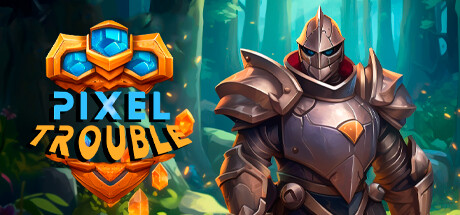
Pixel Trouble is a small-scale yet thoughtfully constructed 2D platformer developed and published by Engineers of the Future Studios that leans into retro design sensibilities while introducing a playful subversion of classic action tropes. Rather than empowering the player with overwhelming combat abilities, the game centers on a hapless knight who quickly discovers that his sword is useless against the ghostly enemies he set out to defeat. This simple narrative hook immediately reframes expectations and establishes the game’s identity as one focused on movement, positioning, and survival rather than direct confrontation.
The gameplay is built around traditional side-scrolling platforming, where careful jumps, timing, and spatial awareness are essential to progress. Since enemies cannot be defeated in the usual way, players must learn to read ghost movement patterns and navigate levels with caution, using avoidance and clever routing instead of brute force. This design choice encourages a slower, more deliberate pace, rewarding patience and observation over aggression. Hazards are placed to test reflexes without becoming overwhelming, and the layout of each level often nudges players toward learning through repetition rather than punishment-heavy difficulty.
Exploration plays a meaningful role in shaping the experience. Levels are dotted with collectibles and optional paths that invite players to stray from the main route, often offering small rewards or safer passages in exchange for added risk. These secrets give the environments more personality and replay value, encouraging completion-minded players to revisit stages and refine their movement. While progression systems are minimal, the act of mastering a level’s layout becomes its own reward, reinforcing the satisfaction of skill-based play.
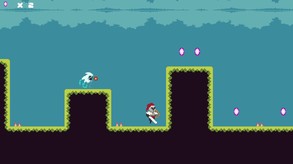
Visually, Pixel Trouble adopts a clean pixel-art aesthetic that draws inspiration from classic fantasy platformers without directly imitating them. Characters and enemies are clearly defined, animations are readable, and color choices ensure that hazards stand out against the background. The art direction favors clarity over complexity, which suits a game where split-second decisions matter. The environments maintain a consistent mood, blending whimsical fantasy with a slightly eerie tone that complements the ghost-centric theme without veering into horror.
Audio design supports this understated approach. Background music is subtle and atmospheric, designed to enhance immersion without distracting from gameplay. Sound effects provide clear feedback for jumps, interactions, and enemy proximity, reinforcing player awareness in moments where visual cues alone might not suffice. Together, the audiovisual elements create a cohesive presentation that feels deliberate despite its modest scope.
In terms of pacing and length, Pixel Trouble is intentionally concise. The game is structured to be completed in relatively short sessions, making it suitable for players who enjoy focused, bite-sized challenges rather than sprawling adventures. Its difficulty curve is gentle but consistent, allowing newcomers to ease into the mechanics while still offering enough challenge to keep experienced platformer fans engaged. While it does not introduce complex mechanics or late-game twists, the refinement of its core idea helps prevent the experience from feeling underdeveloped.
Ultimately, Pixel Trouble succeeds by embracing simplicity and committing fully to its central concept. By stripping away conventional combat and emphasizing movement and evasion, it offers a refreshing take on classic platforming that feels both nostalgic and slightly unconventional. It may not appeal to players seeking deep systems, long campaigns, or narrative complexity, but for those who appreciate focused design, retro aesthetics, and the quiet satisfaction of mastering precise platforming challenges, it delivers a compact and enjoyable adventure that respects the player’s time while offering a distinct personality of its own.
Rating: 6/10