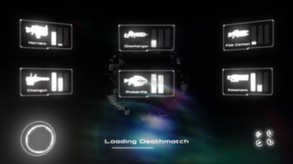
Orbital Gear is a fast paced sidescroller shooter where you utilize the gravitation of celestial objects to give you momentum through space. Arm your Mech with two of the twelve different weapons and destroy your enemies.
Revenue comes from in-game items and microtransactions, which our price-based model doesn't estimate. Copies below reflect the player base, not paid sales.
Media

About
Genres
Stats
Engagement
Reviews
Themes across 40 recent reviews and how positive each mention is. A keyword signal, not full sentiment analysis.
Reviews
"Orbital Gear" ist ein 2D-Multiplayer-Shooter, bei dem die Gravitation eine wesentliche Rolle spielt. Wir steuern einen Mech, der zwei verschiedene Angriffswaffen und eine Sonderfunktion wie etwa Minenlegen besitzt. Die abgegrenzte Spielfläche besteht aus Planeten mit geringem Durchmesser (und manchmal auch anderen Objekten), die alle ihre eigene Gravitation erzeugen. Ohne unseren Boost zu nutzen würden wir immer nur auf einem einzigen Planeten im Kreis laufen. Durch den Boost springen wir von Planet zu Planet und können auch auf dem Weg im freien Raum die Schwerkraft der Objekte nutzen, die merklich unsere Flugbahn beeinflußt. An diese Gravitationsbedingungen muß man sich erstmal ein wenig gewöhnen, auch wenn sie inzwischen in mehreren Spielen ähnlich genutzt wurden. Hat man die erste Orientierungslosigkeit überwunden, ist der eigene Mech durchaus recht zielgenau zu steuern, was auch an der relativ präzisen Steuerung liegt. Die zu Verfügung stehenden Waffen sind abwechslungsreich, auch wenn es eigentlich nur 12 unterschiedliche sind. Dazu kommt dann noch eine Spezialfähigkeit wie Minen zu legen oder ein Turret aufzubauen. Bei den Waffen haben wir relativ normale Maschinenpistolen, aber auch Lenkraketen oder sogar ein Projektil, das die Oberfläche eines anderen Planeten kurzfristig entzündet. Auch ein Schutzschild steht uns zur Verfügung, das sich aber als nur wenig nützlich erweist. Es macht durchaus Spaß mit den Waffen herumzuexperimentieren. Das Tempo ist recht schnell und das Gameplay ist flüssig, wenn auch immer wieder ziemlich chaotisch. Manchmal gelingt es, den Gegner gezielt zu treffen, oft ist ein solcher HIt aber auch mehr Zufall als Können. Das geht aber in Ordnung, denn das Spiel ist merklich primär auf Fun und ein schnelles Spiel zwischendurch ausgelegt. Das größte Problem, wie bei vielen älteren Multiplayer-Titeln: die Server sind praktisch leer. Man findet kaum Mitspieler. Zwar gibt es auch ein paar Single-Player-Herausforderungen, die sind aber kein adäquater Ersatz. Um wirklich Spaß mit dem Spiel zu haben, sollte man also unbedingt ein paar Freunde zur Hand haben. [h1]Wertung:[/h1] 6/10 Atmosphäre -/10 Story 6/10 Grafik 5/10 Sound 7/10 Spielmechanik 7/10 Balancing 6/10 Spielspass [h1]Fazit:[/h1] In Memoriam. [h1][b]6/10 Gesamtwertung
Related
Related
Trends
Concurrent players on Steam, sampled daily since tracking started.
Languages: English*, French, German, Spanish - Spain, Portuguese - Portugal, Portuguese - Brazil, Russian*languages with full audio support
Hours played at review time, across 40 reviews with recorded playtime.
positive critical· bar length = how often the theme comes up
overall very good for free. I recommend it.
[h1] It's ok but you will most likely not find any people online. Still playable for coop which I recommend. Gravity pulls you down towards nearest object so you can walk on its surface. Jumping and dashing between platforms and asteroids is fun yet might be confusing at first but when you get used to it it's ok. Easy to learn, hard to master kind of game. Gameplay is all about shooting and jumping while trying to annihilate all enemy objects in current stage for which you gather performance stars. More stars unlock more powerful weapons. A few different environments and several types of enemies when playing solo. Hard to recommend any other games similar to this one except Robonauts. [/h1]
peanut would love some pets and treats :) 🌸> フ | _ _ l /` ミ_xノ / | / ヽ ノ │ | | | / ̄| | | | | ( ̄ヽ__ヽ_)__) \二つ
Orbital Gear, developed and published by Night Node, is a multiplayer arena shooter that builds its entire identity around a single, standout idea: combat governed by shifting gravity. Instead of traditional flat arenas, matches take place across clusters of small planets and structures, each with its own gravitational pull. This transforms movement into the defining skill, forcing players to constantly reorient themselves as they run along curved surfaces, leap between celestial bodies, and fight from angles that would be impossible in a standard shooter. It’s a concept that immediately distinguishes the game, offering a fresh and disorienting take on both platforming and competitive combat. Movement is the heart of the experience, and mastering it is essential. Players control mech-like units that can traverse planetary surfaces, jump between gravity fields, and use momentum to sling themselves across space. This creates a fluid, almost acrobatic style of navigation where positioning is constantly in flux. Learning how to maintain control while transitioning between different gravitational pulls is both the game’s greatest strength and its biggest challenge. At its best, movement feels dynamic and expressive, allowing skilled players to chain actions together in a way that feels almost effortless. At the same time, the learning curve can be steep, particularly for newcomers who may struggle to orient themselves in such an unconventional environment. Combat is built around this movement system, requiring players to aim and react while constantly adjusting to shifting perspectives. A variety of weapons are available, ranging from rapid-fire options to more experimental tools that interact with gravity in different ways. Some weapons arc or curve depending on the environment, while others can alter the battlefield itself, adding a layer of unpredictability to encounters. This interplay between movement and combat creates moments where positioning becomes just as important as accuracy. However, while the variety of weapons adds tactical depth, the feedback and impact of combat can sometimes feel less satisfying than expected, with certain encounters lacking a sense of weight. The game’s modes are centered on competitive multiplayer, including both free-for-all and team-based objectives such as base destruction. These modes provide a familiar framework that helps ground the otherwise unconventional mechanics. When matches are populated and teams are evenly balanced, the gameplay can be exhilarating, with players darting between planets and engaging in fast-paced, multidirectional firefights. The chaos of these encounters is part of the appeal, as the constantly shifting environment ensures that no two engagements feel exactly the same. However, the reliance on multiplayer also introduces a significant limitation, as the experience depends heavily on having an active player base. Visually, Orbital Gear embraces a bright, neon-infused aesthetic that complements its high-speed gameplay. The contrast between glowing planetary surfaces and the dark backdrop of space helps maintain clarity, which is crucial given the complexity of the movement system. The design is functional rather than overly detailed, ensuring that players can quickly identify their surroundings even during intense action. The soundtrack, with its electronic and synth-driven style, reinforces the game’s energetic tone, adding to the sense of momentum that defines the experience. Despite its strong central concept, the game struggles with long-term depth. The number of maps and modes is relatively limited, and there is little in the way of progression or customization to keep players engaged over extended periods. While the core mechanics are compelling, they are not expanded upon significantly, which can lead to repetition once players become familiar with the available content. Technical issues, including occasional balance concerns and performance inconsistencies, further affect the experience, particularly in competitive matches where precision is important. Another challenge lies in accessibility. The gravity-based movement system, while innovative, can be difficult to grasp, creating a barrier for new players. Without a large and active community, this can make it harder for newcomers to find balanced matches or learn the game at a comfortable pace. The lack of substantial single-player content also means that players have limited options if multiplayer activity is low, reducing the game’s overall longevity. Ultimately, Orbital Gear is a game defined by its creativity. Its approach to movement and combat offers something genuinely different, delivering moments of fluid, exhilarating gameplay that stand out within the genre. However, its limited content, reliance on multiplayer activity, and occasional technical shortcomings prevent it from fully realizing its potential. It is a title that shines brightest when its systems come together in active matches, but struggles to maintain that level of engagement over time. Rating: 8/10
Я бежал в меня стреляли
very cool freakin sweet
so i installed this random game i had from like 6 years ago, no actual idea of what its like, so think hotline miami with anti gravity platforming. game design for this goes hard as hell, too bad its a multiplayer deathmatch arena thing which, yeah good look finding anyone to play this with you. honestly if the developers adapted this concept with like some im sim mechanics like what you see in armored core, i'd devour this entire thing in one sitting, sadly there's barely any content to this, it was intended entirely as a multiplayer game, ouch. don't buy this, honestly this is just a footnote bc gameplaywise its got solid design, but again this is almost like a demo, sad that the developers haven't published anything else after this.
космос это реально круто
Originally a $9.99 game that went Free. The online elements no longer connect leaving the local end stuff. I tried the time trials a little and just wasn't feeling it.
Momentum
Pace estimated from the game's recent review growth (our daily snapshots) at its own sales-per-review ratio — a momentum signal, not booked sales.
Audience
Estimated from the language of this game's reviews — a proxy for where players are, not official Steam demographics.
Related
| HARDCORE MECHA | $1M | 2.7K | 83% | $19.99 |
| Awesomenauts | $8.3M | 26.9K | 85% | $19.99 |
| Gravity Circuit | $714.3K | 5.8K | 91% | $6.79 |
| Intrusion 2 | $602K | 2.3K | 90% | $9.99 |
| Capsized | $309.4K | 1.1K | 76% | $9.99 |
| Levelhead | $67K | 1.1K | 94% | $2.49 |