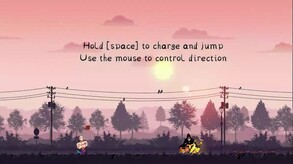
Merman Jump King is a precision-focused platformer that embraces difficulty as its defining feature, building an experience that is less about exploration or variety and more about endurance, timing, and mental resilience. At first glance, the premise is simple, placing you in control of a mermaid warrior navigating a hazardous world through a series of increasingly demanding jumps. However, that simplicity quickly gives way to a far more punishing reality, where progress is fragile and every action carries the risk of significant setbacks.
The gameplay revolves almost entirely around mastering a single mechanic: jumping. Movement is limited, and success depends on carefully measuring the strength and direction of each leap. There is no margin for error, and even small misjudgments can result in losing control and falling back through previously cleared sections. This creates a constant sense of tension, as every successful jump feels earned, but every failure can undo minutes of effort. The game does not provide many safety nets, forcing players to rely on patience and repetition to make progress.
Level design reinforces this approach by structuring the world as a vertical and interconnected series of platforms, where advancement is gradual and often difficult to maintain. Each area introduces slight variations in terrain and layout, requiring players to adapt their timing and positioning, but the core challenge remains consistent throughout. There are no checkpoints in the traditional sense, and losing progress is a central part of the experience. This design philosophy turns progression into a test of persistence, where improvement comes from learning through repeated attempts rather than discovering new mechanics.
Visually, the game adopts a simple 2D style that emphasizes clarity over detail. Platforms and hazards are easy to distinguish, which is essential for a game that demands precise movement. While the environments vary slightly in theme, they remain minimal in presentation, serving more as functional spaces than immersive worlds. The aesthetic supports the gameplay effectively, but it does not leave a strong visual impression, as the focus is clearly on challenge rather than atmosphere.
The pacing of the game is defined by its cycle of progress and failure. Moments of careful advancement are often interrupted by sudden mistakes that send the player back, creating a rhythm that can feel both engaging and frustrating. For some players, this loop is the core appeal, as overcoming difficult sections provides a strong sense of accomplishment. For others, the repetition and frequent setbacks may feel discouraging, particularly when progress is lost repeatedly without any form of relief.
One of the more notable aspects of the experience is how it replaces traditional failure states with continuous consequences. Instead of resetting to a checkpoint, the game allows mistakes to play out fully, often resulting in long falls that undo previous progress. This approach reinforces the importance of precision and concentration, but it also amplifies the emotional impact of failure. It transforms the game into a test of mental endurance as much as skill, requiring players to remain focused even after repeated setbacks.
In terms of content, the game remains tightly focused on its central idea. There are no additional systems such as upgrades, branching paths, or alternative modes to provide variety. This narrow scope keeps the experience clear and consistent, but it also limits its ability to evolve. Once players understand the mechanics, the challenge becomes one of persistence rather than discovery, which can make the experience feel repetitive over time.
Despite its harsh design, there is a certain appeal in how uncompromising the game is. It does not attempt to accommodate a wide audience, instead committing fully to its vision of a demanding platformer that rewards patience and precision. For players who enjoy overcoming difficult challenges and are willing to invest the time required to improve, it can be a deeply satisfying experience. However, for those who prefer more forgiving or varied gameplay, it may feel overly punishing and limited.
In the end, Merman Jump King is a focused and demanding platformer that delivers a consistent but unforgiving challenge built around a single mechanic. It succeeds in creating moments of genuine accomplishment through its difficulty, but its lack of variety and relentless structure make it a niche experience. It stands as a game that prioritizes persistence and mastery above all else, offering a rewarding but often frustrating journey for those willing to endure it.
Rating: 6/10