Market Panic
Market Panic is a turn-based portfolio roguelite about surviving economic chaos. Build a fund across public markets, private equity and crypto, and read the companies inside it. Answer to clients who can leave, rivals who want them, and a committee that comes looking for you.
Estimated lifetime revenueLow confidence
—gross
—
Modeled estimate, not a reported figure. How we estimate →
Est. copies sold
0
mid estimate
Reviews
0
Review score
—
Concurrent players
About
About the game
In Market Panic, every run is a ten-year market cycle and every quarter is a new test of nerve. Build an investment firm across public markets, bonds, cash, hedges, credit, private equity, and crypto. Queue portfolio moves, study the closing plan, and decide whether to take a risk before the tape turns against you.
Open a sleeve and read what is inside it
A sleeve is not one number. Open it and there are six companies inside, each with its own weight, ticker, candlestick chart and return — fourteen sleeves, eighty-four companies. You still allocate at the sleeve level; what is inside is there to be read. One holding is usually carrying the fund and one is usually wrecking it, and you can tell which. Every chart opens on three years of tape that ran before your mandate started, generated fresh for each run, so you are never reading a market that began the day you did.
The market is never completely safe
Inflation shocks, speculative bubbles, bank runs, political scandals, private-equity failures, and rare multi-quarter market legends can expose a portfolio that looked sensible a moment ago. Movement arrives in clusters — quiet stretches, then a handful of quarters that do most of the damage.
Clients who can leave, rivals who want them
Clients have their own limits, personalities, and rivalries, and five of the nine arrive with your opening mandate, in an order that changes every run. Competitors have real portfolios, their own ideas about where the next trade should be, and their own ideas about which of your accounts they would rather be holding. A rival who thinks a relationship has gone weak circles it for several quarters before making a formal approach — and a mandate you never bid on still changes hands.
And you can stand up
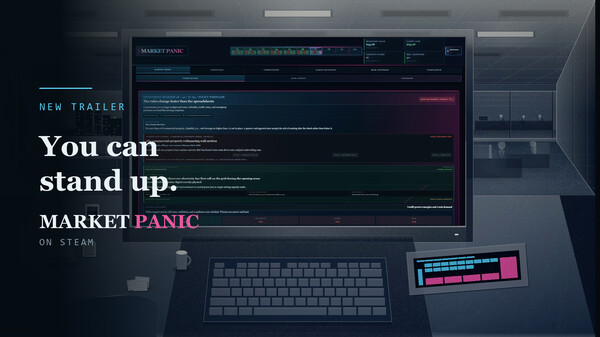
Step back from the terminal and it turns out to be a monitor, on a desk, in an office on whichever floor your career has reached — with the desk still running behind you, live, scaled into the bezel. None of the room is a photograph. It is drawn, every quarter, out of the state of your run.
The ceiling fittings go out one by one as the market turns. The desks are staffed by your actual client book — one lamp per account, lit in the color of that relationship — and the people sitting at them sit differently depending on how it is going. Whoever on the investment committee has lost the most faith is the one waiting on the floor when you get up, standing closer the longer the unhappiness has lasted. Past a certain exposure, the regulator sends somebody as well. Out of the window there is a city that knows which floor you are on, and weather that knows the season.
Finance as drama, not homework
Research rumors, negotiate mandates, document risk exceptions, test crisis scenarios, protect liquidity, or take the aggressive line. The aim is not merely to finish with the best return. It is to build the institution that survives long enough to tell its investors why it did what it did.
Features
Turn-based roguelite runs across a full ten-year market cycle
Queue orders and approve a visible quarter-end allocation
Build across public assets, bonds, cash, hedges, credit, private equity, and crypto
Open a sleeve and read the six companies inside it — eighty-four holdings with their own weights, candlestick charts, and three years of tape from before your mandate began
Crashes, bubbles, bank runs, liquidity freezes, scandals, rare market legends, and ultra-rare systemic crises
Institutional clients with competing mandates and committee pressure, five of the nine drawn fresh for each run
Rival firms with real portfolios, personalities, and performance history — and designs on the accounts you already hold
Research, rumor investigation, compliance choices, risk exceptions, and liquidity planning
Step back from the terminal into a drawn office that reports the run: a lit desk per client, a committee member waiting when confidence falls, a city out of the window that knows your floor
Every object in that room is a real, labeled button, and the whole game plays from the keyboard
Adaptive music, authored market audio, a room ambience of its own, and a terminal-inspired finance interface
Multiple failure states, institutional identities, annual investor letters, and run postmortems
Nine languages — the market writing, the quarterly briefs and the endings, not only the menus
Designed to be readable and strategic without requiring finance expertise
Nine languages
Playable in English, Spanish, Brazilian Portuguese, German, French, Turkish, Japanese, Russian and Simplified Chinese — the market writing, the quarterly briefs and the endings included, not only the menus.