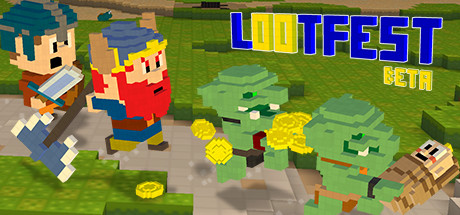
Lootfest is an unusual indie sandbox project developed and published by Fabian Jakobsson through his small studio vikingfabian.com. Released on Steam as a free-to-play Early Access experiment, the game attempts to merge two distinct concepts: a voxel-based construction sandbox and a cooperative adventure game. On paper, the idea is ambitious, combining creative world-building tools with combat and exploration mechanics. In practice, however, the project exists in a somewhat unfinished state, making it feel more like a technical prototype than a fully realized commercial release.
The central idea behind Lootfest revolves around giving players the ability to create and manipulate their own environments using voxel-based editing tools. Similar to other sandbox construction games, players can shape terrain and build structures using basic geometric forms such as cubes, spheres, and other modular shapes. These tools allow for considerable creative freedom, enabling players to construct landscapes, buildings, and various objects within the game’s world. The editing system is flexible enough that players can save their creations as templates and reuse them later, making it possible to gradually assemble larger environments or complex structures over time.
One of the most appealing aspects of the game is the sense of experimentation that comes from this creative system. Players who enjoy designing levels or crafting their own virtual spaces can spend time sculpting environments and testing ideas without being limited by strict rules. The editor effectively turns the game into a creative sandbox where imagination becomes the primary tool. For those interested in game design concepts or voxel construction, this aspect of the project offers an interesting playground.
Alongside the construction tools, the game attempts to provide an adventure-style experience where players can explore environments, fight enemies, and complete objectives. The idea was to combine player-created worlds with gameplay scenarios that involve exploration and combat. In theory, players could build their own maps and then challenge themselves or others to complete them. This concept could have created a powerful cycle of user-generated content where the community continuously expands the game’s available experiences.
Multiplayer functionality was designed to support this vision by allowing players to collaborate online. Friends can connect and work together inside the same voxel environment, building structures or experimenting with terrain editing as a team. Cooperative building sessions can result in larger and more elaborate environments than a single player might create alone. This collaborative aspect highlights the game’s social potential, especially for players who enjoy creative projects with friends.
Unfortunately, the adventure portion of the game never reached the same level of development as the editor itself. While the project originally aimed to include several main levels, enemies, bosses, and challenges, much of that content remains incomplete. The playable adventure segments that exist feel limited and somewhat experimental, lacking the depth or polish expected from a finished game. As a result, players often find that the building tools provide more engagement than the actual gameplay progression.
The limited scope of the content is largely due to the fact that the project was developed primarily by a single creator. Solo development can produce impressive results, but it also comes with significant challenges when attempting to implement complex systems such as multiplayer networking, level editing tools, and combat mechanics within the same game. Over time, development slowed, and the game remained in Early Access without reaching the ambitious goals initially described.
Visually, Lootfest follows the recognizable voxel aesthetic that emphasizes block-like geometry and stylized environments. Characters, terrain, and objects all share this cubic structure, which fits naturally with the construction tools available in the editor. While the graphical fidelity is relatively simple, the visual style supports the game’s creative focus by making it easy to understand how environments are built and modified.
The simplicity of the visuals also contributes to the clarity of the editing process. Because the world is built from recognizable shapes, players can quickly identify how objects are assembled and replicate similar designs. This straightforward design philosophy aligns with the game’s emphasis on creativity and experimentation rather than high-end visual presentation.
Sound design within the game remains fairly minimal. Basic audio effects accompany actions such as building, moving objects, or interacting with the environment. While the audio does not play a major role in the experience, it provides enough feedback to support the game’s mechanics without becoming distracting.
One of the biggest challenges for Lootfest is its unfinished nature. Many of the systems feel like early concepts rather than fully developed features. Players who enter the game expecting a polished adventure or sandbox experience may find themselves disappointed by the limited amount of structured gameplay available. The total playable content remains relatively short, and many of the original development plans were never fully implemented.
However, the project still holds some value as an experimental sandbox. The voxel editor offers a glimpse of the creative possibilities that the game once aimed to support. For players who enjoy exploring indie prototypes or experimenting with level design tools, there is a certain charm in seeing how the system functions and imagining what the project might have become with continued development.
Community reactions to the game have been mixed, reflecting the contrast between its interesting ideas and its incomplete execution. Some players appreciate the creative editor and the freedom it offers, while others criticize the lack of content and long periods without updates. As time has passed without significant development progress, the game has effectively become a snapshot of an unfinished concept rather than an evolving Early Access project.
Despite its shortcomings, Lootfest stands as an example of the ambitious ideas that often emerge from independent game development. Attempting to combine sandbox construction, cooperative multiplayer, and adventure gameplay within a single project is a difficult undertaking for any studio, especially a solo developer. Even though the final product does not fully realize those goals, it still demonstrates the creativity and experimentation that characterize many indie projects.
Ultimately, Lootfest feels less like a traditional game and more like a prototype for a larger vision that was never fully realized. Players who approach it with curiosity about experimental indie projects may find it interesting to explore, particularly for its voxel editing tools and creative potential. However, those looking for a complete and polished adventure experience will likely find the limited content and unfinished systems difficult to overlook.
Rating: 5/10