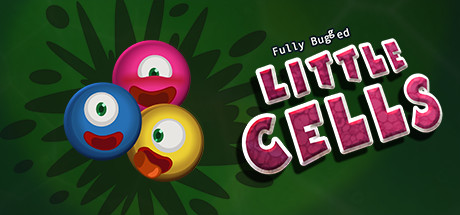
*Little Cells* is one of those deceptively simple games that hides its tension beneath a clean, minimalist presentation. At first glance, it appears to be a gentle puzzle sandbox where you move tiny organisms around in a petri-dish-like environment, nudging colorful cells into one another to clear space or create new combinations. Yet once a session begins, the game quickly reveals a steady escalation of pressure. The dish fills, cells multiply, sickness spreads, and your once-controlled microscopic world starts to spiral if you don’t manage it properly. It’s a structure that draws you in for “just one round,” only to keep you hooked as the balance between control and chaos becomes more delicate with each passing moment.
The mechanics are straightforward on paper. Each cell is a color-coded piece of biological material that reacts when it collides with other cells of the same color. Matching them clears the board, generating space for new generations to form. But there’s a twist: if cells age without being used, they grow darker and eventually turn “sick.” Sick cells don’t just sit idly; they threaten everything around them, transforming the board into a hazardous zone that can collapse your run if left unchecked. To counter this, you can produce special purifying cells that clean contaminated zones and restore the balance. This interplay between clearing, combining, and cleansing structures the game’s flow, adding a thoughtful layer beneath the fast clicking and pattern recognition.
The pace of each session creates a natural arc of rising tension. Early moments feel almost meditative—you calmly observe the microscopic world, shifting cells methodically to keep the dish ordered. But as the seconds pass, new cells spawn faster, the cluster density increases, and the threat of decay starts to loom. Your screen gradually fills with opportunities and dangers alike, forcing quick reactions as well as smart prioritization. When the dish becomes overcrowded, the game transitions into a frantic scramble: matching colors in rapidly shrinking windows, generating white healing cells in the nick of time, and carving out just enough space to hold back the collapse. It’s this momentum—from calm control to energetic chaos—that gives *Little Cells* its addictive quality.
Visually, the game embraces simplicity with purpose. The clean white backdrop and vivid cell colors ensure clarity even as the screen becomes crowded, and the smooth, fluid animations lend an organic charm to movement and collisions. There are no distracting effects or needless embellishments; everything serves the central focus of tracking patterns and managing space. The microscope theme adds personality without overwhelming the experience, making the game feel both scientific and playful. Because *Little Cells* is so lightweight, it runs effortlessly on a wide range of hardware, making it accessible and convenient for quick sessions whenever the mood strikes.
The minimalist design, however, also means the game offers limited long-term progression. There are no unlockable abilities, evolving mechanics, or layered systems waiting several hours in. Once you understand how color management, contamination, and purification work, the core loop stays consistent. For some players, this creates a satisfying purity—*Little Cells* becomes a high-score chase, a test of reflexes and decision-making in increasingly difficult scenarios. For others, the repetition may set in sooner, especially if they’re looking for more structural depth or long-lasting goals. The game thrives on its immediacy rather than its longevity, and its replay value relies heavily on your personal enjoyment of short, intense puzzle rounds.
Even with its limited scope, *Little Cells* succeeds at what it sets out to accomplish. It’s a small, tightly focused puzzle-action hybrid that embraces clarity and efficiency rather than overwhelming you with features. The tension of controlling an ever-shifting microscopic world, the satisfaction of clearing massive clusters, and the race against spreading sickness all create a surprisingly engaging rhythm. It’s the kind of game that fits effortlessly into short breaks—easy to pick up, tough to master, and always urging you to try again the moment a session ends.
In the end, *Little Cells* stands as a modest but charming independent title: simple enough for casual players yet engaging enough for those who enjoy fast, reactive puzzle systems. It won’t occupy hours of your time with deep progression or story, but it offers a refreshing burst of focused challenge whenever you want something quick, colorful, and skill-based. Its clarity, accessibility, and elegant mechanical loop make it a quietly appealing experience that leaves a stronger impression than its minimalism suggests.
Rating: 6/10