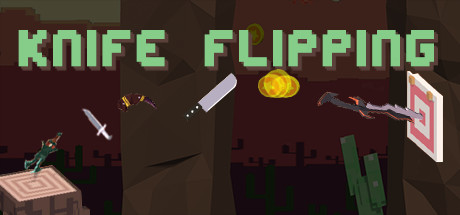
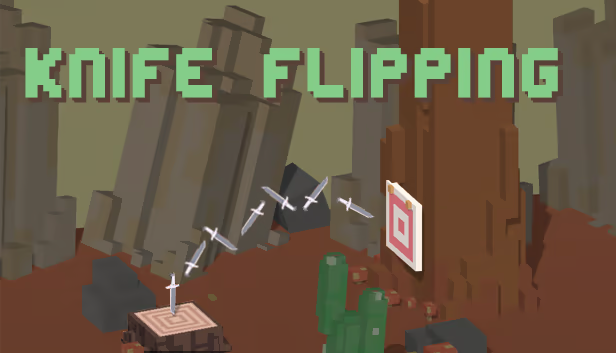
Knife Flipping is a minimalist arcade title that builds its entire identity around a single, straightforward action: throwing knives and making them stick. Developed and published by RewindApp, the game is clearly inspired by the wave of mobile knife-flipping games that emphasize quick reflexes, timing, and the satisfaction of chaining successful actions together. Rather than expanding that idea into a larger structure, Knife Flipping embraces its simplicity, offering a barebones experience designed for short, low-commitment play sessions.
The gameplay loop is immediately understandable. You aim and throw a knife toward a surface, hoping it lands cleanly point-first. A successful throw lets you continue the streak, while a failed flip resets your progress. Timing, angle, and force all matter, and while the mechanics are simple on paper, mastering consistent throws can take more practice than expected. Much of the game’s appeal comes from this pursuit of precision, as players chase higher combos and cleaner execution rather than progressing through levels or story beats.
Variety is introduced primarily through unlockable weapons. The game features dozens of knives and sword-like blades, each with slightly different weight and behavior. These differences are subtle rather than transformative, but they do add a small layer of experimentation as players search for a blade that feels comfortable. Despite this, the core interaction never changes, and every knife ultimately serves the same purpose: flipping and sticking. This keeps the game accessible, but also limits how much the experience can evolve over time.
The environments themselves are sparse, with only a handful of levels available. Each level functions more as a backdrop than a gameplay modifier, offering visual variety without introducing new mechanics or hazards. While the presentation is serviceable, it lacks dynamism, and the limited number of stages means players will see everything the game has to offer relatively quickly. There are no escalating challenges, alternative modes, or rule changes to shake up the routine once familiarity sets in.
Visually, Knife Flipping sits comfortably in the realm of small indie projects. Knife models are clear and readable, and environments are simple enough to avoid distraction. The art style doesn’t aim for realism or flair, instead focusing on functionality. Animations are basic, and while physics interactions can occasionally feel inconsistent, they generally do the job of conveying success or failure. Sound design follows the same philosophy, offering simple audio cues that reinforce actions without adding much personality.
Progression is one of the game’s weakest areas. Unlocking new knives provides some incentive to keep playing, but there is no deeper system of rewards, achievements, or long-term goals. There are no meaningful milestones beyond personal high scores, and once players have unlocked most of the available blades, motivation relies entirely on self-imposed challenges. For some, this is enough; for others, the lack of structure makes the experience feel more like a prototype than a fully fleshed-out game.
Community reception reflects this divide. Players who enjoy ultra-casual arcade games often appreciate the immediacy and simplicity, finding satisfaction in quick sessions and incremental improvement. More critical voices point out the shallow content pool, limited levels, and absence of meaningful progression systems. These criticisms are less about broken mechanics and more about scope, as the game rarely expands beyond its initial premise.
Ultimately, Knife Flipping delivers exactly what its title promises and very little beyond that. It’s a compact, no-frills arcade diversion best suited for killing a few minutes at a time rather than extended play. For players who enjoy simple physics-based challenges and don’t require depth or variety to stay engaged, it can offer brief moments of satisfaction. For those seeking richer mechanics, evolving challenges, or long-term replay value, it may feel thin and quickly exhausted. As a casual experiment built around a single mechanic, Knife Flipping is honest about its limitations—and whether that’s enough depends entirely on what you expect from a game of its scale.
Rating: 5/10