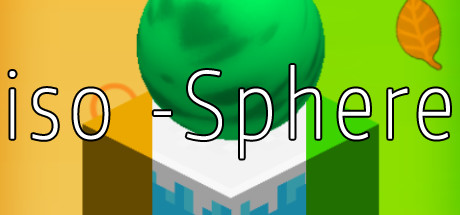
iso-Sphere is an indie isometric puzzle-platformer developed and published by Mighty Fox Studio that builds its entire experience around precision, momentum, and spatial awareness. At a glance, the game appears minimalistic and almost deceptively simple, presenting players with a smooth rolling sphere and a series of floating, geometric levels viewed from an isometric perspective. However, beneath this clean exterior lies a game that is deliberately demanding, one that tests patience and fine motor control just as much as it tests logical thinking. Rather than relying on narrative or spectacle, iso-Sphere commits fully to mechanical challenge, asking players to master movement and physics through repeated practice.
The core gameplay revolves around guiding the sphere from a starting point to an exit tile, navigating platforms suspended in empty space. Movement is governed by momentum rather than strict grid-based control, meaning every push carries weight and consequence. A gentle tap may not be enough to crest a slope, while a slightly stronger push can send the sphere sliding uncontrollably off an edge. Early levels serve as a gradual onboarding process, allowing players to acclimate to the physics and camera angle, but this sense of safety quickly fades as stages become more complex. Narrow bridges, angled ramps, collapsing platforms, and increasingly tight turns demand careful planning and restraint, forcing players to think several seconds ahead rather than reacting impulsively.
Level design is where iso-Sphere shows its strongest identity. The game offers a wide range of stages that steadily escalate in difficulty without relying on gimmicks or sudden rule changes. Each world introduces subtle twists on familiar mechanics, encouraging players to refine their understanding of movement rather than relearn entirely new systems. Optional objectives, such as collectible stars and time-based challenges, add an extra layer of depth for those who wish to perfect their runs. These elements transform levels from simple obstacle courses into skill trials, rewarding mastery and efficiency. At the same time, the unforgiving nature of the design means that mistakes are costly, often resulting in instant failure and a restart, which can be both motivating and frustrating depending on the player’s tolerance for repetition.
Visually, iso-Sphere opts for clarity and color rather than detail. The environments are built from simple shapes and bold palettes, ensuring that platforms, hazards, and paths are easy to read at a glance. This visual restraint works in the game’s favor, as it minimizes distraction and keeps attention focused on movement and positioning. While the presentation lacks the polish or spectacle of higher-budget titles in the genre, it feels cohesive and purposeful. The isometric viewpoint adds an extra layer of challenge, as depth perception can sometimes be deceptive, requiring players to learn how to judge distances and angles through experience rather than intuition.
Sound design and music play a supportive but understated role. The audio does not attempt to dominate the experience, instead offering subtle cues and ambient tracks that complement the abstract nature of the levels. This restraint reinforces the game’s meditative, almost clinical atmosphere, where concentration is paramount and external distractions are minimized. Moments of failure are not heavily dramatized, which helps soften the sting of repeated retries, though the absence of more dynamic audio feedback may leave some players craving stronger sensory rewards for success.
Overall, iso-Sphere is a game that knows exactly who it is for. It is unapologetically focused on precision and challenge, offering little in the way of narrative or mechanical variety beyond its central concept. For players who enjoy physics-driven puzzle-platformers and take satisfaction in incremental improvement, it can be deeply rewarding, delivering that familiar “one more attempt” pull as each failed run feels like a lesson learned. For others, especially those who prefer forgiving difficulty curves or more expressive gameplay systems, its rigidity may prove exhausting. Within its niche, however, iso-Sphere stands as a solid, if uncompromising, example of minimalist design built around skill, patience, and mastery.
Rating: 5/10