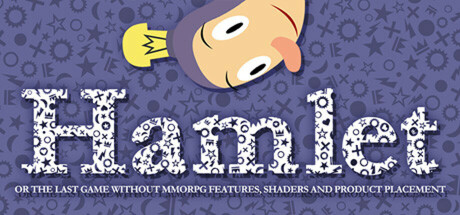
Hamlet or the Last Game without MMORPG Features, Shaders and Product Placement is one of those titles that announces its intentions before the player even presses Start. Developed and published by Denis Galanin, also known as mif2000, it enters the modern gaming landscape not by trying to compete with technical spectacle or elaborate systems, but by deliberately rejecting them. It feels like a response to the industry’s obsession with bigger, louder, and more commercially engineered experiences. Instead, what you get is a short, eccentric, proudly handmade point-and-click adventure that treats Shakespeare’s Hamlet less as sacred literature and more as raw material for comedic reinterpretation. It’s a parody, a puzzle box, and a small artistic experiment presented with a wink.
The premise is already absurd in a way that sets the tone perfectly. A time-traveler accidentally lands on Hamlet, knocks him unconscious, and decides to step in as the protagonist of the story. From there, the plot follows the broad skeleton of the play—Ophelia needs rescuing, villains lurk in the background, and the royal court becomes a playground for surreal events—but the execution is intentionally chaotic. Instead of introspective monologues and philosophical tragedy, players encounter strange contraptions, cartoonish characters, and comedic misunderstandings. The game is not concerned with honoring Shakespeare; it’s far more interested in poking fun at him, at storytelling conventions, and at video game tropes themselves.
Moment-to-moment gameplay consists of puzzle solving rather than traditional inventory-based adventure mechanics. Each screen functions like a self-contained challenge, often structured around visual logic, trial-and-error experimentation, or mechanical sequencing. Some puzzles are clever, playful, and satisfying in their simplicity; others are opaque, requiring leaps of intuition or repeated clicking until something reacts. The absence of an inventory system keeps interactions streamlined, but it also limits the sense of discovery and can make puzzles feel arbitrary. This design choice reflects the developer’s preference for pacing over complexity, but it also leads to spikes of frustration when logic seems secondary to guessing.
Visually, the game’s personality shines brightest. The art style is whimsical, exaggerated, and unapologetically minimalist, resembling a collage of playful doodles rather than polished concept art. Characters bend, stretch, and emote in a way that brings humor to nearly every scene. Backgrounds are surreal and theatrical, appropriate for a story originally staged on literal sets. Even the roughness of the aesthetic feels intentional—it emphasizes the handmade quality of the experience, reminding the player that this world has an individual behind it, not a committee of studio departments. The soundtrack similarly strikes a quirky tone, alternating between lighthearted accompaniment and atmospheric cues that never overshadow the puzzle focus.
Despite its distinct identity, Hamlet is not a universally appealing experience. Its short playtime—often under two hours—means it ends just as some players expect it to deepen. Its comedic tone is specific, leaning on absurdity, awkward timing, and narrative detours that won’t land for everyone. And the inconsistency in puzzle quality can divide players sharply: those who appreciate unconventional problem-solving may enjoy the unpredictability, while others might feel the game breaks its own logic for the sake of a gag. These structural quirks highlight the tension between artistic expression and traditional game design coherence.
Yet there’s something refreshing about a game so unconcerned with standard expectations. It doesn’t inflate itself with filler or repeat mechanics to justify a longer runtime. It doesn’t pretend every joke works or every puzzle is elegant. It feels like a creator expressing amusement, curiosity, and personal taste rather than trying to appeal to everyone. That individuality is increasingly rare in an industry dominated by trends and formula. Hamlet may be uneven, but it is undeniably authentic. It offers an experience that is strange, memorable, and unmistakably its own, even when it falters.
Ultimately, Hamlet or the Last Game without MMORPG Features, Shaders and Product Placement is best approached with openness and the understanding that it is intentionally small, odd, and self-aware. Players seeking a polished, lengthy, narratively cohesive adventure may leave unsatisfied, but those who appreciate experimental indie design, playful reinterpretations of classic literature, and puzzle-driven storytelling may find it unexpectedly charming. It isn’t a grand adaptation of Shakespeare—it’s a mischievous reinterpretation filtered through the lens of a singular developer, and in that sense, it succeeds on its own terms.
Rating: 6/10