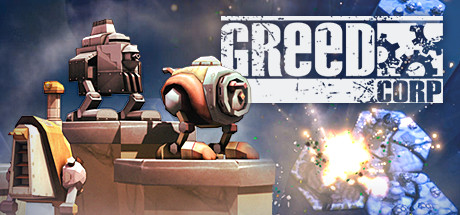
Greed Corp, developed by Vanguard Games and published by Vanguard Entertainment Group, is a turn-based strategy game that builds its entire identity around a single, brilliantly executed idea: the battlefield is as dangerous as the enemy. Set in a stylized industrial world where resources are scarce and exploitation is the norm, the game places players in control of competing factions vying for dominance over a fragile landscape. What immediately sets it apart from more traditional strategy titles is that the terrain itself is not permanent—every action taken to extract value from it brings the map closer to collapse.
At its core, the gameplay unfolds on a hex-based grid where players expand territory, deploy units, and harvest resources to gain an advantage. However, unlike most strategy games where controlling more land is always beneficial, Greed Corp introduces a constant risk-reward calculation. Harvesting tiles provides currency but weakens the ground, eventually causing it to crumble entirely. Any units caught in a collapsing section are lost, turning the environment into both a resource and a weapon. This mechanic fundamentally reshapes how players approach strategy, encouraging not just careful planning but also opportunistic sabotage, where destroying parts of the map can be just as effective as attacking directly.
The elegance of this system lies in how quickly it becomes intuitive. The rules are easy to understand, and within a few matches, players grasp the importance of positioning and timing. Yet beneath that simplicity is a surprising level of depth. Decisions rarely feel straightforward—expanding too aggressively can backfire, while playing too cautiously may leave you outpaced by opponents. Matches tend to be relatively short, which keeps the experience focused and engaging, allowing players to experiment with different tactics without committing to lengthy sessions. This balance between accessibility and strategic nuance gives the game a rhythm that feels both deliberate and dynamic.
The single-player campaign serves as a solid introduction to these mechanics, gradually increasing in difficulty and complexity. Each mission presents new challenges that push players to refine their understanding of the system, though the narrative itself remains minimal and largely secondary to the gameplay. While the campaign is enjoyable, it becomes clear that it functions more as a structured learning experience than a centerpiece. The real potential of the game emerges in competitive play, where human opponents can fully exploit the unpredictability of the collapsing terrain.
In multiplayer, the game takes on a more chaotic and unpredictable character. Carefully constructed plans can unravel in an instant as sections of the map disappear, creating moments that are as entertaining as they are strategic. This unpredictability gives Greed Corp a unique energy, almost resembling a tactical board game where every move has immediate and visible consequences. However, the multiplayer experience is heavily dependent on having an active player base, and without enough participants, it can be difficult to fully appreciate this aspect of the game.
Visually, the game adopts a distinctive steampunk-inspired aesthetic that complements its themes of industrialization and environmental decay. The environments are clean and readable, ensuring that players can easily assess the state of the battlefield, while subtle animations bring the collapsing terrain to life. The presentation is supported by a lighthearted, almost whimsical soundtrack that contrasts nicely with the destructive nature of the gameplay, adding a layer of personality without distracting from the strategic focus.
That said, the game’s tight focus is both a strength and a limitation. While the central mechanic is highly effective, the overall variety of units and strategies is somewhat limited. Over time, the experience can begin to feel repetitive, as most matches revolve around the same core interactions. There are also occasional technical quirks and interface limitations that can detract slightly from the experience, though they rarely overshadow the game’s strengths.
In the end, Greed Corp stands as a clever and memorable take on turn-based strategy, built around a mechanic that fundamentally changes how players think about territory and control. It doesn’t aim for scale or complexity in the traditional sense, but instead delivers a focused and inventive experience that rewards creativity and foresight. While it may not have the longevity of larger strategy titles, its originality and tightly designed gameplay make it a standout for those looking for something different within the genre.
Rating: 8/10