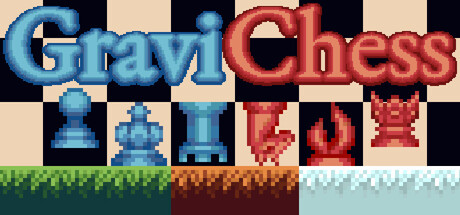
Use the classic chess pieces to work your way through this complex puzzle platformer. Capture all enemy pieces before they get you to beat the 102 intricately designed levels.
Modeled estimate, not a reported figure. How we estimate →
Media

About
Use a specific set of pieces assigned for each level to maneuver around enemies line of sight and capture them all.
Play through 102 unique levels and use mechanics like Time Freezing to your advantage.
Stats
All-time low is the lowest price we've recorded for this game since we started tracking it.
Languages: English
Reviews
Its fun
I enjoyed the level difficulty, you really have to think. The customization options were great too!!!
This is a nice puzzle platformer, with some tight but manageable execution windows. But I must admit I felt a bit tired of it by the end, I feel like it overstayed it welcome a bit. I really liked how the tutorials became more "show, don't tell but the midpoint", you learn mechanics firsthand instead of being told them.
This game was very challenging and fun at the same time. Each level brought something new into the puzzle, it didn't feel repetitive. It's definitely fun for anyone who enjoys playing chess, and anyone who enjoys solving puzzles. There are also many secrets to be found. Overall, I rate this game very high.
GraviChess, created by Lumpy Software, is a creative puzzle-platformer that takes the familiar rules of chess and transforms them into an interactive, movement-based challenge. Instead of recreating the traditional board game, it reimagines chess pieces as controllable entities within compact levels, blending logical problem-solving with platforming elements. This approach gives the game a distinct identity, turning something normally static and turn-based into a more immediate and spatial experience that requires both planning and execution. The core gameplay revolves around navigating levels using the movement rules of classic chess pieces. Each piece retains its traditional behavior, meaning the player must think in terms of lines, angles, and positioning rather than free movement. The objective is usually to eliminate enemy pieces or reach specific points without being captured, and this creates a constant tension between strategy and timing. Players are often required to switch between pieces, carefully choosing which one to use in a given situation. This adds a layer of flexibility, but also increases the complexity of each puzzle, as success depends on understanding how different movement patterns interact within the environment. Level design plays a major role in keeping the experience engaging. The game offers a large number of stages, each introducing new configurations and challenges that build upon the core mechanics. Early levels act as a gentle introduction, allowing players to familiarize themselves with how the rules translate into movement, but later stages demand a more thoughtful approach. Some puzzles require multiple steps of planning, where a single mistake can force a restart. This gradual increase in difficulty provides a sense of progression, though it can occasionally feel uneven, with certain levels presenting sharp spikes that may test the player’s patience. What makes GraviChess particularly interesting is how it balances familiarity with innovation. Even players with little knowledge of chess can quickly grasp the basics through experimentation, while those who understand the game’s logic may find themselves adapting more quickly to its challenges. However, the game does not rely on tutorials or extensive guidance, often expecting players to learn through trial and error. This can be rewarding when solutions are discovered, but it can also lead to moments of frustration when the path forward is not immediately clear. Visually, the game adopts a minimalist pixel-art style that emphasizes clarity and readability. The environments are simple and functional, often resembling abstract boards or geometric spaces that keep the focus on gameplay. While this approach ensures that players can easily track enemy positions and movement patterns, it does little to create a memorable visual identity. The presentation serves its purpose effectively, but it rarely goes beyond that, remaining consistent but unremarkable throughout the experience. The structure of the game is built around short, self-contained levels, making it easy to engage with in small sessions. Each stage presents a distinct challenge, allowing players to progress at their own pace without the need for long-term commitment. However, the experience is almost entirely driven by its mechanics, with little emphasis on narrative or world-building. For some players, this focus on pure gameplay will be a strength, while others may find the lack of context or storytelling makes the experience feel somewhat detached. Replayability is tied mainly to completion and mastery. While there are many levels to work through, the core mechanics remain consistent, and once a puzzle is solved, there is limited incentive to revisit it unless aiming for a more efficient solution. The game’s longevity depends largely on how much the player enjoys its central concept, as there are few additional systems or modes to extend the experience beyond its initial run. Despite its originality, the game does have its limitations. The reliance on a single core idea, while strong, means that the experience can feel repetitive over time, especially during longer play sessions. Additionally, the difficulty curve can be inconsistent, with certain puzzles requiring a level of precision or foresight that may feel more punishing than rewarding. These issues do not overshadow the game’s strengths, but they do highlight the challenges of sustaining engagement with a narrowly focused design. In the end, GraviChess is a thoughtful and inventive puzzle-platformer that successfully reinterprets the rules of chess into a more dynamic format. It offers a unique blend of logic and movement that can be both challenging and satisfying, particularly for players who enjoy problem-solving and unconventional gameplay ideas. While it may not appeal to everyone, its creativity and clear design make it a worthwhile experience within its niche. Rating: 6/10
Related
Related
Trends
Concurrent players on Steam, sampled daily since tracking started.
Momentum
Pace estimated from the game's recent review growth (our daily snapshots) at its own sales-per-review ratio — a momentum signal, not booked sales.
Related
| Project Liminal Redux | $715.8 | 111 | 63% | $0.49 |
| Save Daddy Trump | $713.8 | 65 | 82% | $0.79 |
| PSYCHO | $713.4 | 52 | 65% | $0.49 |
| Beats Warrior: Nian | $713.3 | 52 | 83% | $0.74 |
| Underwater hunting | $713.1 | 72 | 54% | $0.49 |
| fiction.colors | $713 | 57 | 86% | $0.99 |