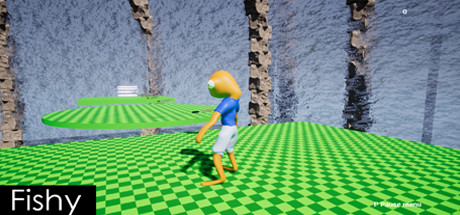
Fishy is a 3D platormer. you play as a fish very far from home . traveling trough 5 worlds such as a jungle oasis to under water to the frozen tundra to inside a volcano to lastly to outer space
Revenue comes from in-game items and microtransactions, which our price-based model doesn't estimate. Copies below reflect the player base, not paid sales.
Media

About
Genres
Stats
Languages: English
Engagement
Reviews
Themes across 40 recent reviews and how positive each mention is. A keyword signal, not full sentiment analysis.
Reviews
There are games that entertain, games that challenge, and then—very rarely—games that quietly, almost imperceptibly, reframe the way you think about the medium itself. Fishy belongs decisively in that last category. At first glance, it presents itself with a kind of disarming simplicity: a modest 3D platformer, stylised environments, an unassuming protagonist. But beneath that exterior lies something far more profound—an experience that feels less like a game you play and more like a world you inhabit, contemplate, and ultimately carry with you. From the moment you begin, Fishy establishes a tone that is difficult to articulate yet immediately resonant. There is an intentionality to its design that borders on philosophical. Movement is not just a mechanic—it is a language. Each step, jump, and traversal across its surreal landscapes feels deliberate, as if the game is asking you to consider not just where you are going, but why. In an era of hyper-optimization and overstimulation, Fishy has the confidence to slow down, to let space and silence do the heavy lifting. Visually, the game operates in a space that blends abstraction with familiarity. The environments—ranging from tranquil underwater expanses to stark frozen tundras and even volcanic interiors—are not striving for photorealism. Instead, they evoke something closer to memory or dream logic. The geometric simplicity, the bold use of color, and the occasionally stark emptiness of the landscapes combine to create a kind of visual poetry. It is not about detail; it is about feeling. And in that respect, Fishy succeeds with remarkable clarity. The protagonist, too, is a study in restraint. There is no overbearing narrative exposition, no lengthy backstory forced upon the player. Instead, you are given a character who simply exists within this world—displaced, perhaps, but determined. This lack of explicit narrative becomes one of the game’s greatest strengths. It invites interpretation. It allows the player to project meaning, to construct their own emotional framework. In doing so, Fishy achieves something rare: it trusts the player. Mechanically, the platforming is deceptively precise. At first, it may seem almost rudimentary, but as the game unfolds, a deeper layer of design reveals itself. The physics, the timing, the spatial awareness required—they all coalesce into a system that rewards attentiveness and patience. There is a rhythm to movement, a cadence that, once understood, becomes almost meditative. Failure, when it occurs, does not feel punitive; it feels instructive. You learn, you adapt, and you try again—not out of frustration, but out of a genuine desire to engage more deeply with the game’s logic. What elevates Fishy beyond even its mechanical and visual accomplishments is its atmosphere. There is an unmistakable sense of solitude throughout the experience, but it is not an oppressive loneliness. Rather, it is reflective, almost serene. The sparse sound design—gentle ambient tones, the subtle echo of movement—enhances this feeling. It creates a space where thought can breathe, where the player is not constantly bombarded but instead gently guided into a state of quiet focus. The progression through its five distinct worlds feels less like a traditional level structure and more like a journey of transformation. Each environment introduces new challenges, yes, but more importantly, each one carries its own emotional weight. The transition from one biome to another is not just a change in scenery; it is a shift in tone, in perspective. By the time you reach the later stages, there is a palpable sense that you have traveled—not just across virtual space, but through a series of internal states. It would be easy to overlook Fishy because of its outward simplicity. It does not rely on cutting-edge graphics, nor does it overwhelm with complex systems or endless content. But that would be to misunderstand its purpose entirely. This is a game that understands restraint. It knows exactly what it wants to be and executes that vision with unwavering commitment. In many ways, it stands as a quiet rebuttal to the prevailing trends of excess in modern gaming. There is also something deeply human about Fishy. Despite its abstract presentation and minimal storytelling, it taps into universal themes—displacement, exploration, perseverance. The idea of being “far from home,” as the premise suggests, resonates on a level that transcends the specifics of the game. It becomes a metaphor, one that each player can interpret through their own experiences. That emotional accessibility, paired with its mechanical elegance, creates a connection that feels both personal and profound. Perhaps the most remarkable aspect of Fishy is how it lingers. Long after you have stepped away, there is a residual impression—a quiet echo of its world and its rhythms. You find yourself thinking about its spaces, its pacing, the way it made you feel. It is not a game that demands attention; it earns it. And in doing so, it achieves a kind of timelessness that many more ambitious titles fail to capture. To call Fishy the pinnacle of gaming is not to suggest that it is the most technically advanced or the most content-rich. Rather, it is to recognize that it embodies something essential about the medium: the ability to create meaningful experiences through interaction, atmosphere, and design. It distills gaming down to its core elements and, in doing so, reveals their true potential. In a landscape crowded with noise, Fishy is a moment of clarity. It is a reminder that games can be art—not through grandiosity, but through intention, subtlety, and sincerity. It does not shout; it speaks quietly, but with conviction. And if you are willing to listen, it has something truly remarkable to say.
Related
Related
Trends
Tracking started Jul 12, 2026 — check back soon for a trend.
Hours played at review time, across 40 reviews with recorded playtime.
positive critical· bar length = how often the theme comes up
It's everything the title promises and ever so slightly more.
melhor jogo do mundo -10/10
amei ❤️❤️❤️
Eu sinto que esse jogo ser de graça acaba saindo caro. Mas é bom
Esse jogo Me fez lembrar de memorias boas é um jogo maravilhoso sempre que eu não consigo cagar eu olho pro jogo e me alivio 10/10
Eu Adorei esse jogo porem a pessoa que me recomendou em até 3 dias uteis não estara mais nesse plano astral, porem fiquei de pau duro, deveria ter conquistas
Eu encontrei esse Jogo e forçei todos meus amigos a jogar, alcançamos a Gnose e nos tornamos suditos de Demiurgo.
Fishy is a very boring game that fails to keep players interested. The gameplay is repetitive and does not offer anything exciting or new as you continue playing. There are no strong goals or meaningful rewards, so it feels like there is no real reason to keep going. Because the game lacks challenge, variety, and a good payoff, it quickly becomes dull and is not worth the time.
morri enquanto jogava nao curti nao achei nao casca de bala nao joguem e muito ruim
Momentum
Pace estimated from the game's recent review growth (our daily snapshots) at its own sales-per-review ratio — a momentum signal, not booked sales.
Audience
Estimated from the language of this game's reviews — a proxy for where players are, not official Steam demographics.
Related
| Burg | $0 | 1.2K | 78% | Free |
| SCP: Secret Laboratory | $0 | 232.3K | 91% | Free |
| KUBOOM | $0 | 4.5K | 64% | Free |
| Only Up: With Friends | $155.6K | 1.8K | 69% | $4.99 |
| Scary Game 2: The Mad Shepherd | $81.5K | 1.2K | 92% | $2.99 |
| Cubic Castles | $0 | 4.3K | 74% | Free |