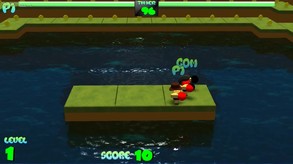
Fighting box is a casual game with characters that use boxing gloves, the player must to hit the opponent until his energy bar drain out, or the opponent fall out from the ring. The game use procedural levels, so the player can play as long as he survives or until the time out per round.
Modeled estimate, not a reported figure. How we estimate →
Media

About


Stats
All-time low is the lowest price we've recorded for this game since we started tracking it.
Languages: English, French, Italian, German, Spanish - Spain, Bulgarian, Simplified Chinese, Traditional Chinese, Korean, Danish, Spanish - Latin America, Finnish +91 more
Engagement
Hours played at review time, across 26 reviews with recorded playtime.
Reviews
wtf böle oyun mu olur
A goofy, cute little roguelike 3D platformer fighting game. Simple in concept, lots of depth in the execution.
This game is the definition of "GREATEST OF ALL TIMES", This game is so good that it stay on my mind to play without me playing it, i cant get it out of my head. Every Second i think of this game playing on my mind nonstop. I glad my friend gave this to me :3
управления ♥♥♥♥♥
FIGHTING BOX, created and published by Artur Rezende, is a compact indie fighting game that embraces simplicity and accessibility above all else. Designed as a straightforward, arcade-style boxing experience, it strips the genre down to its most basic components: movement, punching, and survival inside a confined arena. There is no elaborate narrative framework, cinematic presentation, or layered progression system driving the action. Instead, the game focuses entirely on delivering quick, energetic matches that can be completed in short sessions. From the moment you step into the ring, it becomes clear that FIGHTING BOX is built around immediacy rather than complexity. The core gameplay revolves around one-on-one bouts where players control stylized characters equipped with oversized gloves. The objective is direct and uncomplicated: land enough hits to deplete your opponent’s health or knock them out of bounds. The controls are intentionally minimal, avoiding intricate combos, special abilities, or layered defensive systems. This design makes the game easy to pick up even for players who may not typically gravitate toward fighting games. There is little barrier to entry, and within minutes, players understand the rhythm of moving, striking, and avoiding incoming attacks. However, that same accessibility can also lead to a sense of mechanical shallowness over extended play sessions, as the combat does not evolve significantly beyond its basic foundation. One element that attempts to inject variety into the experience is the procedural generation of arenas. Rather than placing every fight in a static, unchanging ring, the game introduces different layouts and environmental quirks to keep encounters from feeling entirely identical. These procedural touches add an element of unpredictability, requiring players to adapt to slightly altered spaces and movement constraints. While this feature does not transform FIGHTING BOX into a deep or strategically layered fighter, it does help mitigate repetition to a degree. The shifting arenas give each round a small twist, which can be enough to maintain engagement during shorter play sessions. Visually, FIGHTING BOX adopts a colorful and minimalistic aesthetic that aligns with its indie scope. The character models are simple and stylized, and the arenas prioritize functionality over detailed realism. Animations are serviceable, clearly conveying movement and impact without attempting elaborate choreography. The overall presentation carries a playful tone rather than a serious or competitive one. Audio design follows a similar path, offering basic sound effects and straightforward background music that complement the lighthearted feel. The audiovisual package does not aim to impress on a technical level but instead supports the quick and casual nature of the gameplay. Where the game may divide players is in its longevity. Because the mechanics remain straightforward and the variety is limited primarily to arena generation, extended play can begin to feel repetitive. There are no deep character customization options, extensive skill trees, or complex ranking systems to sustain long-term progression. FIGHTING BOX feels most comfortable as a brief diversion rather than a long-form commitment. It is the kind of game that can be launched for a few quick matches before moving on, rather than one that demands hours of focused mastery. Ultimately, FIGHTING BOX stands as a modest indie project that delivers exactly what its premise suggests: uncomplicated boxing-inspired combat with procedural arena variation. It does not attempt to rival larger fighting franchises or offer intricate mechanics, but instead provides a low-cost, accessible experience for players seeking immediate, no-frills action. Those who appreciate simple arcade-style games and short bursts of competitive play may find it enjoyable within its scope. Players seeking depth, complexity, or competitive balance, however, are likely to find its offerings too limited to maintain long-term interest. Rating: 5/10
玩起来特别卡,特别卡!卡到怀疑人生
Related
Related
Trends
Concurrent players on Steam, sampled daily since tracking started.
Audience
Estimated from the language of this game's reviews — a proxy for where players are, not official Steam demographics.
Related
| Glasses and Girls | $315.6 | 51 | 82% | $0.99 |
| Bongo Quest | $315.6 | 51 | 45% | $0.49 |
| Food and Girls | $315.6 | 51 | 86% | $0.99 |
| Dances and Girls | $322 | 52 | 83% | $0.99 |
| Carnival and Girls | $334.4 | 53 | 85% | $0.99 |
| Anime Sunset Ride | $334.4 | 54 | 67% | $0.49 |