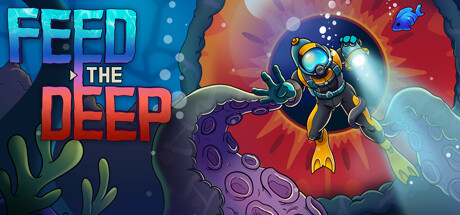
A lovecraftian roguelike. Dive into procedurally generated undersea caves. Collect gold, upgrade your equipment, and Feed the Deep.
Modeled estimate, not a reported figure. How we estimate →
Media

About
Stats
All-time low is the lowest price we've recorded for this game since we started tracking it.
Engagement
Reviews
Themes across 41 recent reviews and how positive each mention is. A keyword signal, not full sentiment analysis.
Reviews
Utterly fascinating. Ever wondered how classic Newgrounds-era flash games would fare compared to today's offerings? I can't say I have, but this game gave me the answer anyway. They'd be... boring. Feed the Deep really feels like one of these classics, but with some clear modern inspirations (such as Dome Keeper). The art style is similar, the simple yet scrappy gameplay loop is here as well. There's even a story, and the way the game evolves is fresh... But unfortunately, all of it falls flat. It's just not good enough, and the whole experience is just your mind waiting for you to realise that you're bored. It's a different kind of boredom than usual, so it's harder to detect - but that's what it is. Every "mission" has the same general objective: Acquire chum, find the Deep, bring chum to the Deep. Nothing wrong here; but something felt just off about the flow of the levels. They're procedurally generated, and somehow I felt like the cohesion and pacing weren't there. Sometimes I'd find the chum early, or late, or find both chum and the Deep too quickly, and... I don't know. All of it just felt wrong, against my instincts to explore and investigate. It's like, there's nothing to find. But your resources are limited; the shop only has a set amount of certain items, including tools. This feeling of scarcity made you want to be efficient, especially since the only way to get more resources to buy stuff is to, well, delve deeper. No freebies here. Again, this is fine. Now, with this in mind, the game has a baffling feature: there are minigames within the game. That you do while underwater. With limited oxygen. And every mission has an unique one. I completely failed to see the point of those; but the worst thing is, they feel like they're put in places that are somewhat challenging to get to. As in they're supposed to be rewards. There's the [url=https://www.youtube.com/watch?v=hnxVOUSzX4A]negative possibility space[/url], and then there's this. Where you're not only disappointed by what you find (or don't find), you feel like you're being rewarded with something you really don't want, but it's framed as if you should. Let me tell you, it's quite a feeling. Everything else is incredibly okay. There are enemies that are a moderate threat and maybe can even give you a scare or two. The exploration aspect is meh. There's a story that's actually quite interesting, but you get almost none of it. In a better game, all of these elements would be things you'd tolerate because you otherwise enjoy the other parts. Here, that's all you have. Wow, this review turned out incredibly mean. I think I hated playing it more than I realised. For the record, 60% of players beat the first level, but merely 6% beat the game. And there's only... 6 missions? Something like that. That's... well, I think I have said enough mean things today. [url=https://store.steampowered.com/curator/42922988/]curator page or something[/url]
Related
Related
Trends
Modeled estimate over time, reconstructed from Steam's monthly review histogram.
Languages: English, French, German, Spanish - Spain, Japanese, Simplified Chinese, Portuguese - Brazil
Hours played at review time, across 41 reviews with recorded playtime.
positive critical· bar length = how often the theme comes up
In the beginning, I enjoyed the game. The atmosphere was really good, and the mini-games were fun. But after a couple of hours, I found it too repetitive and quit. It feels like a simpler version of Dome Keeper
---{ Graphics }--- Comment: Game has a solid art style with some "mistakes" that look odd. ☐ You forget what reality is ☐ Beautiful ☑ Good ☐ Decent ☐ Bad ☐ Don‘t look too long at it ☐ MS-DOS ---{ Gameplay }--- Comment: The gameplay of this game is simply just boring, slow and repetetive. I am suprised the game even got released with such a basic and boring gameplay loop. I expected better from the "Creator of Fruit Ninja and Jetpack Joyride" Which both are good games because of the simple yet fun gameplay. The problem stems from the lack of gameplay depth, poor progression, questionable mechanics, boring enemies and poor objective. A very big problem with this game is that the gameplay doesn't have any depth. You swim, grab stuff and go back. The only decision you'll ever think about is "should I risk diving a bit further". Upgrade decision is too easy and the upgrades have no complexity to them than +stats. You aren't really playing the game. The game is playing you with how easy this game is. There is risk with extending the dive but the rewards are usually never worth it and the risk taking itself is just masked gambling. The game has "missions" which are like different levels. Were you need to complete some objective. I have not played much so I can't go over the different missions. But I believe this was the wrong approach progression. It does make it easier to build a story but I think it hurt the gameplay a lot. The map is randomly generated but it feels like your playing the same map every time anyways so it simply just falls flat as a feature with how little replayability this game already has. The health mechanic is an odd decision to include as the stamina bar already acts as a health mechanic not that you will ever take damage anyways if you are even playing half seriously. The Enemies are very static and make you stall (this is boring.) just make them chase. I have not played through all of the missions with their different objectives. But it is simply just not engaging enough. You deliver brain to big boy and die GG. Cool story concept but I would prefer more "Main character energy" ☐ Very good ☐ Good ☐ It's just gameplay ☑ Mehh ☐ Watch paint dry instead ☐ Just don't ---{ Audio }--- Comment: Solid sound design. Nothing to add. ☐ Eargasm ☑ Very good ☐ Good ☐ Not too bad ☐ Bad ☐ I'm now deaf ---{ Difficulty }--- With enough time you will just simply win. That's what I call "lazy adaptive difficulty." ☐ Just press 'W' ☑ Easy ☐ Easy to learn / Hard to master ☐ Significant brain usage ☐ Difficult ☐ Dark Souls ---{ ? / 10 }--- 2/10 Go play subnautica instead. ☐ 1 ☑ 2 ☐ 3 ☐ 4 ☐ 5 ☐ 6 ☐ 7 ☐ 8 ☐ 9 ☐ 10
[Closer to a mixed, than a thumbs up] i absolutely ADORE underwater games, And its fun for an hour or two But there's really not enough depth (No Pun Intended) for me to give you more info than the trailer does
Feed the Deep is a tightly designed roguelite that takes a simple premise—dive, gather, return—and builds it into a tense, atmospheric experience driven by constant risk and decision-making. Developed and published by Luke Muscat, the game is set in a world where humanity clings to survival above an endless ocean while something vast and unknowable waits below. Your role is not to conquer the depths, but to descend into them repeatedly, collecting resources to appease this presence and delay whatever catastrophe it threatens to unleash. This framing gives the entire experience a sense of quiet dread, where every dive feels less like an adventure and more like a necessary gamble. The gameplay loop is immediately clear but quickly becomes layered with tension. Each run sends you into procedurally generated underwater cave systems where you must gather materials and return before your oxygen supply runs out. What makes this loop compelling is the constant trade-off between risk and reward. Carrying more resources slows your movement, making escape more difficult, while pushing deeper increases the likelihood of getting lost or overwhelmed. Every decision—whether to take one more item, explore one more tunnel, or turn back—feels significant. The game thrives on this balance, turning small choices into moments of genuine suspense. Movement and navigation play a crucial role in shaping the experience. The cave systems are often disorienting, filled with winding paths and limited visibility that make it easy to lose your bearings. Unlike many games that rely on direct threats, Feed the Deep often creates tension through the environment itself. Darkness, tight spaces, and the ever-present need to find your way back to safety become the primary challenges. Hostile creatures do appear, but they are rarely the central focus. Instead, they serve to reinforce the danger of the depths, adding pressure without overshadowing the core survival mechanics. Progression is handled through a gradual accumulation of upgrades and tools that expand your capabilities. These improvements allow for longer dives, better visibility, and more efficient resource gathering, but they do not remove the underlying tension. Even as you become more capable, the game introduces new variables and challenges that keep the experience from becoming predictable. This steady layering of mechanics ensures that each run feels slightly different, encouraging players to adapt their strategies and experiment with different approaches rather than relying on a single optimal path. Atmosphere is one of the game’s defining strengths. The underwater setting is rendered with a sense of isolation that is both calming and unsettling, with limited light sources creating a constant contrast between visibility and darkness. Sound design plays a major role in maintaining this tone, using subtle audio cues and ambient noise to build a sense of unease. The deeper you go, the more oppressive the environment becomes, reinforcing the idea that you are entering a space that was never meant to be explored. This focus on mood over spectacle gives the game a distinctive identity, making it feel immersive without relying on elaborate visuals. The narrative is understated, revealed through small fragments rather than explicit storytelling. Bits of lore scattered throughout the game hint at the nature of the entity below and the precarious situation of those living above the ocean. This approach keeps the focus on gameplay while still providing context, allowing players to piece together the story at their own pace. It is not a narrative-heavy experience, but the minimal storytelling works well within the game’s structure, reinforcing its themes without interrupting the flow of play. Despite its strengths, the game does have some limitations. The core loop, while engaging, can become repetitive over time, particularly for players who spend extended sessions exploring its systems. Enemy variety is somewhat limited, and while the environmental challenges remain effective, they do not always evolve in ways that significantly change the overall experience. The difficulty can also feel unforgiving, with small mistakes often leading to abrupt failure. This adds to the tension but may not appeal to players who prefer a more forgiving progression system. Even with these drawbacks, Feed the Deep succeeds in delivering a compelling and addictive experience. Its strength lies in how well it combines simple mechanics with meaningful decision-making, creating a loop that is easy to understand but difficult to master. Each dive feels like a self-contained challenge, and the constant push and pull between risk and safety keeps players engaged. It captures the essence of what makes roguelites satisfying, where failure is part of the process and each attempt contributes to a deeper understanding of the game. In the end, Feed the Deep stands out as a focused and atmospheric entry in the roguelite genre. It does not aim for complexity or scale, but instead refines its core ideas into something cohesive and engaging. The combination of tension, exploration, and gradual progression creates an experience that is both immersive and rewarding, even if it occasionally leans toward repetition. For players who enjoy methodical gameplay with a strong sense of atmosphere, it offers a journey that is as gripping as it is challenging. Rating: 8/10
Quick Description: -Feed the Deep is an underwater exploration game inspired by Dome Keeper and Wall World. The other main difference is that you don't actually do any mining in this game, but the game progression is very similar. You go down and explore an increasingly hostile underwater world, searching for resources, secrets, and eventually chum to feed to the deep. When you return to the shop, you can use these resources to purchase upgrades that allow you go deeper and survive longer in your quest to explore as much as possible. This game is so close to hitting the mark, but it just never really clicks. I completed the first 4 levels of difficulty and grew very tired of this formula on the 5th level of difficulty. Consensus: -Bottom Shelf Game (Tier 5 and makes up 10% of my reviews). On paper, this should be slam dunk game for me to enjoy, but when actually playing, this game leaves a lot to be desired. Exploring the ocean never feels as rewarding as it should. The challenge varies wildly. The first 3 missions are so easy that you can basically skip all items or upgrades except for the obvious ones that help you stay underwater longer. The fifth level is pitch back for long portions of the level and the shop has a random assortment of items, making it painfully tedious to purchase enough lights in order to see where to go. There just isn't enough enemy diversity, upgrade variety, or fun incentives to keep me playing. So for that reason, I can't recommend this game.
Game feels too dark and slow. Maybe its my own ability to get lost, but swimming around in the dark running into dead ends and running out of air and needing to go back doesn't feel great. Would maybe feel better if there were some kind of vague mapping system to remember the last place I was exploring so I could get back there a bit easier. There are items to aid exploration, but their usefulness is somewhat limited and requires a large amount of investment of time and resources to make them useful. The combination of darkness and trying to find an item lost in the darkness feels like a bit too much to deal with, not to mention how slow it actually is to move through the environment's winding paths.
Not perfect, but still super fun. Feed the deep is a fun game, even with its little nitpicks. It gets a bit repetetive after a while and there are some flaws here and there, but i mean for just 7 bucks its quite good. If you want just a fun cheap game to enjoy for a few hours, this is it.
7/10 I had fun with the game but it got a little repetitive for a roguelite. Its a great little game with a wonderful atmosphere and gameplay thats great and Im fine with randomly generated missions but in return so much of the game is predetermined removing replayability. I wish that after you beat the game some kind "secret mission" would appear thats truly randomized and I wish for a little more enemy variety. Playing through the game once is perfect but replaying it doesnt work well.
cool idea but felt like a mobile game and theres not nearly enough upgrades
Audience
Estimated from the language of this game's reviews — a proxy for where players are, not official Steam demographics.
Related
| DROP - System Breach | $54.6K | 188 | 88% | $9.99 |
| Mighty Switch Force! Collection | $54.6K | 121 | 90% | $19.99 |
| HunterX: code name T | $54.6K | 165 | 86% | $16.99 |
| 3089 -- Futuristic Action RPG | $54.6K | 309 | 78% | $6.99 |
| [Chilla's Art] The Caregiver | 終焉介護 | $54.6K | 461 | 81% | $4.99 |
| Heroic Armored Company | $54.7K | 191 | 57% | $10.19 |