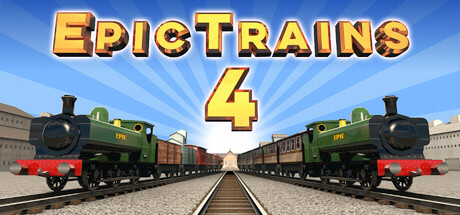
Run a transportation empire with planes, trains, automobiles and ships. Become a transportation tycoon. No generative AI.
Modeled estimate, not a reported figure. How we estimate →
Media

About
No generative AI.
Epic Trains 1 2 & 3 included in the game folder.
1) Create a network of trains, busses and planes to connect all the towns together and overseas.
2) Multi stage resource harvesting and transporting. Ore, Ingots and export goods.
3) Make airports to transport people and mail around the map or overseas.
4) Build airports, train stations, truck depots and more.
5) Import goods from overseas and ship them to towns.
6) 20 Resources to transport from mail to oil.
7) Procedurally generated maps.
8) Maintain fleets of trucks, trains and planes.
9) Large array of trains, trucks, planes and ships to build.
10) Run a transportation empire from 1950 into the modern day.
.
Genres
Stats
All-time low is the lowest price we've recorded for this game since we started tracking it.
Languages: English*, French, Italian, German, Spanish - Spain, Bulgarian, Czech, Danish, Dutch, Finnish, Greek, Hungarian +17 more
Reviews
As it stands, I would not recommend this game to anyone expecting a polished experience, but it has potential to grow into something amazing over time. Steam needs a middle ground between "yes" and "no" for review purposes. The developer still has a long road ahead and you might want to wait out until they are a little further in the process. Do keep your eye on it, and buy it if you want to support the developer. Yes, the basic simulation is there; you can set up transport lines between various companies and these will slowly but surely net you a decent profit allowing you to branch out from trains to other transport vehicles. Unfortunately there are also some problems which inhibit your playing. - The floating boxes explaining what each industrial building offloads or onloads are very large and get in the way when you're panning around trying to lay tracks. - You have to select either a horizontal or diagonal track and there's no quick switching. - You cannot set up a diagonal track easily. It will always need to extend three or more spaces at once so forget using it for a quick corner. I have had to delete the excess quite a few times now but this sometimes also takes away the corner you need. - As far as I've been able to tell there are no signals for tracks yet. Perhaps I missed this or it might come with a later update, so just run a single train per track. - You can't get to the graphics or sound menu from within the game unless you exit to the menu first. - The menu is larger than life and elements could be shrunk down a lot while still remaining readable. - I have had a hang at least twice now (playing the native Linux version). This game has potential, and I hope the developer sticks with it and improves it one update at a time. Don't get disheartened by my review, it may change as the game improves. I am keeping my eye on this title and will continue to play it when I have time, just to see the improvements happen. Once more; buy it to support the developer and have fun with the quirks of the game as it exists now, but don't expect it to be polished.
Related
Related
Trends
Concurrent players on Steam, sampled daily since tracking started.
If you like trains you might like this game. If you love trains you might love this game? If trains killed your father and married your mother and now sit on the throne of Canada, you might not have long to live.
Not just trains, planes and automobiles as well! A great management sim without too much bloat. Oh, and there's also boats.
Epic Trains 4 is an ambitious indie transport management and empire-building simulator developed and published by Andrew Rowe that aims to capture the long-term satisfaction of classic tycoon games while expanding their scope with modern presentation and multi-modal logistics. Rather than focusing solely on railways despite its name, the game invites players to design an interconnected transportation ecosystem that spans trains, buses, trucks, planes, and ships. From the outset, Epic Trains 4 positions itself as a sandbox for players who enjoy watching complex systems grow organically from humble beginnings into sprawling networks of infrastructure and commerce. The core experience revolves around building and optimizing transport routes across procedurally generated maps. Players begin with limited funds and basic infrastructure, then gradually expand by connecting towns, industries, and resource nodes. Each transport type has its own role and strengths, encouraging thoughtful planning rather than a single dominant strategy. Trains excel at moving large quantities of goods over long distances, road vehicles handle local distribution, aircraft provide speed for passengers and mail, and ships enable large-scale or international logistics. This layered design means that success often comes from combining systems intelligently rather than relying on brute expansion. Economic management plays a central role in Epic Trains 4. The game features a wide range of cargo types and demands that fluctuate as cities grow and industries develop. Establishing profitable routes requires attention to supply chains, vehicle capacities, and operational costs. Poorly planned networks can quickly become financial drains, while efficient logistics reward players with steady income and expansion opportunities. The satisfaction comes not from moment-to-moment action, but from seeing a carefully planned system begin to run smoothly, with vehicles moving in rhythm and resources flowing predictably. Visually, Epic Trains 4 adopts a 3D isometric perspective that allows players to observe their networks from both a strategic and a more immersive viewpoint. While the graphics are modest and utilitarian rather than flashy, they effectively convey scale and movement, letting players zoom in to watch vehicles operate or pull back to analyze bottlenecks and coverage gaps. The presentation favors clarity over spectacle, which suits a management-focused game where readability and information flow are essential. Interface elements are functional and generally straightforward, supporting mouse-driven control and emphasizing accessibility. In terms of depth, the game strikes a middle ground between approachability and complexity. Newcomers to the genre can grasp the basics of building routes and assigning vehicles without being overwhelmed, while experienced transport sim players will find plenty of room for optimization and long-term planning. Fine-tuning routes, balancing multiple transport modes, and adapting to new map layouts create a steady sense of progression. Because maps are procedurally generated, each new game presents fresh geographic challenges, encouraging players to rethink strategies rather than rely on a single optimal setup. As an indie title, Epic Trains 4 shows both its strengths and its rough edges. The scope of its systems is impressive for a solo-developed project, but there are moments where mechanics feel underdeveloped or where bugs and balance issues can interrupt the flow of play. These issues are especially noticeable during longer sessions, where stability and polish become more important. However, the underlying systems are strong enough that these problems feel like growing pains rather than fundamental flaws, particularly given the game’s ongoing development and active engagement with player feedback. What ultimately defines Epic Trains 4 is its sense of scale and patience. It is not a game that rushes players or provides constant spectacle; instead, it rewards careful thinking, experimentation, and incremental improvement. Watching a small network evolve into a continent-spanning transport empire delivers a quiet but powerful sense of accomplishment. For fans of transport tycoons, logistics simulators, and sandbox management games, Epic Trains 4 offers a compelling foundation with plenty of room to grow, standing as a promising entry in the genre that emphasizes creativity, strategy, and the joy of well-designed systems working in harmony. Rating: 6/10
I know this is a cheap game, but still. After starting a new game, the only things I can do are selecting a station or rotating the map. However, I cannot place it anywhere in the map, I cannot scroll the map, I cannot select anything else on the screen, I cannot invoke the in-game menu... Fortunately, Alt-F4 still works (is it a suggestion?). Also, the Polish language version is sh*tty. Among numerous errors, there is not “depot” in Polish, “oil well” is no “studnia naftowa”, and “credits” are no “napisy”. AI slop probably.
At this time I don't find it enjoyable. Graphics are basic, UI is clunky and glitchy, the simplest actions are difficult. Just trying to do the tutorial was very frustrating. I realise that it's still a work in progress so should get better over time. I'm happy to try it again when it's more polished but for now it's not for me.
Related
| Hidden Cats: Rome | $982.7 | 58 | 95% | $0.99 |
| 魔法少女は自由に変身できない。 | $983.9 | 59 | 98% | $0.99 |
| Gachi Bird | $983.9 | 60 | 83% | $0.99 |
| Poor Stickman | $984.5 | 66 | 79% | $0.69 |
| Wonky Pigeon! | $979.8 | 58 | 21% | $0.79 |
| BYTE FYTE (MULTIPLAYER) | $979.4 | 53 | 72% | $0.69 |