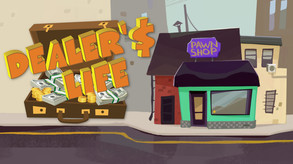
Live the ultimate pawn shop experience in this funny retro style tycoon game!
Modeled estimate, not a reported figure. How we estimate →
Media
About
Dealer's Life is a tycoon game where you manage your pawn shop. Haggle with infinite randomly generated customers to buy and sell whatever items you can manage to score and offer! Have fun for hours and use all your negotiation, psychology, and management skills to create your pawn empire! Thanks to procedural generation, special characters, and random events, you’ll never know what’s coming next!
Getting to know your customers is the key to skyrocketing your activity, and personal relations are also quite unpredictable…
In Dealer’s Life, you will meet thousands of unique customers, with ever-changing behaviors and traits: they all act differently during negotiations according to their specific psychological traits, which are reflected in their appearance. Thanks to our Trading Engine, all the exchanges you will have with your clients will vary. Based on your input, the NPCs will react in a wide range of manners: they can choose to make a counter offer, accept your proposal, reject the negotiation and go away, get angry with the player for his ridiculous offer, impose a final offer without further negotiation... and all of these reactions depend on the offer made by the player to the perceived value of the item, along with all the specific combination of psychological traits of the customer.
And that’s not all! The Trade Engine includes another peculiar aspect: we mentioned the "perceived value" because in Dealer’s Life, the goods’ real value is never shown anywhere. It’s up to you and your client, based on your Competence skill, to estimate the value of an object. No in-game guides or tutorials, just your instinct will bring success in your negotiations!

In Dealer’s Life, your character will have various skills that will drastically shift your gameplay experience. Getting more experience to spot counterfeit items and a keen eye for goods with potential will make you a smarter negotiator who won’t only save some bucks, but also make a fortune thanks to your experience!
Talking of your contracting traits, you can also improve and gain other psychological abilities that will guarantee you the upper hand during negotiations: persuade your customer to get a better deal or convince them to sell out a precious item they know nothing about just for a better price.
The dealers’ world is ruthless; only the most cunning will thrive!

During your dealer’s adventure, you may encounter random events that could also be influenced by the reputation you built, leading to different situations and scenarios that will track down that time you didn’t prove yourself capable of spotting a fake item, or when you decided to scam that one random guy… Which was later revealed to be a buddy of the local mafia.
Making more money will always come with some risks and consequences dictated by the integrity of your choices. Maybe the best skill a dealer can have is recognizing when to be cunning or a perfectly law-abiding entrepreneur.

Genres
Stats
All-time low is the lowest price we've recorded for this game since we started tracking it.
Languages: English*, French*, Italian*, German*, Spanish - Spain*, Spanish - Latin America*, Portuguese - Portugal*, Portuguese - Brazil*, Turkish**languages with full audio support
Engagement
Hours played at review time, across 42 reviews with recorded playtime.
Reviews
Themes across 42 recent reviews and how positive each mention is. A keyword signal, not full sentiment analysis.
positive critical· bar length = how often the theme comes up
Reviews
Really bad because most of the time the customers won't buy your items and you lose the round for no reason
Dealer’s Life is a surprisingly addictive pawn shop management simulator that transforms the simple act of buying and selling secondhand items into a tense psychological game filled with negotiation, risk management, and unpredictable customer interactions. While the premise initially sounds straightforward, the game quickly reveals a remarkable amount of depth beneath its comedic presentation. Every customer interaction becomes a battle of instinct and strategy where reading personalities, estimating value, and knowing when to push negotiations can mean the difference between building a thriving business or collapsing into debt. The gameplay centers around operating a pawn shop where customers arrive carrying all kinds of objects, ranging from worthless junk to valuable collectibles and rare artifacts. Instead of immediately revealing an item’s exact value, the game forces players to make educated guesses based on experience, upgrades, and observation. This simple mechanic creates constant tension because every purchase involves risk. Paying too much for an item can damage profits, while offering too little may cause customers to walk away with potentially valuable merchandise. The uncertainty surrounding every transaction keeps the gameplay loop engaging for surprisingly long periods of time. One of the game’s strongest features is its negotiation system. Customers are not simply generic NPCs repeating the same dialogue. Each visitor has different personalities, emotional reactions, and psychological traits that directly influence how they respond during bargaining. Some are impatient and easily offended, others are gullible or overly emotional, while certain individuals are skilled scammers trying to trick the player with counterfeit goods. The game constantly encourages players to pay attention to behavior patterns and adjust their negotiation tactics accordingly. Successful deals often feel less like mathematical calculations and more like small psychological victories. The procedural generation system also contributes heavily to the game’s replayability. Customers, random events, item quality, and shop encounters are continuously generated, meaning every playthrough unfolds differently. One day may bring profitable collectors carrying expensive antiques, while another floods the store with suspicious individuals attempting to sell fake products. The unpredictability keeps the experience fresh because players never know exactly what opportunities or disasters are about to walk through the front door. Progression systems add another layer of depth to the management gameplay. Players can invest skill points into various abilities that improve appraisal accuracy, negotiation effectiveness, customer analysis, and counterfeit detection. These upgrades gradually allow players to become more efficient and specialized in their approach to running the business. Some players may focus heavily on charisma and manipulation to maximize profits during negotiations, while others prioritize careful analysis and fraud prevention to avoid costly mistakes. Managing the pawn shop itself becomes increasingly important as the business grows. Expanding storage space, hiring employees, upgrading facilities, and investing in specialists all contribute to long-term success. Employees such as restorers, experts, and profilers introduce additional strategy because each role provides unique advantages. Restorers can increase item value significantly, while profilers help reveal customer personality traits during negotiations. These systems create a satisfying sense of progression as the tiny pawn shop gradually transforms into a larger and more profitable operation. The visual presentation uses a colorful retro-inspired art style that perfectly matches the game’s humorous tone. Character portraits are exaggerated and expressive, helping negotiations feel more lively and entertaining. The pixel-art aesthetic may appear simple at first, but it gives the game a distinct personality that fits the chaotic world of bargaining and shady business deals surprisingly well. The exaggerated facial expressions and customer animations often make negotiations more amusing than they would be in a more realistic presentation style. Humor is another major strength throughout the experience. Dealer’s Life constantly throws bizarre situations, strange customers, and unexpected events at the player. Pop culture references, ridiculous item descriptions, and absurd encounters help prevent the management systems from becoming overly repetitive or dry. Even failed negotiations and financial disasters often remain entertaining because the game never takes itself too seriously. The pacing of progression is particularly satisfying because success feels earned rather than automatic. Early-game survival can be difficult, especially when players misjudge item values or fall victim to scams. Money management becomes increasingly important as expenses rise and risks become larger. Every profitable deal creates genuine satisfaction because failure always feels possible. This constant balance between greed and caution becomes one of the most addictive aspects of the game. Despite its many strengths, Dealer’s Life does have some noticeable flaws. Over very long sessions, the gameplay loop can begin feeling repetitive because the core structure changes very little throughout the experience. Negotiations eventually become somewhat predictable once players fully understand customer behaviors and optimal bargaining strategies. The interface can also feel cluttered at times, especially when managing large inventories and multiple employees simultaneously. Randomness occasionally creates frustration as well. Since many systems rely heavily on procedural generation, some failures can feel based more on bad luck than player skill. Certain random events may punish players harshly despite careful preparation, which could irritate players who prefer more predictable business simulators. However, that unpredictability also contributes heavily to the game’s charm because it reflects the unstable and risky nature of running a pawn business. What ultimately makes Dealer’s Life so engaging is how effectively it turns ordinary buying and selling into a tense psychological management experience. Every transaction carries uncertainty, every customer interaction requires careful judgment, and every successful negotiation feels rewarding because profits are never guaranteed. The game constantly creates the feeling that one excellent deal could transform the business while one terrible mistake could ruin everything. Dealer’s Life is an excellent management simulator that combines negotiation strategy, procedural unpredictability, and humorous presentation into an experience far deeper than its simple concept initially suggests. Its addictive gameplay loop, charming personality, and constant stream of unique customer interactions make it easy to lose hours managing the chaotic world of secondhand trading and pawn shop capitalism. Rating: 9/10
Played this a lot on my phone, super fun game. Saw there were some sequels to check out also, but got stuck playing the old one :p
MÜKEMMEL
nice
ıyı oyun
çok zor
Random events and being forced into MINUS balance ruins the fun. Game also doesn't tell you at any point that if you go minus balance 3 times no matter how you went minus the game ends// eventually you will lose all your progress and be sent back to the main screen with a "New Game" option.
Başlarda iyi zevkli ama oyun çok kendini tekrar ediyor bu yüzden bi kaç kez oynadıktan sonra sıkılıp bırakabilirsiniz hani al daha fazlaya sat sonra bişeyler geliştir sonra aynı döngüyü tekrar et arada polisler gelsin fln küçük şeyler var ama bence daha fazla çeşitlilik katılabilir oyuna bu durumda oyunun kendini tekrar etme durumu kalmaz ama genede ben beğenmiştim başta o yüzden tavsiye ediyorum
gg
Related
Related
Trends
Concurrent players on Steam, sampled daily since tracking started.
Audience
Estimated from the language of this game's reviews — a proxy for where players are, not official Steam demographics.
Related
| Comic Book Hero: The Greatest Cape | $103.1K | 136 | 44% | $19.99 |
| Panoptic | $103K | 324 | 96% | $16.99 |
| Japan Stigmatized Property -日本事故物件監視協会- | $103.1K | 361 | 74% | $7.99 |
| CDF Starfighter VR | $103.1K | 102 | 63% | $29.99 |
| Harmony: The Fall of Reverie | $103K | 282 | 73% | $24.99 |
| PARANOID | $103.1K | 294 | 43% | $17.99 |