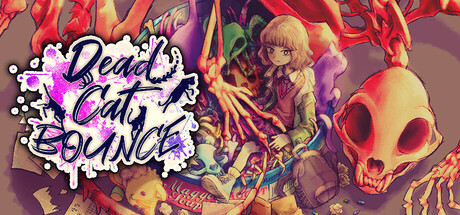
Dead Cat Bounce is a compact narrative-driven indie adventure developed by Sesame and published by PsychoFlux Entertainment, offering a reflective, atmosphere-heavy experience built around quiet exploration and emotional introspection. Rather than pursuing complex mechanics or elaborate gameplay systems, the title leans fully into storytelling, presenting a subdued journey that unfolds across a modest but carefully crafted urban setting. It is the kind of game that prioritizes mood over spectacle, asking players to slow down, observe, and engage with subtle emotional cues rather than chase objectives or master mechanics.
The story centers on Sera, an ordinary student whose routine life takes an unexpected turn when she encounters a mysterious talking calico cat. This surreal event becomes the catalyst for a journey that moves through city streets, familiar landmarks, and fragments of memory. The cat functions less as a traditional fantasy guide and more as a narrative device—an embodiment of curiosity, regret, or perhaps unresolved emotion. As Sera follows this unusual companion, the narrative gradually reveals layers of her inner world, touching on themes of memory, uncertainty, and personal growth. The premise may sound whimsical on the surface, but the tone quickly settles into something more contemplative and grounded.
Gameplay is deliberately minimalist. Built using RPGMaker tools, Dead Cat Bounce employs a 2D top-down presentation with simple yet expressive pixel art. Movement through environments triggers dialogue sequences, environmental observations, and small narrative revelations. There are no combat systems, puzzles, or branching mechanics to complicate progression. Instead, the player advances by exploring spaces and engaging with contextual prompts that deepen the story. This design choice transforms the game into something akin to an interactive short story or a digital walking simulator, where immersion arises from atmosphere rather than challenge.
The pacing reflects this philosophy. Scenes unfold at an unhurried rhythm, with conversations and internal monologues spaced between quiet stretches of exploration. The soundtrack complements this approach with understated melodies and ambient sound design that reinforce the reflective mood. The environments—city sidewalks, quiet corners, and subtly detailed interiors—create a grounded setting that contrasts gently with the surreal presence of the talking cat. This contrast gives the experience a dreamlike edge without fully departing from realism.
Emotionally, the game relies on suggestion rather than overt drama. Much of its impact comes from what is implied rather than explicitly stated. The narrative avoids melodrama, instead inviting players to interpret Sera’s thoughts and reactions through context and subtle cues. This understated approach may resonate strongly with players who appreciate introspective storytelling, though it may feel too subdued for those expecting dramatic twists or high-stakes conflict. The brevity of the experience reinforces its tone; it feels more like a short reflective episode than a sprawling narrative arc.
One of the game’s strengths lies in its cohesion. Every design element—visual style, sound design, pacing, and structure—supports the central theme of quiet self-exploration. The simplicity of the mechanics ensures that nothing distracts from the narrative focus. However, that same simplicity also limits replay value. With a largely linear progression and minimal branching, the experience is meant to be absorbed once rather than revisited repeatedly. Its impact depends largely on how much the player connects with its tone and themes.
While Dead Cat Bounce may not appeal to players seeking mechanical depth or extended playtime, it succeeds within its chosen scope. It demonstrates how a small-scale indie project can deliver emotional resonance through careful atmosphere and focused storytelling. By embracing restraint and prioritizing introspection over complexity, the game creates a contemplative experience that lingers gently after completion.
Ultimately, Dead Cat Bounce stands as a thoughtful and intimate narrative piece. It is not designed to overwhelm or astonish, but to quietly engage and provoke reflection. For players who value story-driven exploration and understated emotional journeys, it offers a short yet meaningful experience that showcases the potential of minimalist design when paired with heartfelt storytelling.
Rating: 6/10