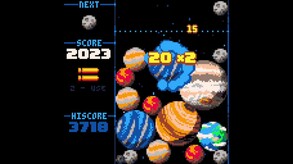
Cosmic Collapse, developed by Johan Peitz and Vav and published by Apskeppet, is a minimalist physics-based puzzle game that builds its appeal around a single, well-executed mechanic: combining celestial bodies to create larger ones. It presents itself with an almost deceptive simplicity, offering a concept that is immediately understandable yet capable of producing surprisingly engaging and satisfying moments. Rather than layering on complex systems or multiple modes, the game focuses on refining this core idea, creating an experience that feels both approachable and quietly addictive.
The gameplay centers on dropping and merging planets within a confined space, gradually building toward larger and more valuable celestial objects. Each object behaves according to a light physics system, introducing a sense of motion and unpredictability that keeps the experience dynamic. While players can influence outcomes through careful placement and timing, there is always an element of uncertainty in how objects will settle and interact. This balance between control and chaos is key to the game’s appeal, as it encourages experimentation while still rewarding thoughtful decision-making.
Unlike many puzzle games that rely on time pressure or strict scoring systems, Cosmic Collapse adopts a more relaxed pace. There is no urgency forcing players to act quickly, allowing them to take their time and consider each move. This slower rhythm gives the game a meditative quality, where the focus shifts from competition to process. At the same time, there is still a sense of progression, as players aim to create increasingly larger objects and manage the limited space effectively. The challenge emerges naturally from the accumulation of smaller decisions rather than from external constraints.
To add a layer of strategy, the game introduces limited-use tools that can help players recover from difficult situations. These mechanics provide a safety net without removing the consequences of mistakes, encouraging players to think carefully about when and how to use them. Combined with a scoring system that rewards efficient merges and chain reactions, the game offers subtle incentives for optimization without overwhelming the player with complexity.
The visual presentation is clean and understated, relying on colorful pixel art to create a clear and readable play space. Each object is distinct, making it easy to track movement and anticipate interactions. The aesthetic leans into a retro-inspired style, but it avoids unnecessary detail, ensuring that the focus remains on the gameplay. This simplicity works in the game’s favor, reinforcing its identity as a straightforward yet polished experience.
However, the game’s greatest strength—its simplicity—is also its main limitation. The core mechanic, while satisfying, does not evolve significantly over time. There are no major additions or variations that fundamentally change how the game is played, which can lead to a sense of repetition during longer sessions. While the gameplay loop remains enjoyable, it may not provide enough depth to sustain extended engagement for players seeking more variety or complexity.
The overall scope of Cosmic Collapse reflects a clear design intention. It is built for short, repeatable sessions rather than long, continuous play. This makes it well-suited for casual play, where players can engage for a few minutes and still feel a sense of accomplishment. At the same time, this structure limits its long-term appeal, as the absence of deeper progression systems or diverse modes reduces the incentive to return over extended periods.
Despite these limitations, the game succeeds in delivering a cohesive and polished experience. It demonstrates how a simple concept, when executed well, can create a compelling gameplay loop that resonates with players. The consistent positive reception highlights its effectiveness in achieving its goals, even if those goals are intentionally modest.
Ultimately, Cosmic Collapse is a game that understands its strengths and builds around them. It does not attempt to expand beyond its core idea, instead focusing on making that idea as engaging as possible. The result is a puzzle game that is easy to pick up, satisfying to play, and capable of providing moments of genuine enjoyment through its blend of physics and strategy.
In the end, Cosmic Collapse stands as a refined and accessible puzzle experience that excels through simplicity and clarity. It may not offer the depth or variety of larger titles, but it delivers a focused and enjoyable experience that is well-suited to short bursts of play.
Rating: 8/10