Constricting Cubes is a minimalist arcade puzzle experience that transforms a very simple gameplay concept into something unexpectedly tense, claustrophobic, and psychologically engaging. Developed and published by D.W.S., the game combines classic color-matching mechanics with environmental pressure and virtual reality immersion to create a puzzle experience that feels far more stressful and survival-focused than traditional casual puzzle games. At first glance, the game appears almost deceptively simple, built around glowing cubes and straightforward mechanics, but the moment the walls begin closing inward and the available space starts disappearing, the experience changes completely. Rather than encouraging relaxation or passive problem-solving, Constricting Cubes creates constant pressure by making the player physically trapped inside the puzzle itself. The result is a unique indie title that succeeds less through complexity and more through atmosphere, pacing, and the unusual sensation of solving puzzles while fighting against confinement and spatial collapse.
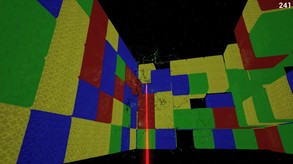
The central concept is remarkably straightforward. Players are placed inside a three-dimensional arena surrounded by clusters of colored cubes slowly moving inward from all directions. The objective is to destroy matching cube formations before the environment completely closes around the player and crushes them. This combination of puzzle-solving and environmental survival immediately gives the game a different identity compared to standard match-three experiences. Most puzzle games position the player outside the action as an observer manipulating a board or grid from a safe distance. Constricting Cubes instead places the player directly inside the puzzle space, making physical positioning and environmental awareness just as important as identifying matching colors. That single design decision fundamentally changes the emotional tone of the experience and turns what could have been a calm arcade puzzler into something tense and occasionally overwhelming.
One of the game’s most interesting qualities is how effectively it uses shrinking space as a source of pressure. The cube structures constantly move inward at a steady pace, reducing the player’s room for movement and increasing the sense of urgency with every passing moment. This environmental constriction creates a surprisingly strong psychological effect, especially during later stages where the available space becomes dangerously limited. The tension does not come from enemies or combat but from the growing realization that hesitation directly reduces the player’s chances of survival. Every second spent searching for matches allows the walls to creep closer, transforming simple decision-making into a constant race against compression and collapse. It is a surprisingly effective concept because it weaponizes space itself against the player.
The game was originally designed with virtual reality support as one of its core features, and that focus becomes immediately obvious while playing. In VR, the shrinking cube walls create a much stronger sensation of immersion and physical confinement. Looking around inside the collapsing arena while manually interacting with glowing cube formations gives the gameplay a level of presence rarely found in minimalist puzzle games. The sensation of physically standing inside the puzzle environment makes the pressure feel much more immediate and personal. Watching the walls close in around your body while trying to rapidly identify matching cube colors creates moments of genuine stress despite the abstract visuals. This immersive quality helps Constricting Cubes stand apart from many other VR puzzle experiments because the game’s core mechanic naturally benefits from physical spatial awareness. ([store.steampowered.com](https://store.steampowered.com/app/535270/Constricting_Cubes/?utm_source=chatgpt.com))
At the same time, the game remains fully playable without VR hardware, supporting traditional displays, gamepads, and mouse controls. Surprisingly, the gameplay still functions relatively well outside VR because the central mechanic is strong enough to survive without the added immersion. While the standard display version naturally loses some of the claustrophobic physical tension that VR provides, the shrinking environments still create enough urgency to keep the gameplay engaging. The controls are intuitive regardless of platform, allowing players to focus entirely on identifying cube matches and managing the constantly collapsing space around them.
Visually, Constricting Cubes embraces a clean and futuristic neon aesthetic built around glowing geometric structures, dark backgrounds, and minimal environmental clutter. The graphics are intentionally simplistic, but that simplicity serves the gameplay extremely well because players need to immediately recognize colors, spatial relationships, and environmental movement during high-pressure situations. Bright cube colors contrast sharply against dark void-like environments, ensuring that gameplay information always remains readable even during chaotic later stages. The game’s visual identity feels heavily inspired by classic arcade aesthetics and minimalist science-fiction design, creating an atmosphere that is simultaneously sterile and hypnotic.
One of the strongest aspects of the presentation is how effectively it supports immersion despite its minimalism. The glowing cubes, dark environments, and ambient lighting create the impression of existing inside some kind of futuristic simulation or digital containment chamber. The world itself lacks detailed narrative context, but the visual design subtly reinforces the sensation of isolation and confinement. Players are not exploring a story-driven environment but surviving inside an abstract machine designed entirely around pressure and compression. This lack of narrative complexity actually benefits the experience because it keeps the player’s attention fully focused on survival and spatial awareness.
Gameplay revolves around balancing speed, efficiency, and environmental management. Players must quickly identify groups of matching cubes and eliminate them before the surrounding structures move too close. As the game progresses, cube arrangements become more complicated and constriction speeds increase dramatically. Early levels allow enough breathing room for players to comfortably learn the mechanics, but later stages become frantic and stressful as space disappears much faster than before. The escalating pace transforms the gameplay from calm puzzle-solving into something resembling arcade survival gameplay. Certain later sequences become genuinely intense because players must process visual information and react rapidly while the environment physically closes in around them.
For players who enjoy arcade-style puzzle games, experimental VR experiences, and indie titles built around strong central mechanics, Constricting Cubes offers a tense and surprisingly unique experience filled with claustrophobic pressure and addictive survival gameplay. Its repetitive structure, limited variety, and minimalist presentation prevent it from becoming one of the genre’s defining puzzle games, but the creativity behind its core concept still makes it stand out within the crowded indie puzzle scene. The game ultimately succeeds as a focused experimental project that proves even the simplest mechanics can become compelling when combined with the right atmosphere and sense of physical pressure.
Rating: 5/10