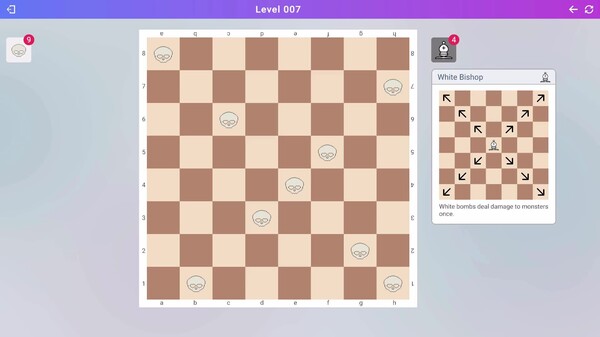
Chess Bomb is a unique puzzle game where bombs take the shape of chess pieces. Strategically use these explosive chess bombs to fend off waves of invading monsters threatening the chess kingdom.
Modeled estimate, not a reported figure. How we estimate →
Media

About
Chess Bomb is a unique puzzle game where chess-piece-shaped bombs are used to defeat monsters. Place the bombs on empty squares of the chessboard, and they attack in patterns following the movement rules of chess pieces. The goal of each level is to eliminate all enemies using a limited number of bombs.
The game features various enemies and obstacles, such as stubborn monsters that require multiple hits, mysterious ghosts that appear and disappear, and tiles where bombs cannot be placed.
Players can use powerful White, Black, and Ghost Chess Bombs. For example, the Black Bomb obliterates enemies in one explosive move, while the Ghost Bomb can be placed even on restricted squares. Overcome more than 200 levels with clever strategies and creative thinking, and experience explosive victories on the chessboard!
Stats
All-time low is the lowest price we've recorded for this game since we started tracking it.
Languages: English, French, Italian, German, Spanish - Spain, Russian, Japanese, Simplified Chinese, Traditional Chinese, Turkish, Portuguese - Portugal, Korean
Reviews
Chess Bomb is a clever tactical puzzle game that transforms traditional chess movement into an explosive logic-based challenge built around strategy, planning, and experimentation. Developed and published by NovaScreen, the game takes familiar chess piece movement patterns and reimagines them as bomb mechanics used to eliminate monsters across grid-based puzzle boards. Instead of playing competitive chess matches, players solve increasingly difficult tactical scenarios where every bomb placement matters. The result is a surprisingly addictive puzzle experience that feels both approachable and strategically rewarding. The core idea behind Chess Bomb is simple but extremely effective. Every bomb follows the movement behavior of a specific chess piece. Rook bombs attack horizontally and vertically, bishops strike diagonally, knights hit unusual jump positions, and queens cover massive sections of the board. Players must use these explosive tools to destroy all enemies within each level while working around strict placement limitations and environmental restrictions. The game immediately succeeds because it takes a familiar ruleset and applies it to an entirely different genre in a way that feels natural and satisfying. One of the game’s greatest strengths is how accessible it remains even for players who are not deeply familiar with chess. The early stages gradually introduce each bomb type and teach their movement patterns through simple and intuitive puzzle design. Instead of overwhelming players with complicated mechanics immediately, the game slowly increases complexity by layering new enemy types, board restrictions, and tactical requirements onto the core gameplay loop. This progression feels smooth and carefully designed, allowing players to naturally understand the mechanics through experimentation and repeated problem-solving. The puzzle design itself becomes surprisingly creative as the game progresses. Early levels focus mainly on understanding movement and positioning, but later stages demand far more careful planning. Certain enemies require multiple hits, some monsters behave differently depending on timing, and special environmental conditions restrict where bombs can be placed. Additional bomb variations also help expand the strategy further. Special bombs with unique effects introduce new tactical possibilities that force players to rethink familiar approaches instead of relying on the same solutions repeatedly. The game’s pacing works very well for both short sessions and longer puzzle-solving marathons. Individual levels are generally compact enough to complete quickly, but the increasing complexity encourages players to stay engaged for extended periods while trying to solve particularly difficult stages. With more than two hundred levels included, the game offers a surprisingly large amount of content for players who enjoy grid-based tactical puzzles and logic games. Visually, Chess Bomb embraces a clean and minimalist presentation style that fits the gameplay perfectly. The boards are easy to read, enemy placement remains clear, and the game avoids unnecessary visual clutter that could interfere with strategic planning. The graphics themselves are simple rather than technically impressive, but the clean design becomes an advantage once levels grow more complicated and players need to quickly analyze large sections of the board. Enemy designs add a small amount of fantasy personality without distracting from the core puzzle mechanics. The soundtrack and audio design support the experience effectively. Background music remains calm and subtle, helping maintain concentration during longer puzzle sessions without becoming repetitive or distracting. Sound effects tied to explosions and successful enemy eliminations provide satisfying feedback that makes solving difficult levels feel rewarding. The audio presentation overall is understated, but it suits the slower tactical pacing extremely well. One of the most interesting things about Chess Bomb is how it makes chess-inspired logic feel approachable and fun even for players who normally avoid traditional chess games. Since the experience focuses entirely on puzzle-solving instead of direct competition, players can enjoy the spatial reasoning and movement patterns associated with chess without needing to learn advanced strategies or memorize openings. The game captures the tactical satisfaction of chess while removing much of the intimidation that often keeps casual players away from the genre. The game is not without flaws, however. The minimalist design means there is very little narrative or progression outside of solving puzzles. Players looking for story-driven content, character development, or large gameplay shifts may eventually find the structure repetitive. Even though the puzzles become more complicated over time, the overall gameplay loop always revolves around placing bombs and clearing enemies from boards. Difficulty balancing can also become surprisingly intense during later stages. Some levels require extremely precise planning and may force players into repeated trial-and-error attempts before the correct solution becomes clear. While puzzle enthusiasts will likely appreciate the challenge, more casual players may become frustrated by how demanding certain boards become. The overall presentation is also fairly barebones outside of the puzzle mechanics themselves. Menus and interface design are functional but minimal, and the game places almost all of its focus on the logic gameplay without much additional atmosphere or personality. This focused approach works well mechanically, but it may leave some players wishing for a stronger sense of worldbuilding or visual flair. Despite these limitations, Chess Bomb succeeds because its central concept is genuinely strong. The fusion of chess movement rules with explosive puzzle-solving creates a gameplay loop that feels fresh, satisfying, and intellectually rewarding. Every solved level feels earned because success depends entirely on observation, strategy, and creative thinking rather than luck or reflexes. Chess Bomb ultimately stands out as a smart and highly engaging indie puzzle game that successfully reinvents chess-inspired movement as a tactical logic challenge. While its minimalist presentation and repetitive structure may not appeal to every player, fans of strategic puzzle design and thoughtful gameplay will likely find it extremely rewarding. The large number of levels, steadily increasing challenge, and clever core mechanics combine into an experience that remains consistently enjoyable from beginning to end. Rating: 6/10
Related
Related
Trends
Concurrent players on Steam, sampled daily since tracking started.
Momentum
Pace estimated from the game's recent review growth (our daily snapshots) at its own sales-per-review ratio — a momentum signal, not booked sales.
Related
| Bongo Quest | $315.6 | 51 | 45% | $0.49 |
| Food and Girls | $315.6 | 51 | 86% | $0.99 |
| Glasses and Girls | $315.6 | 51 | 82% | $0.99 |
| Dances and Girls | $322 | 52 | 83% | $0.99 |
| Carnival and Girls | $334.4 | 53 | 85% | $0.99 |
| Anime Sunset Ride | $334.4 | 54 | 67% | $0.49 |