Catlists is a lightweight party-style word game created and published by Burkus that centers on quick thinking, vocabulary, and social interaction. Designed primarily as a multiplayer experience, the game takes inspiration from classic tabletop word games where players race to produce answers based on categories and letter prompts. Instead of attempting to build a deep narrative or progression system, the title focuses on delivering a fast-paced social activity that encourages creativity and playful competition. The result is a simple but engaging party game that thrives when played with friends or groups who enjoy testing their vocabulary and improvisational thinking.
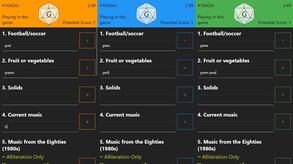
At the core of the gameplay is a round-based structure in which players are presented with a series of prompts and a randomly generated starting letter. Each round begins with a set of categories—these might include things like animals, food items, fictional characters, locations, or other everyday topics. Alongside the categories, the game rolls a letter that must be used as the starting point for all answers during that round. Players are then given a limited amount of time to type responses that match each category while beginning with the specified letter. The challenge is not simply to think of answers quickly, but also to ensure they are both accurate and unique.
One of the defining mechanics of Catlists is the rule that identical answers cancel each other out. If two or more players submit the same response for a category, those answers receive no points. This seemingly small rule dramatically changes how players approach the game. Instead of defaulting to the most obvious answer, players must anticipate what others might write and attempt to produce something different. This creates a subtle psychological layer where creativity and prediction become just as important as vocabulary knowledge.
The pressure of the time limit adds another dimension to the experience. Each round moves quickly, forcing players to brainstorm several answers before the clock runs out. The fast pacing often leads to humorous or unexpected responses as players scramble to think of unusual words that still meet the requirements. These moments of frantic creativity often become the highlight of the game, particularly in group settings where players react to each other’s clever or bizarre answers during the scoring phase.
Another element that keeps the game fresh is the inclusion of gameplay modifiers that can alter how rounds function. Certain modifiers may change scoring rules, introduce bonus points for specific types of answers, or impose unusual restrictions on the categories. These variations prevent the game from feeling entirely predictable and encourage players to adapt their strategies. The modifiers also help maintain variety across sessions, as different rule combinations can make the same category feel surprisingly different from one round to the next.
The game also benefits from a procedural round generation system that constantly mixes categories, letters, and modifiers into new combinations. This design ensures that players rarely encounter the same exact round twice, giving the game strong replay potential. Even after multiple sessions, the randomness of the prompts can continue producing unexpected scenarios that challenge players to think in new ways.
Visually, Catlists adopts a bright and minimalistic interface that prioritizes clarity. The screen is dominated by clean typography, colorful backgrounds, and clearly organized prompts that allow players to quickly read and respond to the categories presented. This straightforward design is important in a fast-paced word game where players must process information quickly. The visual presentation avoids unnecessary clutter, ensuring that the focus remains entirely on the prompts and the player’s responses.
The user interface also includes small customization options, such as theme color adjustments that allow players to personalize the appearance of the game. While these features are relatively minor, they help give the game a bit of personality and allow groups to tailor the look of the interface to their preferences. Combined with the clean layout, these design choices contribute to a friendly and accessible atmosphere.
One of the more thoughtful aspects of the game’s design is its flexibility in multiplayer participation. The game allows players to join sessions from multiple devices, meaning friends can participate using phones or other devices while the main screen displays the round prompts. This setup recreates the feeling of traditional party games played around a shared table, where everyone contributes individually while watching the same round unfold together. It also makes the game easy to integrate into social gatherings or casual group settings.
While the multiplayer mode clearly represents the heart of the experience, the game does include a single-player option. However, the solo mode lacks much of the tension and unpredictability that comes from competing against other people. Without the risk of matching answers with other players, the strategic element becomes less significant. As a result, the single-player mode functions more as a practice environment than a fully engaging alternative to multiplayer sessions.
The simplicity of the core mechanic can also become noticeable after extended play. No matter how many categories or modifiers are introduced, the fundamental activity remains the same: generating words that match a letter and category. For players seeking complex progression systems or evolving gameplay mechanics, the experience may feel repetitive over time. However, this simplicity is also part of the game’s appeal, as it allows new players to join immediately without needing to learn complicated rules.
Despite these limitations, Catlists excels at what it sets out to do: provide a fast, creative, and often humorous party game that rewards clever thinking and originality. The combination of wordplay, time pressure, and competitive scoring creates a lively atmosphere where players constantly try to outthink one another. The spontaneous nature of the answers often leads to unexpected laughter and memorable moments, which is exactly what a social party game aims to achieve.
Ultimately, Catlists is best enjoyed as a group activity where its mechanics can shine through player interaction and shared humor. Its clean presentation, accessible rules, and procedurally generated rounds make it easy to pick up and play in almost any social setting. While it may not offer the depth or long-term progression of larger multiplayer titles, it succeeds as a compact and entertaining word game that thrives on creativity and friendly competition.
Rating: 7/10