Capitals is an indie strategy title created and published by TheTrueEnding that blends elements of city-building, tactical board games, and idle mechanics into a compact competitive experience. Instead of presenting a long campaign or large-scale civilization simulation, the game focuses on short strategic matches where players attempt to grow their capital city across a procedurally generated map while competing with rival factions. The result is a hybrid strategy game that emphasizes rapid expansion, clever positioning, and efficient decision-making rather than the slow, detailed development typical of traditional city builders.
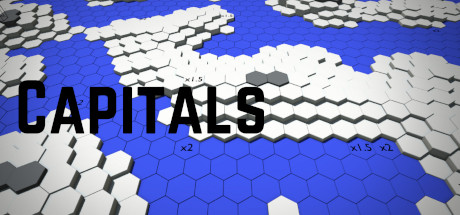
At the start of each match, players are placed on a hexagonal grid map that serves as the battlefield for expansion. Every tile represents a piece of territory that can potentially be claimed and developed into part of the player’s growing capital. The objective is straightforward: expand your influence across the board while preventing rival cities from doing the same. Because all participants are competing for the same limited space, the map quickly becomes a strategic puzzle where positioning and timing determine success or failure.
The hex-grid layout plays a crucial role in shaping the gameplay. Each expansion must be carefully planned because claiming one tile often influences the availability of neighboring spaces. Players must consider not only where to expand next but also how their territory will connect and grow over time. A poorly planned expansion can leave gaps in the player’s territory that opponents may exploit, while a well-structured layout can create a strong defensive network that protects valuable sections of the city.
Unlike traditional city-building games where the focus lies on constructing individual structures and managing complex resource chains, Capitals streamlines the process into a more abstract form of territorial development. Cities expand by claiming tiles and gradually strengthening the capital’s influence across the map. This simplified approach allows matches to move quickly, keeping the focus on strategy and competition rather than detailed management.
One of the more interesting aspects of the game is the presence of idle-style mechanics within its strategic framework. Certain aspects of city growth occur automatically over time, allowing the capital to generate resources and expand its capabilities even when the player is not constantly issuing commands. These automated systems reduce the need for heavy micromanagement and allow players to concentrate on larger strategic decisions such as where to expand next or how to respond to rival movements.
Despite these idle elements, the game remains highly interactive and competitive. Opponents are constantly expanding their own territories, creating a dynamic battlefield where opportunities can appear or disappear rapidly. Players must pay close attention to the evolving map and be ready to seize advantageous positions before rivals claim them. This constant race for territory keeps the pace brisk and ensures that every decision has meaningful consequences.
Victory in Capitals can be achieved through different strategic approaches. One method focuses on capturing a majority of key tiles scattered across the map. These special locations act as strategic objectives that can determine the outcome of the match. Controlling enough of them can secure victory even if rival cities still exist elsewhere on the board. This encourages players to think carefully about which areas of the map hold the greatest strategic value.
Another path to victory involves direct competition with rival cities. By expanding aggressively and surrounding opponents, players can gradually weaken their control over the map. Strategic expansion can isolate enemy territories, preventing them from growing further and eventually eliminating them as serious competitors. This approach rewards players who prefer a more confrontational style of play, where careful positioning can slowly squeeze rivals out of the competition.
The procedural map generation system adds a great deal of replayability to the experience. Because each match begins with a different layout of tiles and starting positions, players must constantly adapt their strategies rather than relying on a fixed approach. Some maps may favor defensive play with narrow corridors of expansion, while others encourage aggressive growth across wide open areas. This unpredictability keeps matches fresh even after many sessions.
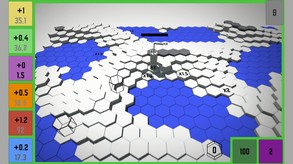
Visually, the game adopts a clean and minimalist style that prioritizes clarity over spectacle. The top-down perspective makes it easy to read the map and understand how territories connect with one another. Buildings and capital markers are represented with simple but recognizable designs, allowing players to quickly assess the state of the battlefield without being distracted by excessive visual detail. While the presentation is modest, it effectively supports the strategic gameplay.
The interface also emphasizes accessibility. Important information such as territory control and expansion paths is displayed clearly, making it easy for players to evaluate their options during each turn. The streamlined design helps newcomers grasp the basic mechanics quickly while still offering enough depth for more experienced players to develop advanced strategies.
The game supports both single-player matches against AI opponents and multiplayer competition against other players. The multiplayer mode is where the strategic systems truly shine, as human opponents tend to employ more creative tactics and unpredictable expansion strategies. Competing against other players transforms each match into a tense strategic duel where every tile placement can shift the balance of power.
However, the game’s hybrid design may not appeal to everyone. Players expecting a deep city-building simulation with complex infrastructure systems may find the mechanics somewhat simplified. Similarly, fans of pure idle games might find the strategic elements more demanding than they expect. The game sits somewhere between these genres, which can require a short adjustment period before the gameplay rhythm becomes fully enjoyable.
The relatively modest scope of the project is also noticeable in its presentation and feature set. While the core mechanics work well, the game does not offer the extensive content or variety found in larger strategy titles. Over long play sessions, some players may begin to notice repetition in the structure of matches and strategic options.
Despite these limitations, Capitals succeeds in offering a creative take on territory-based strategy gameplay. The combination of procedural maps, fast-paced matches, and hybrid idle mechanics results in a distinctive experience that feels both accessible and strategic. It is particularly well suited for players who enjoy quick strategy games where careful planning and territorial control play a central role.
Ultimately, Capitals stands as an interesting indie experiment that merges several gameplay concepts into a compact strategic experience. Its focus on rapid expansion and competitive map control creates an engaging gameplay loop that rewards both foresight and adaptability. While it may not provide the depth of large-scale strategy simulations, it offers a satisfying and replayable experience for players looking for a streamlined tactical challenge.
Rating: 6/10