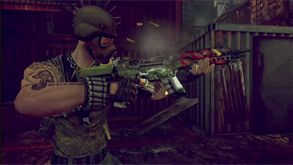
You decide the combat role you want to assume in the world of Brink as you fight to save yourself and mankind’s last refuge!
Revenue comes from in-game items and microtransactions, which our price-based model doesn't estimate. Copies below reflect the player base, not paid sales.
Media

About
Genres
Stats
Languages: English, French, German, Italian, Spanish - Spain
Engagement
Reviews
Themes across 42 recent reviews and how positive each mention is. A keyword signal, not full sentiment analysis.
Reviews
Greatest game ever made BRINKillions must capture command posts
SHORT VERSION: 'Brink is over 15 years old, and is a dinosaur of a game in many ways. But dinosaurs are awesome, and so is Brink.' ----------------------------------------- Brink is a faction-based team-based game (security forces vs rebels) where you play handcrafted missions. It could be ungenerously described as 'Counter Stirke 3000', but it has a basic storyline at least. There are two campaigns (one per faction) which can be played against bots, solo or in a group (with bots filling any empty friendly slots). I imagine you could also face off against other human players but I'm not sure the game is popular enough for that to happen unless you organised it yourself. I was gaming back when this first launched all those years ago. I remember hearing it was a weird game that didn't know what it wanted to be. That's nonsense. Brink is clearly an 'objective-based team shooter'. I saw a review here that described Brink as 'ahead of its time'. I think that's true. Sure, only by a few years or so - but still. It didn't get the credit it deserved at the time. Don't get me wrong. This isn't a masterpiece of gaming. But it sure is some damned good *fun*. This game has become my 'I need to waste 30 minutes and I want to shoot stuff' game. And it's solid as hell, which is the main thing I look for in a game. What do I mean by 'solid'? Many things. The game has never crashed on me. It might in future of course, but it's not part of the experience, like with certain other games. The balance seems pretty well done. Having a turret as an engineer isn't an instawin like in other games, it's more like a decoy that can shoot. The graphics have held up pretty well in my opnion, although some of the animations are a little janky. The only real weakness is the sound of the guns, which sound incredibly plniky and/or tinny. All other sound design is fine. There is another complaint folks might have: The game UI feels kind-of half-finished, like it's all indie placeholder stuff. I like it because it's easy to read at a glance, and I reckon you can't really go wrong with minimalism. The actual layout is fine, no issues there, everything is where it should be. The game itself is basically a series of Counter-Stirke-esque missions: Free the prisoner, hack the safe, hold the area, all that great stuff. Every mission has multiple objectives, but if you play well enough you might finish the map by completing the first objective (the first mission is a good example of this). You can replay the missions whenever/if you want. You need to beat a mission to play the next one, which seems fair enough to me. There's a basic challenge mode, and also a few dedicated tutorials, as well as a simple primer to get you started. You have a set number of missions for free (8 per faction, I think), a handful more if you buy the reaasonably-priced DLC. Sidenote - this game has the perfect pricing for DLC in my opnion. Just thought I'd mention that. This is one of the few games in existence where I wish they'd make more DLC, but sadly that ain't happenig. I think the highest compliment I could give the game is this: While trying it out for the first time, I completely forgot it was a Bethesda game - because none of the normal Bethesda issues presented themselves. It just worked. Ironically.
Related
Related
Trends
Concurrent players on Steam, sampled daily since tracking started.
Hours played at review time, across 42 reviews with recorded playtime.
positive critical· bar length = how often the theme comes up
[h1] Bethesda still feels a bit like a forced hot pop in your mouth. [/h1]
Typically 360 Era games are supposed to look nicer on PC but this was the exception
When your hipster friend recommends a F2P gem you had no idea existed, ahead of its and my time but I am having fun regardless
BRINK is a first-person shooter developed by Splash Damage and published by Bethesda Softworks that aimed to reinvent the online shooter formula with a strong focus on mobility, teamwork, and objective-driven gameplay. Released during a period dominated by gritty military shooters, the game immediately stood out because of its colorful futuristic setting, exaggerated visual style, and emphasis on fluid parkour movement instead of traditional cover-based combat. Even years after its release, BRINK remains one of the more ambitious multiplayer shooters of its generation, remembered as much for its creativity as for the problems that prevented it from reaching its full potential. The game takes place on the Ark, a massive floating city created as humanity’s refuge after catastrophic environmental disasters flooded the planet. What was intended to be a utopian society slowly descends into conflict between two factions: Security, which seeks to maintain order, and the Resistance, which fights against growing oppression and inequality. While the story itself is relatively simple, the setting is surprisingly memorable thanks to the game’s environmental design. The Ark feels dense and alive, filled with industrial machinery, cramped residential areas, futuristic infrastructure, and signs of a society collapsing under pressure. The worldbuilding gives BRINK a distinct personality that separates it from many generic shooters released around the same time. The most innovative aspect of BRINK is undoubtedly the SMART movement system, which allows players to move through environments with speed and style. Instead of manually performing difficult parkour inputs, the game simplifies traversal into a smooth system where characters automatically vault obstacles, climb ledges, slide under barriers, and sprint across terrain with impressive fluidity. Movement becomes a major part of combat, making firefights feel faster and more dynamic than traditional corridor shooters. Chasing objectives while leaping across rooftops or escaping enemies through acrobatic movement creates an energetic flow that still feels refreshing today. This mechanic alone gave BRINK a unique identity and showcased how mobility could enhance multiplayer shooters. Combat revolves around class-based teamwork rather than individual kill counts. Players can choose roles such as Soldier, Medic, Engineer, or Operative, each with important responsibilities during missions. Soldiers resupply ammunition and handle explosive objectives, Medics revive teammates, Engineers repair equipment and defenses, while Operatives focus on hacking and intelligence gathering. This structure encourages players to cooperate instead of simply hunting kills, and successful teams usually depend on good coordination between classes. Matches feel more tactical because objectives constantly shift the focus toward teamwork, creating a stronger sense of purpose than standard deathmatch-focused shooters. Customization also plays a significant role in BRINK’s appeal. Players can personalize characters with different body types, clothing options, masks, tattoos, and weapon modifications. The exaggerated art direction helps these customizations stand out visually, allowing players to create characters that feel unique without making combat visually confusing. Weapons can also be modified to support different playstyles, giving progression a rewarding sense of experimentation. Unlocking new cosmetics and abilities adds motivation to continue playing, especially in multiplayer sessions where individuality becomes part of the experience. Visually, BRINK still manages to stand apart because of its stylized presentation. Rather than aiming for realism, the game embraces a bold science-fiction aesthetic filled with bright colors, graffiti-inspired design, and exaggerated architecture. The Ark’s environments combine decay with advanced technology, creating a world that feels both futuristic and desperate. This artistic approach has aged far better than many shooters from the same era because it avoids the muddy realism that quickly became outdated. The soundtrack and sound effects also complement the atmosphere well, with impactful weapon audio and energetic combat sounds helping battles feel intense and chaotic. Despite all its strengths, BRINK struggled with several issues that damaged its reputation at launch. Technical problems, unstable online performance, weak matchmaking systems, and inconsistent AI bots frustrated many players. The game also suffered from a lack of content variety, with limited maps and repetitive objectives reducing long-term replay value. Since the experience relied heavily on multiplayer cooperation, these issues became especially damaging in a competitive market already crowded with established online shooters. While the core gameplay mechanics showed enormous promise, the overall package lacked the polish and support needed to maintain a healthy player base. Looking back, BRINK feels like a game that was ahead of its time in several ways. Its emphasis on fluid movement, team synergy, and objective-focused multiplayer anticipated ideas that later became popular in modern shooters. Many of its concepts can be seen reflected in later titles that successfully blended mobility and class-based gameplay into mainstream successes. Although BRINK never fully achieved the impact its developers likely hoped for, it deserves recognition for taking creative risks instead of following safer industry trends. For players interested in experimental multiplayer shooters or overlooked titles with ambitious ideas, BRINK remains an intriguing experience. It may not have reached the heights suggested by its innovative mechanics, but it still offers enjoyable movement systems, satisfying teamwork, and a memorable setting that continues to stand out among shooters from its era. The game’s flaws are impossible to ignore, yet its creativity and willingness to challenge genre conventions make it far more interesting than many technically superior but less imaginative competitors. Rating: 7/10
Brink is a game I’d honestly only recommend for nostalgia, mainly for Xbox 360 players that remember the hype around it back then. Playing it in 2026 really shows how stuck in its era this game is. The gameplay is super clanky, mostly because the PC port is terrible and feels weird half the time. Movement suffers from this too, which sucks because the movement system was supposed to be one of the main things about the game. Shooting and combat is okay I guess, not terrible but nothing memorable either. The classes are fine but don’t really do anything new. AI bots act exactly how you’d expect bots from a 2011 game to act, so don’t expect much there. The story is basically filler and doesn’t really go anywhere, but the world-building is kinda cool. Sometimes the environments and overall vibe reminded me a bit of Mirror's Edge. The art style is honestly one of the better things about the game. Multiplayer in 2026 is completely dead, which honestly isn’t surprising at all. I didn’t run into any game-breaking bugs or glitches, but the whole game just feels strange mechanically, like nothing fully works the way it should. There’s nothing here I’d call super well done — most of it just feels mediocre. In the end, Brink feels like a game that failed its original idea. Still, there’s some nostalgic charm left if you played it back in the Xbox 360 days, nothing more nothing less. 5/10
Single player campaign is just a multiplayer match against bots with cutscenes and the bots are awful to play with and against.
As if every other decision made didn't make it obvious, locking single player missions to 30 FPS firmly cements how ♥♥♥♥♥♥♥ stupid the people that made this game were.
Карявая стрельба но играется нормально, типа Team Fortress 2
Audience
Estimated from the language of this game's reviews — a proxy for where players are, not official Steam demographics.
Related
| Evolve Stage 2 | — | 48.2K | 70% | — |
| Pixel Strike 3D | $0 | 12.5K | 74% | Free |
| Call of Duty®: Black Ops II | $48.5M | 49.1K | 86% | $39.99 |
| Avatar: Frontiers of Pandora™ | $8.5M | 15K | 78% | $29.99 |
| Tom Clancy's Ghost Recon: Future Soldier™ | $3.7M | 6K | 71% | $19.99 |
| Tom Clancy's Rainbow Six® Vegas 2 | $1.9M | 6.1K | 85% | $9.99 |