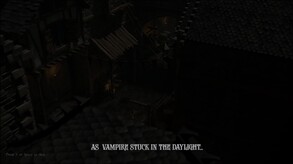
Bloodlust is a short gothic vampire adventure that builds its identity around atmosphere, vulnerability, and a simple survival objective. Developed by Laela Russell and published by Ringling College of Art and Design, the game originated as Russell’s 2024 Ringling College thesis project and was created as a solo production in Unreal Engine 5. This background helps explain its concentrated design. Rather than attempting to become an enormous vampire RPG, Bloodlust focuses on delivering a relatively brief journey centered on exploration, environmental storytelling, and the constant need to feed.
The player assumes the role of Vandor, a vampire who has stayed outside for far too long during his nightly hunt. Dawn has arrived, placing him in a dangerous situation as he attempts to return to the protection of his castle. His journey takes him through an isolated medieval town devastated by plague, where the remaining inhabitants become potential sources of blood. It is an effective setup because Vandor occupies two roles at once. He is a supernatural predator capable of hunting humans, yet daylight has transformed him into a vulnerable creature struggling to survive. This contrast gives the premise more personality than a conventional vampire power fantasy.
Feeding is an important part of the experience because Vandor needs blood to maintain his strength. The inhabitants scattered around the town are therefore connected directly to his survival rather than existing merely as background characters. Hunting them reinforces the darker side of playing a vampire while providing a practical reason to explore the environment. There is also an appropriately bleak quality to the scenario. The town is already suffering from disease, and Vandor arrives as another threat to people trapped in miserable circumstances. Bloodlust consequently creates horror through its setting and situation rather than relying entirely on monsters appearing unexpectedly.
The gothic medieval environment is one of the game's most appealing elements. Dark architecture, abandoned-looking spaces, narrow passages, and the plague-ridden surroundings complement the vampire theme particularly well. Environmental presentation appears to be a major priority, which makes sense considering the project's origins and Russell's emphasis on environment creation. Unreal Engine 5 provides a suitable foundation for the lighting and detailed scenery needed to establish this atmosphere. The world feels designed to make the journey back to Vandor's castle the central experience rather than simply serving as an arena for continuous combat.
Bloodlust incorporates elements associated with exploration, horror, stealth, puzzles, RPGs, simulation, and action-adventure games, but its limited scale should be kept firmly in mind. These ingredients do not necessarily mean that every system has the complexity expected from a large commercial production. Its RPG and stealth characteristics are better viewed as supporting components of a narrative exploration game. Players primarily interested in elaborate character builds, extensive inventories, branching quest lines, sophisticated combat, or dozens of hours of progression are unlikely to find that kind of depth here.
That narrow scope is both beneficial and restrictive. The advantage is that Bloodlust does not bury its central concept underneath unnecessary systems. The objective remains understandable: stay alive, acquire blood, move through the dangerous settlement, and find a way home. The disadvantage is that the premise feels capable of supporting a considerably larger game. A vampire forced to navigate hostile daylight while hunting humans for survival could potentially support deeper stealth mechanics, more complex resource management, alternative routes, expanded enemy behavior, and meaningful decisions about when or whom to attack. Bloodlust instead provides a smaller interpretation of these possibilities.
The short duration can therefore affect players differently. Those who enjoy compact independent projects may appreciate an experience that establishes its premise, explores it without excessive padding, and concludes before repetition becomes overwhelming. Players wanting a substantial vampire adventure could find themselves wishing that Vandor's journey continued much further. The game's value is consequently less about the quantity of content and more about experiencing a particular environment and scenario.
Its technical expectations are also reasonably straightforward for a modern Windows release. The listed requirements include Windows 10, a quad-core Intel or AMD processor running at 2.5 GHz or better, 8 GB of memory, and a DirectX 11 or 12 compatible graphics solution. English is supported for the interface, subtitles, and full audio. VR is not supported. These specifications reinforce the straightforward nature of the project, which concentrates its resources on the core single-player experience rather than numerous modes or additional features.
As a solo thesis project, Bloodlust deserves particular recognition for maintaining a coherent theme from premise to environmental design. Vandor's desperate daytime journey provides an immediate motivation, while the medieval plague setting gives the vampire fantasy an appropriately grim backdrop. The game does not need a complicated mythology to establish its identity because its strongest ideas are communicated through the situation itself. A vampire who would normally dominate ordinary humans suddenly depends upon their blood simply to endure long enough to escape the sunlight.
Bloodlust ultimately succeeds most effectively as a concise atmospheric showcase rather than a fully developed vampire RPG. Its gothic setting, feeding mechanic, exploration, plague theme, and reversal of the traditional predator fantasy create a memorable foundation. Its biggest weakness is that these ideas invite considerably more development than the project's modest scope can provide. Nevertheless, players who approach it as a short independent narrative experience rather than a massive role-playing adventure should find an interesting interpretation of vampire survival.
Bloodlust offers a compelling setting and a strong central concept, with its gothic atmosphere and vulnerable vampire protagonist providing its most distinctive qualities. Greater mechanical depth and a longer adventure could have elevated the premise considerably, but Laela Russell's focused solo project remains an appealing example of how a simple survival scenario and carefully constructed environment can give a small game its own recognizable personality.
Rating: 6/10