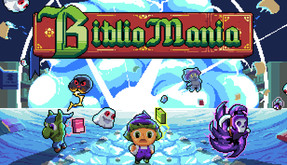
BiblioMania takes the familiar image of a peaceful library and transforms it into a lively multiplayer playground where organization can quickly descend into supernatural chaos. Developed and published by Red Scale Studio, the game is a free-to-play 2D platforming experience centered on working as a clerk inside a cursed library. Instead of treating the location as a serious simulation, the game uses ordinary responsibilities such as receiving, sorting, and delivering books as the foundation for an arcade-style challenge. The result is an unusual combination of platforming, light management, cooperation, competition, and unpredictable events designed primarily for short and replayable sessions.
The main gameplay loop is intentionally straightforward. Players are expected to perform their duties efficiently by handling books and getting them to the correct clients while navigating the library environment. What prevents these responsibilities from becoming completely routine is the curse affecting the building. Strange events can interfere with otherwise simple assignments, forcing players to respond to changing circumstances rather than following exactly the same procedure during every attempt. This unpredictability gives BiblioMania much of its personality. The library is effectively an obstacle course disguised as a workplace, and maintaining order becomes increasingly entertaining when the environment refuses to cooperate.
Its endless structure reinforces this arcade-oriented philosophy. Rather than being built around a lengthy campaign with a conventional beginning and conclusion, BiblioMania encourages repeated attempts and improvement. Players can become faster at completing objectives, learn the layouts and gimmicks of different maps, and gradually develop more effective strategies. The concept works especially well for people who enjoy chasing better performances instead of following a heavily scripted adventure. Repetition is naturally an important part of the design, however, so players who prefer constant story progression or large amounts of new content may find the central routine comparatively limited.
Multiplayer is where the concept becomes considerably more interesting. BiblioMania supports cooperative play with up to four participants and provides both online and local multiplayer options. Coordinating several clerks as everyone attempts to keep the cursed library operating creates a different experience from playing alone. Successful cooperation requires players to divide responsibilities, move efficiently, and react when unexpected situations disrupt their plans. At the same time, mistakes and poor coordination can produce amusing moments, making failure part of the entertainment rather than simply a punishment.
Local multiplayer is particularly appropriate for this style of game. Having several people sharing a session turns the straightforward objective of handling books into a social challenge where communication can be as important as mechanical skill. Online support provides additional flexibility for groups unable to play in the same room. Single-player functionality means the game is not entirely dependent on having friends available, but its mechanics and overall presentation clearly benefit from multiplayer interaction. The unpredictable nature of other players adds another layer of disorder on top of the supernatural events already affecting the library.
The inclusion of versus gameplay also prevents BiblioMania from being exclusively cooperative. Competitive modes introduce combat and allow players to challenge one another directly, creating a substantially different rhythm from performing library duties together. This variety is important because it gives the movement and platforming systems more than one purpose. One session can focus on teamwork and completing responsibilities, while another can emphasize rivalry. Team-oriented possibilities further expand the multiplayer appeal and make the package suitable for groups that enjoy switching between cooperation and competition.
Different maps contribute additional variation by introducing their own gimmicks. Learning how each environment behaves becomes part of improving at the game, and players must adjust their movement and strategies accordingly. The availability of distinct characters also adds personality, particularly when several participants are sharing the screen. The colorful 2D presentation supports the playful nature of the experience. Despite being set inside a cursed location, BiblioMania is more interested in comedy and energetic disorder than genuine horror. Its supernatural elements function as gameplay disruptions rather than an attempt to frighten the audience.
The game's simplicity is simultaneously one of its greatest strengths and its clearest limitation. The basic objectives are understandable almost immediately, making BiblioMania approachable for casual players and groups that do not want to spend a long time learning complicated mechanics. The combination of platforming, task management, unusual events, and multiplayer interaction provides enough moving pieces to make that simple foundation entertaining. Conversely, players expecting detailed library simulation, sophisticated character progression, extensive narrative development, or highly elaborate management mechanics should approach it with appropriate expectations. This is fundamentally an arcade-like party experience rather than a deep simulation.
BiblioMania is also exceptionally lightweight from a technical standpoint. Its modest system requirements and small storage footprint make it accessible to computers that would struggle with considerably more demanding modern games. This suits its identity as an uncomplicated multiplayer title that players can install and start without a significant technical commitment. The free-to-play model lowers the barrier even further, which is valuable for a game whose greatest appeal comes from convincing several friends to participate together.
Overall, BiblioMania succeeds by embracing an unusual but immediately understandable premise. Red Scale Studio turns mundane library work into a framework for platforming challenges, supernatural disruptions, endless replayability, cooperative coordination, and competitive encounters. The individual mechanics are deliberately uncomplicated, but their interaction can produce entertaining situations, particularly with multiple players. Its relatively narrow scope means it will not satisfy everyone looking for a substantial long-term progression system, yet that compactness also makes the experience easy to approach.
For players searching for a small, quirky multiplayer game that does not demand a major investment of time or money, BiblioMania has genuine appeal. The cursed-library concept gives it an identity beyond the usual party-game setting, while local and online multiplayer ensure that its cooperative and competitive ideas can be enjoyed in different circumstances. It is at its best when the library becomes increasingly difficult to control and several players are desperately trying to restore some semblance of order. As a modest indie experience built around accessible mechanics and social chaos, it offers a creative interpretation of an otherwise ordinary workplace.
Rating: 8/10